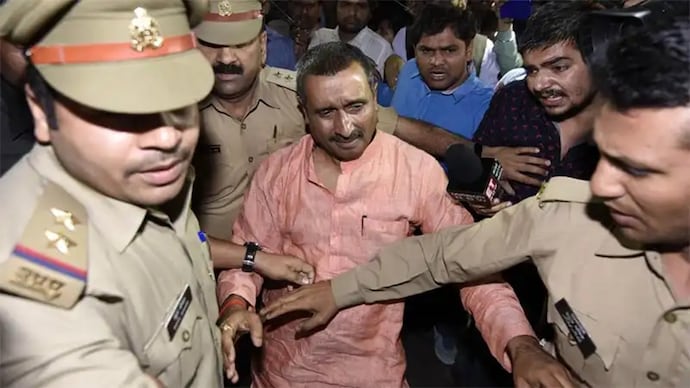
The controversy surrounding the Delhi High Court’s decision to stay the life sentence of Unnao rape convict and former BJP MLA Kuldeep Singh Sengar has now reached the Supreme Court, with the Central Bureau of Investigation (CBI) mounting a strong legal challenge. On Monday, the CBI relied on past Supreme Court judgments involving senior political leaders LK Advani and former Prime Minister PV Narasimha Rao to argue that legislators must be treated as “public servants” under special criminal statutes like the Protection of Children from Sexual Offences (POCSO) Act.
The Delhi High Court had granted interim relief to Sengar by holding that, although he was an MLA at the time of the offence, he did not fall within the definition of a “public servant” under the POCSO Act. As a result, the court ruled that the charge of aggravated penetrative sexual assault—which carries a minimum sentence of 20 years—would not apply in his case.
Challenging this interpretation, the CBI argued before the Supreme Court that such a narrow reading undermines the very purpose of the POCSO Act, which is designed as a special, victim-centric law to protect children from sexual abuse, especially when the offender is in a position of power or authority.
CBI Cites LK Advani and PV Narasimha Rao Judgments
In its appeal, the CBI referred to the 1997 Supreme Court verdict involving LK Advani and the landmark ruling in the PV Narasimha Rao case. In both cases, the apex court held that Members of Parliament and Members of Legislative Assemblies fall within the definition of a “public servant” under the Prevention of Corruption Act, 1988.
The investigating agency argued that if MPs and MLAs can be treated as public servants for corruption-related offences, there is no legal justification for excluding them from the scope of “persons in authority” under the POCSO Act, which deals with far more grave offences involving direct harm to children.
“The High Court has erred in law by failing to adopt a purposive interpretation that advances the object and intent of the POCSO Act, a special legislation enacted to protect children from sexual offences,” the CBI stated in its plea before the Supreme Court.
Supreme Court Raises Key Question
During the hearing, the Supreme Court bench raised a pointed question that strengthened the CBI’s argument. The court observed that under the POCSO Act, even a constable or a patwari can be considered a public servant, and questioned how a sitting legislator could be excluded from the same definition.
This observation highlighted the apparent inconsistency in the Delhi High Court’s reasoning, especially in a case involving abuse of power by an elected representative.
POCSO Offences More Serious Than Corruption: CBI
The CBI further submitted that offences under Section 5(c) of the POCSO Act are far more serious than corruption offences committed by MPs or MLAs.
“Section 5(c) POCSO offences involve direct abuse of children, causing severe bodily, psychological and moral harm, whereas corruption primarily undermines governance,” the agency stated. It added that the legislature intentionally prescribed strict mandatory punishments and enhanced liability under the POCSO Act to reflect the higher societal interest in protecting vulnerable children.
The plea emphasized that while corruption damages institutions, sexual offences against children inflict irreversible harm on victims, justifying a stricter legal framework and broader interpretation of accountability.
Harmonious Interpretation of Laws
The CBI also pointed out that the legislative intent behind Section 21 of the Indian Penal Code, Section 2(c) of the Prevention of Corruption Act, and Section 5(c) of the POCSO Act is consistent: to hold individuals in positions of authority, trust, or public duty accountable for misuse of power.
“A purposive and harmonious construction of these provisions ensures that MPs, MLAs, government officials and others exercising public functions are treated as ‘public servants’ or ‘persons in authority’ wherever abuse of office or trust occurs,” the CBI argued, adding that such an approach strengthens both anti-corruption enforcement and child protection.
Supreme Court Stays Delhi High Court Order
Taking note of the CBI’s submissions, the Supreme Court on Monday stayed the Delhi High Court’s order granting bail to Kuldeep Singh Sengar in the Unnao rape case.
A bench headed by Chief Justice of India Surya Kant observed that the matter raises “substantial questions of law” and issued notice, signalling a deeper examination of how special laws like POCSO should be interpreted when crimes involve powerful public figures.
The outcome of this case is expected to have far-reaching implications for how courts interpret accountability, authority, and abuse of power under India’s child protection laws.
For breaking news and live news updates, like us on Facebook or follow us on Twitter and Instagram. Read more on Latest India on thefoxdaily.com.






COMMENTS 0