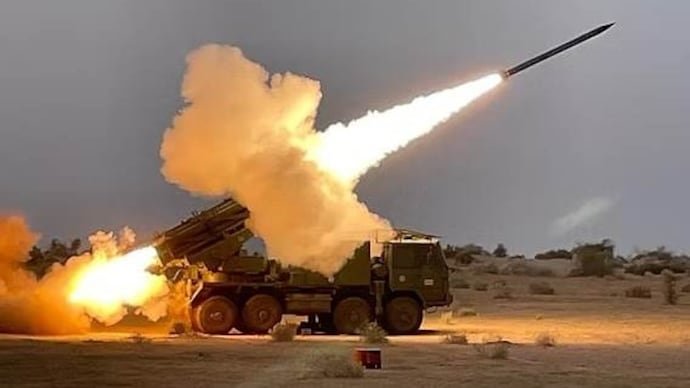
A quiet missile renaissance is underway. From Operation Sindoor to the wars in the Middle East and Ukraine, recent conflicts have underscored how decisive long-range rockets, missiles, and drones have become in modern, non-contact warfare. Against this backdrop, India is seriously examining a long-pending proposal to raise a dedicated “rocket-cum-missile” force to counter the dual challenges posed by china and Pakistan.
Speaking on Army Day, Chief of Army Staff General Upendra Dwivedi made the case unambiguously. With both China and Pakistan already operating specialised rocket forces, he said, India needs a unified command for long-range rockets and missiles—calling it “the need of the hour.”
WHY A ROCKET FORCE NOW?
At present, India’s missile and rocket assets are distributed across artillery formations and the Corps of Army Air Defence (AAD). While this arrangement has served in the past, the evolving character of warfare is pushing New Delhi toward consolidation and centralised control.
Operation Sindoor, during which India employed missiles to strike terror infrastructure deep inside Pakistan, reinforced the value of precision, reach, and rapid escalation control. General Dwivedi noted that rockets and missiles are increasingly complementary on today’s battlefield: both can deliver decisive effects at long range, often within overlapping mission profiles.
Technically, rockets and missiles are distinct—missiles are guided systems designed to hit specific targets, while rockets traditionally lack onboard guidance. In practice, however, advances in guidance kits and precision rockets have blurred this distinction.
India already fields an extensive missile inventory, much of it indigenously developed or co-produced. This includes the Agni series, BrahMos, Prithvi, Pralay, and other systems. The Army recently tested an extended-range guided version of the Pinaka rocket system with a reach of up to 120 km, and contracts for missiles with ranges between 300 and 450 km have reportedly been finalised.
CHINA AND PAKISTAN IN FOCUS
The push for a rocket–missile force is shaped primarily by developments across India’s northern and western borders. China’s People’s Liberation Army Rocket Force (PLARF) is among the most powerful arms of the Chinese military, responsible for both conventional and nuclear missiles. It enjoys significant autonomy and plays a central role in Beijing’s deterrence strategy.
According to recent US Pentagon assessments, the PLARF operates roughly 1,250 ballistic and cruise missiles. China is also rapidly expanding its nuclear arsenal, with warhead numbers projected to rise from over 600 today to around 1,000 by 2030.
Pakistan, China’s close strategic partner, has moved to emulate this model. Following setbacks during the May 2025 hostilities and vulnerabilities exposed by Operation Sindoor, Islamabad established the Army Rocket Force Command (ARFC). The new formation is intended to enhance Pakistan’s long-range strike and saturation-attack capabilities.
While India retains a clear qualitative edge in missile technology and range—and possesses over 180 nuclear warheads—Pakistan’s rocket force could still pose challenges in a short, intense conflict through massed launches and saturation tactics. China, meanwhile, remains well ahead in hypersonic weapons and overall missile sophistication.
WHAT INDIA CAN LEARN FROM IRAN
Beyond its immediate neighbours, India can draw instructive lessons from Iran, which has built one of the world’s most formidable rocket–missile forces under sustained international pressure and sanctions.
Iran’s missile arsenal—comprising ballistic, cruise, and hypersonic systems—is operated primarily by the Islamic Revolutionary Guard Corps Aerospace Force (IRGCASF), established in 2009. The force functions alongside Iran’s regular air force but reports directly to the country’s supreme leadership, giving it a unique degree of focus and strategic autonomy.
The IRGCASF also oversees Iran’s expanding Drone Warfare capabilities. Its effectiveness was highlighted during last year’s limited conflict with Israel, when coordinated missile salvos reportedly penetrated Israel’s multilayered air-defence network, including the Iron Dome, and struck key targets.
A major strength of Iran’s rocket force lies in its extensive network of underground missile tunnels and hardened launch sites. These facilities allow missiles to be stored securely and launched from concealed positions, complicating detection and pre-emptive strikes.
US estimates suggest Iran possesses around 3,000 ballistic missiles—the largest stockpile in the Middle East. Analysts widely believe that this capability has acted as a significant deterrent, discouraging both Israel and the United States from pursuing a full-scale military confrontation.
For Tehran, the rocket force is not merely a military tool but a strategic and political lever, particularly as the regime faces external pressure and internal unrest.
THE WAY AHEAD FOR INDIA
Recent conflicts have made one reality unmistakable: missiles and drones are now central to modern warfare. Precision strikes, deep reach, and survivable launch systems increasingly shape deterrence and escalation dynamics.
General Dwivedi’s call for a rocket-cum-missile force reflects this new battlefield logic. With China and Pakistan presenting simultaneous challenges, India’s debate is no longer about whether such a force is needed, but how quickly and effectively it can be created—while balancing inter-service equities and strategic control.
If New Delhi moves ahead, the experience of countries like Iran suggests that organisation, survivability, and integration may matter as much as sheer numbers. In an era defined by long-range precision and rapid escalation, a unified rocket–missile command could become a cornerstone of India’s future deterrence posture.
For breaking news and live news updates, like us on Facebook or follow us on Twitter and Instagram. Read more on Latest India on thefoxdaily.com.






COMMENTS 0