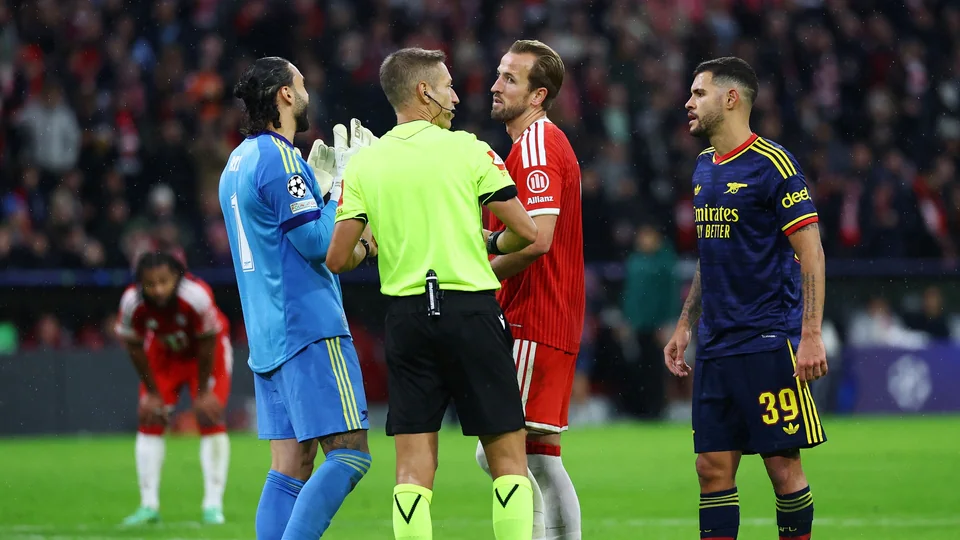
Arsenal and Bayern Munich shared the points after an absorbing 2-2 draw at the Allianz Arena, with Harry Kane‘s influence, bold tactical decisions and Arsenal’s late resilience shaping a compelling UEFA Champions League encounter. Both teams moved away from some of their familiar strengths to exploit weaknesses in the opposition, producing an end-to-end contest in which neither side managed to secure all three points.
Arsenal showed greater patience in possession, finishing the match with 57% of the ball, while Bayern demonstrated that they could threaten through direct attacks and quick transitions without controlling the game for long periods. The tactical contrast was particularly noticeable in Bayern’s approach, with Kane dropping deeper to help build attacks and Alphonso Davies operating in a more advanced position on the left.
Martin Odegaard’s creativity helped Arsenal find a route through Bayern’s defence, while Kane influenced the match through his passing, movement and penalty conversion. Arsenal eventually earned a draw through Declan Rice‘s 82nd-minute strike, extending a pattern of late goals that has become an important feature of their campaign.
The result reflected the adaptability of both sides. Bayern found ways to threaten despite missing key creative personnel, while Arsenal demonstrated that their attacking ambition could coexist with the composure required to recover from a difficult second-half situation.
Arsenal and Bayern Munich Abandon Familiar Approaches in Champions League Thriller
Both clubs entered the contest with established footballing identities, but the circumstances of the match required tactical flexibility. Arsenal have often relied on defensive organisation and controlled possession, while Bayern are accustomed to dominating the ball and using their attacking quality to put opponents under sustained pressure.
At the Allianz Arena, however, neither team could rely entirely on its usual approach. Arsenal attempted to progress the ball patiently and create opportunities through carefully constructed attacks. Bayern, meanwhile, accepted periods without possession and looked to exploit spaces through quick transitions.
The resulting contest was open and unpredictable. Arsenal finished with 57% possession, suggesting that they were comfortable having the ball even in an intimidating away environment. Bayern responded by finding opportunities to attack when the Gunners’ defensive structure was stretched.
The tactical changes also reflected the importance of individual availability. Arsenal were without William Saliba during the match, while Bayern missed Joshua Kimmich and Michael Olise. Those absences affected the options available to both managers and helped shape the decisions made throughout the game.
Rather than allowing those setbacks to dictate the outcome, both teams adapted. Bayern used Kane’s intelligence to connect midfield and attack, while Arsenal relied on Odegaard’s passing, their depth on the bench and the late influence of Rice to remain competitive.
Martin Odegaard’s Vision Helps Arsenal Break Through Bayern’s Defence
Arsenal’s attacking approach was built around patience and precise passing, with the Gunners looking to progress through Bayern’s defensive lines rather than simply wait for counterattacking opportunities.
One of the most significant moments came when Odegaard produced an unexpected chipped pass from midfield into the path of Eberechi Eze. The delivery caught Bayern’s defensive line off guard, allowing Eze to receive the ball and finish past Manuel Neuer with a right-footed strike.
The goal highlighted the value of changing the tempo and direction of an attack. Arsenal had been using short, quick passes to advance, encouraging Bayern to prepare for combinations along the ground. Odegaard’s lofted through ball offered a different solution and exposed the space behind the defence.
Eze’s movement and finishing were equally important. The midfielder recognised the opportunity, controlled the delivery and converted it before Bayern could recover. The sequence showed how Arsenal’s technical quality could create openings even when their opponents appeared organised.
It also illustrated the importance of having multiple attacking options. Arsenal’s ability to threaten through different types of passes meant Bayern could not focus exclusively on blocking short combinations around the edge of the penalty area.
Arsenal’s Squad Depth Provides Tactical Flexibility
The supplied match account also highlighted Arsenal’s growing squad depth, particularly the presence of Eze as an attacking option. His involvement showed how the club could maintain its approach even when changes were required.
Mikel Arteta’s calm response to the need for a substitution was notable. The manager introduced Eze, and Arsenal adjusted their attacking positions, with Noni Madueke operating on the right flank and Eze taking the left.
The change did not require a complete tactical overhaul. Instead, Arsenal retained their general approach while redistributing responsibilities across the forward line. This allowed them to continue seeking opportunities through possession and movement rather than abandoning the game plan.
That flexibility can be particularly valuable in the Champions League, where injuries, substitutions and opponents’ tactical decisions can force teams to adapt quickly. Arsenal’s ability to make changes without losing their attacking identity helped them remain competitive throughout the match.
Harry Kane’s Deeper Role Gives Bayern Munich a Different Attacking Dimension
While Arsenal looked to create opportunities through possession, Bayern found a different route into the game by using Kane in a deeper role. The England international did more than operate as a conventional centre-forward, regularly dropping into midfield to help his team progress the ball and connect its attacking movements.
Kane’s movement was central to Bayern’s ability to threaten without dominating possession. By moving away from the central defensive line, he created opportunities to receive the ball between midfield and attack, giving teammates another passing option and helping Bayern move forward more directly.
The approach also allowed other players to make runs into the spaces created by Kane’s movement. Ismael Saibari and Konrad Laimer were among those looking to exploit gaps through off-the-ball runs, adding movement around the England striker.
Rather than remaining high and waiting for service, Kane took on responsibilities that helped Bayern build attacks from deeper positions. His performance demonstrated how a centre-forward can influence a match through passing, positioning and defensive work as well as finishing.
The role was particularly significant because Bayern were missing Olise, whose suspension removed an important creative option from the side. Without the Frenchman, the German club needed alternative ways to supply its forwards and create scoring opportunities.
Kane helped provide that solution. His ability to move between midfield and attack allowed Bayern to vary their approach, making it harder for Arsenal to anticipate where the next attacking move would originate.
Kane’s Pass to Alphonso Davies Changes the Game
Bayern’s equaliser offered a clear example of Kane’s influence. Manager Vincent Kompany made the bold decision to use Davies on the left wing rather than in his more familiar full-back role, taking advantage of the Canadian’s pace and ability to attack space.
The move paid off when Kane delivered a pass from near the centre of the pitch into Davies’ path. Arsenal were caught by the directness of the move, and Davies used his speed to help Bayern restore parity.
The goal underlined the benefits of Bayern’s tactical adjustment. By deploying Davies further forward, Kompany gave his team another way to attack Arsenal’s defensive line and forced the Gunners to account for a threat arriving from a less familiar position.
Kane’s pass was the decisive element in the move. His ability to recognise Davies’ run and deliver the ball at the right moment allowed Bayern to bypass the more patient attacking patterns Arsenal had been dealing with.
The equaliser also demonstrated that Bayern did not need to control possession to create dangerous opportunities. They could wait for the right moment, move the ball quickly and use the pace of their wide players to disrupt Arsenal’s organisation.
Bayern Take the Lead as Harry Kane Scores From the Penalty Spot
Arsenal began the second half with a patient approach, continuing to look for openings through controlled possession. Bayern, however, remained composed and continued to threaten when opportunities arose to attack quickly.
Kane’s deeper positioning remained a key feature of Bayern’s play. He attempted to win the ball in midfield and link up with teammates, while Laimer and Saibari looked to move into attacking spaces around him.
In the 60th minute, Kane received a pass from Laimer near the edge of the penalty area and attempted a shot. The effort was blocked, but the sequence had a major consequence when Jurrien Timber handled the ball, resulting in a penalty for Bayern.
Kane stepped up and sent David Raya the wrong way, giving Bayern a 2-1 lead. The goal was reported as his 16th against Arsenal, adding another significant entry to his record against the club.
The penalty reflected Kane’s composure in a high-pressure moment. With Arsenal having started the second half positively, Bayern needed to make their opportunities count, and Kane delivered when the chance arrived.
His contribution went beyond the goal itself. The striker had already helped Bayern create their equaliser through his pass to Davies, and his movement continued to provide an outlet when the team needed to progress the ball from midfield.
Why Harry Kane’s All-Round Performance Matters
Kane’s display illustrated why his value to Bayern extends beyond his goal-scoring record. Although he remains a central attacking threat, his willingness to drop deeper, distribute the ball and participate in the team’s build-up gave Bayern an alternative way to approach the match.
Modern centre-forwards are often judged by their ability to stretch defensive lines, finish chances and occupy central defenders. Kane offers those qualities, but he can also operate as a creator, linking play and making passes that allow teammates to attack from different positions.
Against Arsenal, that versatility was particularly important because Bayern were missing Olise. Kane helped compensate for the absence by taking on additional creative responsibilities, allowing the team to create opportunities without relying exclusively on its usual attacking combinations.
His pass for Davies’ equaliser showed his vision, while his penalty conversion demonstrated his composure in front of goal. His deeper movement also helped Bayern’s midfielders advance into dangerous positions.
The supplied match account further noted that Kane even took goal kicks to help ensure smooth distribution, despite the presence of experienced goalkeeper Neuer. That detail reinforced the broader impression of a player willing to contribute to different phases of the game.
Rather than remaining isolated in the penalty area, Kane helped connect the team. His performance demonstrated how a striker’s movement and passing can shape an entire attacking system, particularly when tactical circumstances require a team to find alternative routes towards goal.
Arsenal’s Resilience Delivers Another Late Goal
Despite falling behind 2-1, Arsenal remained composed and continued searching for an equaliser. The Gunners did not abandon their patient approach or resort entirely to hopeful attacks. Instead, they continued to build possession and look for opportunities to move the ball into dangerous areas.
Their persistence paid off in the 82nd minute when Rice scored to make it 2-2. The move developed through a combination of passing and movement, with Rice initially finding Madueke before the ball was directed towards Viktor Gyokeres.
Rice continued his run into the penalty area and received the ball back from Gyokeres before finishing past Neuer. The goal rescued a point for Arsenal and demonstrated the value of midfielders arriving in attacking positions at the right moment.
The equaliser was also an example of Arsenal’s ability to remain patient under pressure. Bayern had taken the lead through Kane’s penalty, but the Gunners maintained their structure and continued to seek openings rather than allowing the setback to dictate the remainder of the match.
Rice’s decisive contribution highlighted his influence beyond defensive duties. His movement into the box gave Arsenal another attacking option and helped them turn a developing move into a goal.
A Growing Pattern of Late Arsenal Goals
The equaliser against Bayern followed a series of late goals that have helped Arsenal change the course of matches this season. According to the supplied match account, the Gunners secured a 1-0 win over Nottingham Forest with an 80th-minute goal.
They also scored twice after the 60th minute against Leeds United, recovering from a one-goal deficit to win 2-1. In the Champions League, Arsenal found a decisive breakthrough against Napoli when Odegaard scored the only goal of the game in the 75th minute.
The late strike against Bayern continued that pattern. Arsenal showed that they could remain competitive even when the scoreline was not in their favour, relying on sustained pressure and carefully constructed attacks to create opportunities late in matches.
Late goals can reflect several qualities, including fitness, squad depth, tactical adjustments and the ability to remain mentally composed. The available results suggest that Arsenal have been able to maintain their attacking focus in difficult situations, although each match presents its own circumstances.
Against Bayern, the equaliser was especially valuable because it came away from home against a team capable of punishing mistakes. Rather than leaving the Allianz Arena empty-handed, Arsenal’s persistence earned them a point from a match in which the momentum had shifted several times.
Missing Players Influence the Tactical Battle
Both teams had to adapt to the absence of important players, and those changes influenced the way the match developed.
Arsenal were without William Saliba, a significant absence in a contest against Bayern’s attacking players. The Gunners’ defensive line had to deal with Kane’s movement and the speed of Davies, while also managing the threat posed by Bayern’s runs from midfield.
Bayern were missing Kimmich and Olise. Kimmich’s absence was particularly notable in the defensive and organisational context described in the match account, while Olise’s suspension removed a major creative influence from the forward line.
Those absences help explain why Bayern relied more heavily on Kane to connect midfield and attack. The England striker’s deeper positioning offered the team a way to compensate for the loss of a regular creative outlet.
Davies’ advanced role was another response to the circumstances. Rather than using him primarily to support the defence, Kompany looked to exploit his pace in attacking areas, and the equaliser showed how that decision could trouble Arsenal.
Arsenal, meanwhile, benefited from the availability of attacking alternatives such as Eze and Madueke. Their involvement allowed Arteta to make adjustments without abandoning the team’s overall plan.
The match therefore offered a useful example of how squad depth and tactical flexibility can influence elite European football. Injuries and suspensions may reduce a manager’s preferred options, but they can also encourage different solutions that create unexpected problems for opponents.
Possession Statistics Reveal a Different Bayern Munich Approach
The final possession figures captured one of the most interesting aspects of the contest. Arsenal finished with 57% of the ball, meaning Bayern had to accept a more reactive role than they might normally prefer.
For Arsenal, the possession advantage reflected their patient approach and willingness to take responsibility for building attacks. They moved the ball through midfield, looked for forward passing opportunities and continued to search for openings even after Bayern moved ahead.
Bayern’s approach was different. Rather than trying to dominate possession at all costs, Kompany’s side looked to exploit transitions and attack the spaces Arsenal left behind. Kane’s deeper role helped the team progress the ball, while Davies’ pace provided a direct route into the attacking third.
The contrast showed that possession alone does not determine control of a football match. Arsenal had more of the ball, but Bayern still created dangerous moments and took the lead through Kane’s penalty. The Gunners, in turn, demonstrated that a possession-based approach can remain effective when a team is patient enough to wait for the right opportunity.
Arsenal’s willingness to take risks was also notable. A side known for its defensive solidity could have responded to Bayern’s attacking threat by concentrating primarily on protecting its own goal. Instead, the Gunners continued to seek openings and ultimately found the equaliser through a midfielder arriving in the box.
The result was a balanced contest in which both teams demonstrated that tactical flexibility can be just as important as sticking to familiar strengths.
What the 2-2 Draw Means for Arsenal and Bayern Munich
The draw offered encouragement to both sides, although neither could leave the Allianz Arena entirely satisfied after failing to secure victory.
For Arsenal, the ability to recover after falling behind was a positive sign. Their patient approach produced attacking opportunities, while Rice’s late goal demonstrated the importance of midfield contributions in tight European matches.
The Gunners also showed that they could maintain their composure away from home against a major opponent. Even when Bayern took the lead, Arsenal continued to build attacks and eventually found a route back into the game.
Bayern, meanwhile, demonstrated that they could threaten without dominating possession. Kane’s all-round performance and Davies’ advanced role offered alternative attacking solutions, particularly with Olise unavailable.
However, Bayern will also have reasons to reflect on the result. After taking a 2-1 lead, they were unable to prevent Arsenal from scoring again in the closing stages. The equaliser highlighted the difficulty of protecting a narrow advantage against a side that remained patient and continued to attack.
For both teams, the match provided evidence that tactical flexibility can create opportunities but does not eliminate defensive vulnerabilities. Arsenal found success through possession and late attacking runs, while Bayern used direct transitions and Kane’s creativity to produce their own dangerous moments.
Final Verdict: A Fair Result After an Absorbing Champions League Contest
Arsenal’s 2-2 draw with Bayern Munich was defined by tactical adaptation, individual quality and the determination of both teams to find a result. The Gunners relied on patient possession and Odegaard’s creative passing, while Bayern used Kane’s deeper role and Davies’ pace to create opportunities without dominating the ball.
Kane was central to Bayern’s performance. His pass helped create the equaliser, his penalty put the German side ahead, and his movement provided a connection between midfield and attack. His all-round contribution demonstrated why he remains such an influential figure in Bayern’s system.
Arsenal’s response was equally important. Eze took his opportunity to score, while Rice delivered the decisive late goal that secured a point. Their ability to remain calm after falling behind reflected a team increasingly capable of responding to difficult situations.
The final possession figure of 57% for Arsenal underlined the difference in approach, but it did not prevent Bayern from creating dangerous attacks. Both sides showed that they could adapt when their preferred methods were challenged, producing a contest in which the momentum shifted repeatedly.
Ultimately, a 2-2 draw was a fair reflection of an evenly matched encounter. Arsenal demonstrated resilience and attacking patience, while Bayern showed that Kane’s creativity and Kompany’s tactical adjustments could compensate for missing players. The result left both teams with positives to take forward, along with lessons about defending leads and managing the changing demands of a Champions League match.
For breaking news and live news updates, like us on Facebook or follow us on Twitter and Instagram. Read more on Latest Football on thefoxdaily.com.






COMMENTS 0