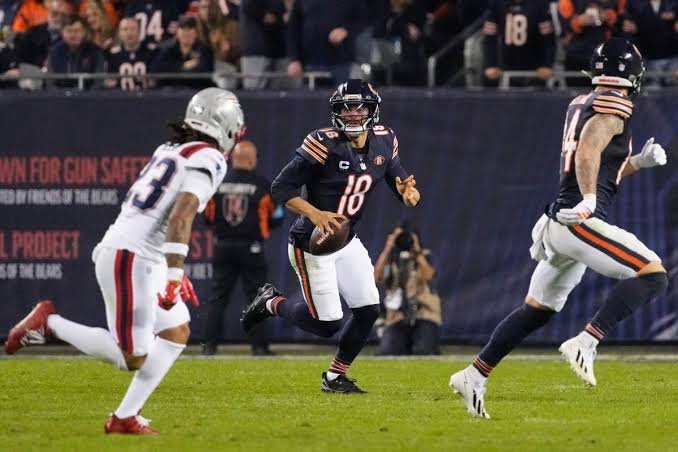
The Chicago Bears opened Week 7 of the 2026 NFL season with a dramatic 30-24 victory over the New England Patriots on Thursday night, October 22, at Soldier Field. Quarterback Caleb Williams led Chicago’s offense with 308 passing yards and two touchdown passes, while rookie wide receiver Luther Burden III emerged as one of the game’s biggest playmakers.
The matchup featured explosive offensive plays, a crucial interception, a remarkable touchdown just before halftime and a tense finish. Chicago built an early advantage, absorbed a New England comeback attempt and ultimately secured the win with a 58-yard field goal from Cairo Santos and a successful recovery of the Patriots’ late onside kick.
For the Bears, the result extended their strong run of form and improved their record to 5-2. The Patriots, meanwhile, fell to 4-3 after seeing their three-game winning streak come to an end.
Beyond the final score, the game offered an intriguing look at two young quarterbacks, the importance of explosive passing plays and the fine margins that can decide a close NFL contest.
Week 7 NFL TNF Highlights: Bears and Patriots Deliver a Thrilling Contest
Chicago entered Thursday’s game with questions surrounding Williams’ recovery from a hamstring injury. After missing three games, the quarterback returned the previous week against the Atlanta Falcons and helped the Bears earn a 31-23 victory. His second appearance following the injury provided another opportunity to assess his movement, accuracy and command of the offense.
New England arrived with momentum of its own. Drake Maye had helped the Patriots put together three consecutive wins, strengthening the team’s position after an uneven start to the season. The Thursday night meeting therefore presented a significant test for both teams.
The quarterbacks were selected near the top of the 2024 NFL Draft, with Williams going first overall to Chicago and Maye selected third by New England. Their contrasting styles made the matchup particularly compelling: Williams could extend plays and attack downfield, while Maye looked to combine efficient passing with the ability to make plays on the ground.
Neither quarterback disappointed statistically. Williams finished with 22 completions on 33 attempts for 308 yards and two touchdowns. Maye threw for 321 yards and two touchdowns, added a rushing touchdown and was intercepted once.
The difference came in how the teams managed crucial possessions. Chicago converted its biggest opportunities into points, while a red-zone interception and several defensive breakdowns left New England chasing the game.
Luther Burden III Produces Two of the Bears’ Biggest Offensive Plays
One of the defining stories of the game was Burden’s impact as a receiving threat. The young wide receiver finished with four catches for 130 yards and a touchdown, repeatedly turning opportunities into significant gains after the catch.
A 58-yard reception sets up Chicago’s first touchdown
Chicago established an early offensive rhythm after its defense stopped New England on the opening possession. Williams immediately connected with Burden for a 26-yard gain, moving the Bears into Patriots territory and helping set up a 43-yard field goal by Santos.
The Bears then extended their advantage to 10-0 late in the first quarter. Williams found Burden on a 58-yard pass that carried Chicago to the New England 4-yard line. Running back D’Andre Swift finished the drive with a four-yard touchdown run.
The sequence demonstrated the value of pairing an explosive passing attack with an effective running game. Burden’s ability to gain substantial yardage on one play forced New England’s defense to defend a short field, allowing Chicago to finish the possession without needing another long drive.
Burden’s 24-yard touchdown restores Chicago’s control
Burden made another decisive contribution late in the first half. After Williams delivered a screen pass, the receiver worked through the defense and used his blocking support to reach the end zone for a 24-yard touchdown.
The play gave Chicago a 20-7 lead with 14 seconds remaining in the second quarter. Burden’s route and movement after the catch turned a relatively short pass into a scoring opportunity, highlighting the difference between a receiver who simply catches the football and one who creates additional yardage.
His performance also gave Williams a reliable target during his return from injury. By producing explosive gains early and a touchdown later, Burden helped Chicago establish an offensive identity built around quick decisions, downfield opportunities and yards after the catch.
Drake Maye’s Touchdown Run Keeps New England in the Game
New England’s response began with Maye using his mobility to reach the end zone. After Chicago had established a 10-0 lead, the Patriots quarterback capped a nine-play, 74-yard drive with a seven-yard rushing touchdown early in the second quarter.
The score reduced the deficit to 10-7 and demonstrated that New England could generate points without relying exclusively on its passing game. Maye’s ability to scramble and run near the goal line gave the Bears another dimension to account for defensively.
Chicago answered with a 31-yard field goal from Santos, but the Patriots continued to find opportunities to move the football. The decisive problem was converting those opportunities into consistent scoring drives while preventing Chicago from extending its lead.
D’Marco Jackson’s Interception Changes the Momentum
One of the most consequential defensive plays came when Bears linebacker D’Marco Jackson intercepted Maye in the end zone. New England had moved into scoring territory and was threatening to reduce Chicago’s advantage, but the turnover ended the possession without points.
The interception illustrated the importance of finishing drives in the red zone, the area of the field near an opponent’s goal line. A team can gain substantial yardage between the 20-yard lines and still come away empty-handed if a promising possession ends in a turnover.
For Chicago, the takeaway provided an opportunity to preserve its advantage and put additional pressure on New England. For the Patriots, it was a missed opportunity in a game in which they eventually needed every available point.
The Bears’ defense also applied pressure early. Defensive back Kyler Gordon sacked Maye on fourth down during New England’s opening possession, forcing a turnover on downs and giving Chicago an immediate chance to take control.
These plays mattered because they limited the Patriots’ margin for error. Maye produced strong passing numbers, but the interception and the unsuccessful opening drive helped Chicago build a lead that New England spent much of the game trying to erase.
Rhamondre Stevenson Scores a Stunning Touchdown Before Halftime
Just when Chicago appeared to have the second quarter under control, New England produced one of the night’s most remarkable highlights.
With only three seconds remaining before halftime, Maye completed a short pass to running back Rhamondre Stevenson near midfield. Stevenson then worked through the Bears’ defense and turned the reception into a 48-yard touchdown as time expired.
The play transformed what could have been a comfortable 20-7 halftime advantage for Chicago into a much tighter 20-14 game. It also gave New England a significant psychological boost after the Patriots had surrendered two touchdowns and a field goal during Chicago’s response.
Stevenson’s score was a reminder that defensive positioning matters until a play is officially over. Chicago had multiple defenders in the area, but missed tackles and a breakdown in pursuit allowed Stevenson to reach the end zone.
For the Patriots, the touchdown provided evidence that their offense could strike quickly even when time was nearly exhausted. For Chicago, it exposed a weakness that needed attention after the break.
The sequence also demonstrated why late-half possessions can be unusually important in the NFL. A team that scores immediately before halftime can carry momentum into the locker room, while the opponent must regroup after giving up points at a particularly damaging moment.
Colston Loveland Extends Chicago’s Lead in the Third Quarter
The Bears responded to New England’s late touchdown with an efficient opening possession in the second half. Chicago moved 72 yards over nine plays before Williams connected with tight end Colston Loveland for a 12-yard touchdown.
Loveland broke a tackle and continued through multiple defenders to complete the scoring play, putting Chicago ahead 27-14.
The touchdown highlighted another element of the Bears’ offense: the ability to distribute opportunities among different receiving options. Burden had supplied the explosive plays in the first half, while Loveland provided the finishing touch after the break.
Using a tight end as a scoring target can create difficult matchups for a defense, particularly when defenders must also account for outside receivers and a mobile quarterback. Chicago’s drive forced New England to defend several possibilities rather than focus on a single player.
The possession was important for another reason. After allowing Stevenson to score at the end of the first half, the Bears needed a composed response. Their opening drive of the third quarter restored a two-touchdown lead and put pressure back on the Patriots.
Eli Raridon’s 30-Yard Touchdown Keeps the Patriots Within Reach
New England did not allow Chicago’s advantage to become insurmountable. Maye answered Loveland’s touchdown by connecting with tight end Eli Raridon for a 30-yard scoring pass late in the third quarter.
The touchdown cut the deficit to 27-21 and ensured that the Patriots remained within one possession of taking the lead. It also underscored Maye’s ability to make plays downfield even after his earlier interception.
Maye finished with 321 passing yards and two touchdown passes, along with one interception. His rushing touchdown gave him another scoring contribution, making the Patriots quarterback one of the central figures in the contest despite the defeat.
Raridon’s reception was particularly valuable because it came in response to a Chicago scoring drive. Rather than allowing the Bears to control the game through consecutive possessions, New England immediately put points on the board.
However, the Patriots could not complete the comeback. Their defense needed another stop, and their offense ultimately required a late-game scoring sequence that never produced the touchdown needed to take the lead.
Cairo Santos Delivers a Career-Long 58-Yard Field Goal
The fourth quarter featured a crucial missed opportunity followed by one of the game’s most decisive plays.
Chicago initially appeared capable of adding another field goal, but Santos’ 53-yard attempt struck the right upright and failed. The miss left the Patriots within six points of the Bears’ eventual winning margin, preserving their opportunity to complete a comeback.
Williams then helped the Bears move into a better position on a subsequent possession, completing important passes to Rome Odunze and Loveland. Although the drive encountered trouble when Williams was sacked for a 10-yard loss, Chicago remained within field-goal range.
Santos took the field again and converted from 58 yards, setting a career best and extending Chicago’s lead to 30-21 with 1 minute and 34 seconds remaining.
The kick was significant for more than its distance. A successful field goal from that range requires the kicker to generate sufficient power and accuracy while accounting for the defensive rush and the pressure of the situation. Santos delivered when Chicago needed points to create additional separation.
Instead of leaving New England a chance to win with a single touchdown, the field goal forced the Patriots to respond with a scoring drive and then recover the ball quickly enough to create another opportunity.
Late Patriots Field Goal Falls Short as Bears Recover Onside Kick
New England continued to fight after Santos’ long field goal. The Patriots moved into position for a 47-yard field-goal attempt, which Andy Borregales converted to make the score 30-24 with 37 seconds remaining.
The six-point margin meant a touchdown and successful extra point could still have changed the result. New England therefore needed to recover the ensuing onside kick to regain possession.
Chicago prevented that possibility when Odunze recovered the kick. The recovery allowed the Bears to protect their lead and close out the game.
The ending highlighted the importance of special teams in close NFL contests. The offense and defense may account for most of the game’s visible action, but kickers and return units often determine whether a late comeback remains possible.
New England’s late field goal kept the score close, but it did not erase the consequences of the earlier interception, defensive breakdowns and missed opportunities. Chicago, meanwhile, executed the final sequence well enough to avoid a last-minute collapse.
Caleb Williams vs. Drake Maye: Comparing the Quarterback Performances
The matchup between Williams and Maye offered a useful comparison of two quarterbacks capable of generating explosive offense in different ways.
Williams finished with 308 passing yards, two touchdown passes and 22 completions on 33 attempts. His biggest contribution came through his connection with Burden, but he also found Loveland for a touchdown and made important completions during the fourth-quarter drive that set up Santos’ 58-yard kick.
Maye threw for 321 yards and two touchdowns on 24 completions from 31 attempts. He also scored on the ground, demonstrating the dual-threat ability that helped New England remain competitive.
Their statistics show that the final result was not simply a matter of one quarterback producing substantially more passing yardage than the other. Maye actually finished with more passing yards, while Williams’ team scored six more points.
The distinction illustrates a central principle of football: passing production does not automatically translate into victory. Turnovers, red-zone efficiency, defensive stops and special-teams execution can determine the outcome even when the losing quarterback posts impressive numbers.
For Williams, the victory offered another positive step after his hamstring injury. For Maye, the performance demonstrated that New England could move the ball against a competitive opponent, although the team still had to address the mistakes that proved costly in Chicago.
Key Stats From Bears vs. Patriots in Week 7
| Statistic | Chicago Bears | New England Patriots |
|---|---|---|
| Final score | 30 | 24 |
| Record after the game | 5-2 | 4-3 |
| Quarterback | Caleb Williams | Drake Maye |
| Passing yards | 308 | 321 |
| Passing touchdowns | 2 | 2 |
| Interceptions thrown | 0 | 1 |
| Leading featured receiver | Luther Burden III: 130 yards, 1 TD | Rhamondre Stevenson: 93 yards, 1 TD |
The figures capture the balance of the contest. New England generated more passing yards, but Chicago made its opportunities count and avoided throwing an interception. The Bears also benefited from Santos’ three field goals, including the long kick that helped secure the result.
What the Week 7 TNF Result Means for Both Teams
Chicago Bears gain momentum after another strong performance
The victory moved Chicago to 5-2 and gave the team its fourth win in five games. Williams’ continued availability after his hamstring injury was an encouraging development, while Burden’s performance showed the potential value of an explosive receiving option in the offense.
The Bears also demonstrated resilience by recovering after the late first-half touchdown and maintaining their advantage when New England threatened to close the gap. However, the missed field goal and defensive breakdown that allowed Stevenson’s touchdown showed that there are still details for Chicago to improve.
With a road game against the Seattle Seahawks scheduled for the following Monday night, the Bears will have limited time to review the film and prepare for their next opponent.
New England Patriots must address costly mistakes
The Patriots left Chicago with a 4-3 record after their three-game winning streak ended. Their offensive production offered reasons for encouragement, particularly Maye’s passing yardage and the contributions from Stevenson and Raridon.
The more immediate concern is consistency. The interception in the end zone denied New England a scoring opportunity, while the defensive lapses that allowed Burden’s touchdown and Stevenson’s late-half score made it difficult to control the contest.
New England also faced a demanding challenge in stopping Chicago’s varied offense. The Bears generated explosive plays through Burden, found Loveland for a touchdown and used Swift to finish a short-yardage opportunity.
The Patriots’ next task is to turn promising offensive production into a more complete performance. Avoiding turnovers and limiting opponents’ big plays would give the team a better chance of converting close games into victories.
Final Takeaway: The Biggest Lessons From Week 7 NFL TNF
The Bears’ 30-24 victory over the Patriots was shaped by several standout moments: Burden’s 130-yard receiving performance, Jackson’s end-zone interception, Stevenson’s spectacular touchdown before halftime, Loveland’s third-quarter score and Santos’ career-long field goal.
Williams delivered a strong performance in his second game after returning from injury, while Maye demonstrated that New England’s offense could remain productive even when the team was trailing. The difference was Chicago’s ability to capitalize on important possessions and make the decisive plays late in the game.
For readers following the NFL’s Week 7 action, the matchup offered a reminder that big passing numbers are only one part of winning football. Teams must also protect the ball, finish scoring opportunities, defend explosive plays and execute under pressure.
Chicago handled those closing moments more effectively, leaving Soldier Field with a 5-2 record and an important prime-time win. New England showed enough offensive ability to stay in contention, but the Patriots will need a cleaner overall performance to turn similar opportunities into victories in the weeks ahead.
For breaking news and live news updates, like us on Facebook or follow us on Twitter and Instagram. Read more on Latest NFL on thefoxdaily.com.






COMMENTS 0