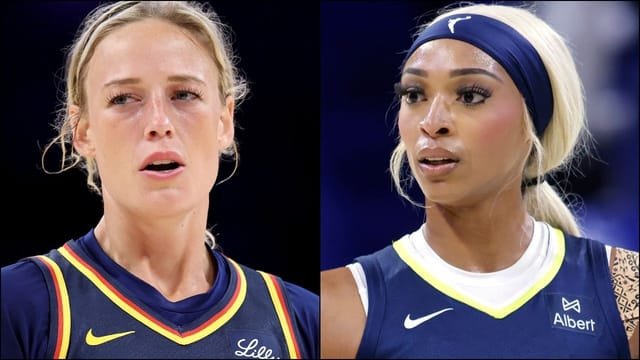
DiJonai Carrington has become the center of a heated WNBA controversy after her ejection during the Chicago Sky’s game against the Indiana Fever on Saturday. What began as a physical incident involving Sophie Cunningham quickly developed into a much larger debate after Carrington referenced “White Privilege” in a social-media post following her ejection.
The incident happened during the first quarter when Cunningham attempted a fast-break layup. Carrington made contact with Cunningham’s face while the Fever player was airborne and subsequently fell to the court. Players from both teams moved toward the confrontation before officials intervened.
Carrington was initially assessed a Flagrant 1 foul, but officials reviewed the play and upgraded it to a Flagrant 2, resulting in her ejection. After leaving the game, Carrington posted “White Privilege” on social media while tagging the Fever, immediately changing the nature of the discussion.
Former NFL offensive tackle Breiden Fehoko, who was a teammate of Joe Burrow at LSU, strongly criticized Carrington’s response. Former NFL linebacker and analyst Emmanuel Acho also questioned whether race had anything to do with the officials’ decision.
What happened between DiJonai Carrington and Sophie Cunningham?
The DiJonai Carrington controversy began with a first-quarter play that quickly became one of the most discussed moments of the game.
Cunningham received an opportunity to attack the basket in transition and attempted a layup. As she went up for the shot, Carrington swept her arm across Cunningham’s face. The Indiana player went down, and tensions immediately rose between the two teams.
Officials initially ruled the contact a Flagrant 1. After reviewing the play, however, they upgraded the foul to a Flagrant 2 and ejected Carrington.
That distinction is important. A Flagrant 2 is not simply another ordinary foul. It represents a much more serious judgment by officials and carries an immediate ejection.
From that point, the conversation moved beyond the Basketball court. Carrington’s subsequent “White Privilege” post introduced questions about race and perceived treatment into an incident that had initially been centered on the physical contact.
Why the Flagrant 2 decision became the central issue
The controversy is easier to understand when three separate questions are considered independently.
First, there is the basketball question: Was the contact serious enough to warrant a Flagrant 2? Second, there is the personal question: Why did Carrington believe race was relevant to the situation? Third, there is the broader social question: How should athletes discuss perceived racial issues when they arise during competition?
The first question can be examined through the available game footage and the officials’ review. The second involves Carrington’s personal interpretation of the incident. The third is part of a much wider conversation that extends well beyond the WNBA.
Keeping those questions separate is important because a disagreement about the officiating does not automatically prove or disprove a player’s personal experience.
Breiden Fehoko strongly criticizes Carrington
Breiden Fehoko became one of the most prominent outside voices to criticize Carrington’s response.
The former NFL player argued that Carrington was adopting what he described as a “victim mentality.” His criticism focused less on the physical foul and more on the decision to frame the incident around race.
Fehoko’s comments attracted attention partly because of his background in professional football and his connection to Joe Burrow from their LSU days. His involvement brought the WNBA dispute into a broader sports conversation, particularly among NFL fans and social-media users who may not normally follow the Sky or Fever closely.
His position represents one side of the debate surrounding athlete activism. Players increasingly have direct platforms through social media, allowing them to immediately discuss issues they believe are important. But those same platforms can turn an emotional reaction into a national controversy within minutes.
That is exactly what happened here.
Emmanuel Acho also questions the racial interpretation
Former NFL linebacker and sports analyst Emmanuel Acho also reacted to Carrington’s post.
Acho shared Carrington’s “White Privilege” message and argued that, in his opinion, race was not responsible for the Flagrant 2 decision.
His argument highlighted a key distinction in the controversy: the foul itself can be analyzed through the game footage, while determining whether racial bias influenced the decision requires evidence about motivation and intent.
That distinction matters in almost every sports controversy involving accusations of bias. Viewers can often determine what happened on the court, but determining why officials, players or coaches behaved in a particular way can be far more complicated.
Sophie Cunningham calls the contact intentional
Cunningham provided her own perspective after the Fever’s victory, describing Carrington’s action as unnecessary and intentional.
She said she had never really spoken with Carrington and suggested there was no established personal rivalry between them. Cunningham nevertheless believed Carrington had some pent-up frustration and used the incident to express it.
Cunningham also pointed toward the enormous attention surrounding the Indiana Fever. Because of the team’s national profile, games involving Indiana routinely receive significant attention, meaning controversial moments can quickly become major stories.
Her comments add an important layer to the discussion because they focus on the possibility that the incident was influenced by the heightened attention surrounding the Fever.
However, Carrington’s motivation cannot be established simply from Cunningham’s interpretation. That remains an area where the players involved may have very different perspectives.
The Indiana Fever’s national spotlight matters
One of the most overlooked elements of the controversy is the extraordinary amount of attention surrounding the Indiana Fever.
When a team becomes one of the most watched organizations in its league, every opponent effectively receives a larger stage when playing against it. A routine hard foul can become a viral clip, while an argument between players can become a national sports story.
Cunningham specifically referenced that environment after the game. Whether or not that explains Carrington’s actions, the underlying point is significant: the Fever are playing in an unusually intense media environment.
That creates both opportunities and challenges for opposing players. More attention can increase exposure for the league and its athletes, but it also means mistakes, confrontations and controversial decisions receive far more scrutiny.
Why the Carrington controversy is bigger than one foul
The incident demonstrates how professional sports have changed in the social-media era.
In the past, a controversial foul might have generated discussion during the postgame press conference and then disappeared from the news cycle. Today, an athlete can publish a reaction immediately, fans can respond instantly, and analysts from completely different sports can enter the conversation.
Carrington’s post changed the headline. Instead of the primary story being an ejection for a Flagrant 2 foul, the discussion quickly became centered on “White Privilege,” race and whether the player was unfairly treated.
This is one of the defining challenges of modern athlete communication. Social media gives players unprecedented control over their voices, but it also removes the distance that once existed between an emotional moment and a public statement.
A post written immediately after an ejection can become part of the permanent public record long after the emotions of the game have disappeared.
Comparison: basketball evidence versus personal interpretation
| Issue | What happened | Why it matters |
|---|---|---|
| Physical incident | Carrington made contact with Cunningham’s face during a first-quarter fast break. | The play triggered the initial foul and subsequent review. |
| Officiating decision | The Flagrant 1 was upgraded to a Flagrant 2. | The upgraded ruling resulted in Carrington’s ejection. |
| Carrington’s response | She referenced “White Privilege” in a social-media post. | The dispute expanded into a discussion about race and perceived treatment. |
| Cunningham’s response | She described the action as unnecessary and intentional. | Her comments directly challenged Carrington’s interpretation of the incident. |
| Outside criticism | Fehoko and Acho questioned Carrington’s framing of the incident. | The controversy spread beyond the WNBA into wider sports media. |
The overlooked issue: perception has become part of professional sports
One of the most important lessons from the Carrington-Cunningham controversy is the growing importance of perception in professional sports.
Athletes compete in an environment where nearly every significant moment can be recorded, clipped and redistributed within seconds. The audience watching the incident is no longer limited to the people inside the arena or those watching the television broadcast.
A foul can become a short video clip. The clip can become a social-media argument. That argument can attract former athletes and national analysts. Their reactions can then create additional headlines.
The original play may eventually become secondary to the debate surrounding it.
That cycle is particularly relevant for the WNBA as the league continues to attract larger audiences and more mainstream attention. Greater visibility means greater commercial opportunities, but it also means greater scrutiny whenever something controversial happens.
The Fever’s 20-12 record adds another layer
The controversy came during a significant point in the Fever’s season. Indiana defeated Chicago 90-86, improving its record to 20-12.
That result is important because the Fever are not simply generating attention; they are also competing from a strong position in the standings.
Cunningham had a relatively modest statistical contribution, finishing with three points, one rebound and two assists in 17 minutes. Yet the altercation became one of the most discussed aspects of the game.
This highlights an enduring reality of sports journalism: statistics often determine the result, but controversy frequently determines what dominates the conversation afterward.
What could happen next for DiJonai Carrington?
The immediate basketball consequences of Carrington’s ejection will depend on the league’s disciplinary process and any additional review of the incident.
The reputational consequences are more difficult to predict.
Because Carrington publicly connected the incident to “White Privilege,” the discussion has moved beyond whether the foul deserved an ejection. Her comments have now become part of the story themselves.
For the Chicago Sky, the priority will be to keep the focus on basketball. For Carrington, the challenge may be managing the reaction to both the physical incident and her subsequent social-media statement.
The episode also offers a lesson for athletes across professional sports. Social media can provide a powerful platform for speaking directly to fans, but timing matters. A statement made during an emotional moment can take on a life of its own.
Why the controversy could continue beyond the game
The involvement of Fehoko and Acho means the discussion has already moved outside the normal WNBA audience.
That makes the controversy more significant than a standard in-game dispute. It has become part of a broader discussion about race, accountability, athlete expression and how sports audiences interpret controversial incidents.
There is also an important distinction between personal experience and objective proof. Carrington can explain how she perceived the situation, while critics can challenge whether that interpretation is supported by the available evidence.
Both parts of the conversation can exist without automatically resolving the other.
The bigger WNBA lesson from the Carrington-Cunningham dispute
The incident arrives at a time when the WNBA is operating under an increasingly powerful national spotlight. That means players are no longer competing only against opponents on the court. They are also operating inside an enormous media ecosystem.
Every confrontation can generate commentary. Every controversial call can become a debate. Every social-media post can influence the public narrative.
For the league, this attention can ultimately be valuable if it creates meaningful discussion and brings more fans into the sport. But controversy can also become distracting when the original basketball issue gets buried under competing interpretations.
The best response is therefore not necessarily to silence disagreement. It is to distinguish between what can be established from the footage, what players personally believe happened, and what outside commentators infer from the situation.
Final outlook on the DiJonai Carrington controversy
The DiJonai Carrington controversy has developed from a first-quarter altercation into a much broader conversation about race, officiating, accountability and social media in professional sports.
The basketball sequence is clear: Carrington was initially given a Flagrant 1 after making contact with Sophie Cunningham during a fast-break layup attempt. Following review, the foul was upgraded to a Flagrant 2, leading to Carrington’s ejection.
The conversation became significantly more complicated after Carrington posted “White Privilege” following the decision. Breiden Fehoko criticized her response, while Emmanuel Acho argued that race did not factor into the Flagrant 2 decision. Cunningham separately described the contact as intentional and unnecessary.
The most useful way to evaluate the situation is to separate the physical play from the larger social debate. The foul can be judged through the game footage and officiating decision, while Carrington’s interpretation involves personal perception and a broader discussion about race and athlete experiences.
Ultimately, the controversy shows how dramatically the sports-media environment has changed. The game may have ended with Indiana winning 90-86 and moving to 20-12, but the conversation surrounding Carrington and Cunningham is likely to continue.
As the WNBA’s national profile continues to grow, incidents like this will receive more attention, not less. For players, that means every action and every public reaction can carry consequences far beyond the final score.
For breaking news and live news updates, like us on Facebook or follow us on Twitter and Instagram. Read more on Latest NFL on thefoxdaily.com.






COMMENTS 0