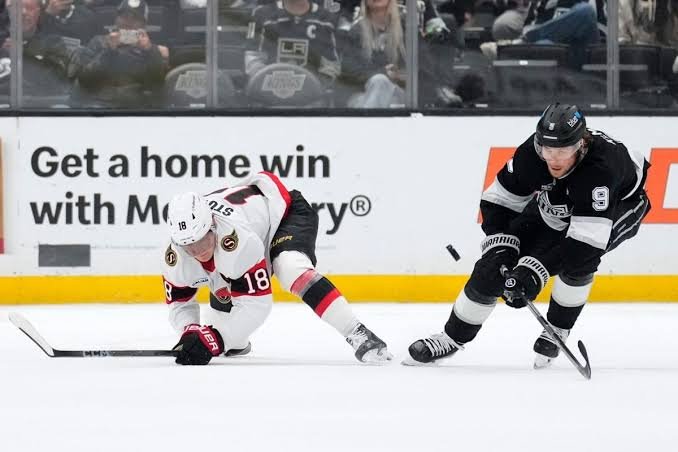
The Ottawa Senators‘ 6-5 overtime defeat against the Los Angeles Kings was overshadowed by a controversial second-period hit that resulted in forward Hayden Hodgson being ejected. Hodgson received a major penalty and a game misconduct after driving Kings defenseman Brandt Clarke into the boards during Thursday night’s NHL matchup in Los Angeles.
The incident added to an already physical contest between the two teams, which combined for 13 penalties. Clarke was unable to return after suffering an upper-body injury, while the Kings continued their comeback effort and eventually secured victory through Quinton Byfield’s overtime goal.
Although the Senators appeared to be heading towards a heavy defeat after falling behind 5-1, they produced an impressive four-goal third period to force overtime. Shane Pinto scored with 1:40 remaining to level the game, but Byfield delivered the decisive moment at 3:37 of overtime, giving Los Angeles a dramatic 6-5 win.
Hayden Hodgson Ejected After Boarding Brandt Clarke
The controversial incident occurred with 8:45 remaining in the second period, when Ottawa forward Hayden Hodgson delivered a dangerous hit on Los Angeles defenseman Brandt Clarke. Clarke was positioned just below the goal line when Hodgson charged towards him and drove him into the boards.
According to the game broadcast, Hodgson was travelling at approximately 21 miles per hour before making contact. The speed and nature of the collision resulted in a major penalty for boarding and an automatic game misconduct, ending Hodgson’s participation in the contest.
The hit immediately created tension between players from both teams. A brief scrum developed following the collision, as Kings players reacted to the incident involving their teammate. Los Angeles forward Erik Haula received a two-minute roughing penalty for his involvement in the confrontation with Hodgson.
Clarke was ruled out for the remainder of the game with what the Kings described as an upper-body injury. His absence was a significant development for Los Angeles, particularly during a game in which the team was already dealing with an increasingly physical opponent.
Boarding penalties are intended to address situations in which a player dangerously checks an opponent into the boards. Such incidents can create serious injury risks because the player receiving the hit may have limited opportunity to protect themselves, especially when positioned near the end boards.
Hodgson’s ejection became one of the defining moments of the game, adding another layer of controversy to an encounter that featured aggressive play, repeated penalties and a dramatic finish.
Brandt Clarke Unable to Return After Upper-Body Injury
The biggest immediate concern for the Kings following the incident was the condition of Brandt Clarke. The defenseman was unable to continue after being driven into the boards and was ruled out for the rest of the contest because of an upper-body injury.
Clarke’s absence forced Los Angeles to adjust its defensive rotation during a game that was already becoming difficult to manage. Losing a defenseman during a physical contest can affect line combinations, ice-time distribution and the ability to maintain defensive structure.
The Kings did not provide further details about the injury in the supplied game account. As a result, the full extent of Clarke’s condition and his availability for upcoming matches remained unclear.
For Ottawa, the incident resulted in a major penalty and the loss of Hodgson for the remainder of the game. For Los Angeles, it meant dealing with an injured defenseman while attempting to protect a lead and manage the growing hostility on the ice.
The collision also highlighted the risks associated with high-speed contact near the boards. Players frequently battle for possession in that area, but checks must remain within the rules to protect opponents from dangerous impacts.
Incident Comes During Kings’ Three-Goal Scoring Burst
The boarding incident took place shortly after Los Angeles had taken control of the scoreboard with a remarkable offensive spell. The Kings scored three goals in just 4 minutes and 3 seconds, turning a competitive game into a commanding 4-1 advantage.
The scoring run put Ottawa under significant pressure and forced the Senators to make a change in goal. Jonas Johansson was chased from the game as Los Angeles continued to find opportunities in the attacking zone.
The quick succession of goals gave the Kings momentum and placed the Senators in a difficult position. Ottawa had to respond defensively while trying to prevent the deficit from growing further.
The timing of Hodgson’s penalty added to the pressure. Ottawa was already struggling to contain the Kings’ attack, and the major penalty created another challenge for the visitors as they attempted to regain control.
Instead of allowing the physical confrontation to distract them, Los Angeles continued to make use of its power-play opportunities. The Kings’ ability to convert penalties into goals became an important factor in building their lead.
Kings Capitalise on Ottawa’s Penalties to Build 5-1 Lead
Ottawa’s discipline became a major problem during the opening two periods. The Senators committed six penalties, giving Los Angeles repeated opportunities to attack with a numerical advantage.
The Kings made the most of those situations, with Erik Haula and Artemi Panarin scoring power-play goals. Their contributions helped Los Angeles establish a 5-1 lead heading into the third period.
Power plays can significantly influence the direction of an NHL game because the team with an extra skater has more opportunities to create passing lanes and attack defensive weaknesses. When opponents repeatedly take penalties, the pressure on the penalty-killing unit increases.
For Ottawa, the combination of defensive mistakes and penalties made the first two periods particularly difficult. The Senators struggled to contain Los Angeles and entered the final period facing a four-goal deficit.
At that stage, the Kings appeared to have the game under control. However, the Senators produced a remarkable response in the third period, transforming what looked like a comfortable Los Angeles victory into a tense contest that required overtime.
Ottawa Senators Produce Four-Goal Third-Period Comeback
Despite trailing 5-1, Ottawa refused to accept defeat. The Senators scored four goals in the third period, putting pressure on the Kings and gradually reducing the deficit.
The comeback demonstrated the importance of maintaining attacking intensity even when a team is several goals behind. Ottawa found opportunities to create scoring chances and took advantage of its improved offensive momentum.
The final breakthrough came when Shane Pinto scored with 1 minute and 40 seconds remaining. Ottawa had an extra attacker on the ice in a 6-on-5 situation, and Pinto found the net to make it 5-5.
The goal completed the Senators’ four-goal third-period effort and sent the game into overtime. It also changed the atmosphere inside the arena, with Los Angeles suddenly facing the possibility of losing a match it had controlled for much of the evening.
For Ottawa, forcing overtime after falling four goals behind was a significant achievement. However, the comeback ultimately did not produce the result the team wanted, as the Kings recovered in the extra period to secure the victory.
Quinton Byfield Scores Overtime Winner for Los Angeles
The game was decided at 3:37 of overtime when Quinton Byfield scored for the Los Angeles Kings. His goal ended Ottawa’s comeback attempt and gave the home team a dramatic 6-5 victory.
Overtime hockey places additional importance on possession, positioning and quick decision-making. With fewer players on the ice, open space becomes more available, but mistakes can also create dangerous scoring opportunities for the opposition.
Byfield’s goal ensured that the Kings avoided the disappointment of surrendering a four-goal advantage. After leading 5-1 entering the third period, Los Angeles had allowed Ottawa to score four unanswered goals and force an extra period.
The overtime winner provided the final answer to a contest that had featured scoring runs, physical confrontations and disciplinary action. It also ensured that the Kings collected the victory despite the late pressure from the Senators.
For Ottawa, the defeat was particularly frustrating because the team had shown enough attacking quality to recover from a difficult position. The Senators’ late rally earned them an overtime opportunity, but they could not complete the comeback.
Thirteen Penalties Reflect a Heated Contest
The Hodgson-Clarke incident was not the only disciplinary moment of the game. Both teams struggled to keep emotions under control, and the contest featured a total of 13 penalties.
The physical nature of the matchup was visible throughout the game, with players from both sides becoming involved in confrontations. The repeated penalties interrupted the flow of play and created additional opportunities for special-teams units to influence the score.
Another notable incident occurred early in the third period, when Ottawa’s Samuel Helenius and Los Angeles’ Nick Cousins each received 10-minute misconduct penalties. The penalties were handed out 4 minutes and 52 seconds into the period, further reflecting the tension between the teams.
Misconduct penalties can remove players from a game for an extended period and are often issued when officials determine that a player’s behaviour has crossed disciplinary boundaries. In this contest, the penalties added to the growing list of interruptions and confrontations.
The combination of the major boarding penalty, roughing call and misconduct penalties made discipline a central storyline. Both teams had to manage their lineups while dealing with the consequences of their players’ actions.
Hayden Hodgson’s Penalty Record Adds to the Story
Hodgson has appeared in only 24 NHL games across five seasons, but his penalty total has reached 51 minutes, including the punishment received against Los Angeles.
Penalty minutes do not always tell the full story of a player’s style or contribution. Physical forwards can be involved in confrontations and take penalties while fulfilling demanding roles, but repeated disciplinary issues can create problems for their teams.
In this game, Hodgson’s major penalty and game misconduct had an immediate impact because Ottawa lost a forward for the remainder of the contest. The incident also contributed to the physical atmosphere and brought attention to the importance of safe checking around the boards.
For a player with limited NHL appearances, moments like this can become particularly visible because they attract attention beyond the final score. However, the broader assessment of Hodgson’s role must consider his overall performance and the circumstances of each disciplinary incident.
The hit on Clarke was undoubtedly one of the most significant talking points from Thursday’s matchup, especially because it resulted in an injury that prevented the Kings defenseman from returning.
What the Result Means for the Senators and Kings
The 6-5 result gave Los Angeles a victory after a game that nearly slipped away. The Kings demonstrated their offensive ability by building a four-goal advantage, but their defensive performance in the third period allowed Ottawa to return to the contest.
For the Senators, the comeback offered a positive sign despite the defeat. Scoring four times in the final period showed that the team could create attacking pressure and compete even after a difficult opening 40 minutes.
However, Ottawa will also need to examine the penalties that contributed to the deficit. Committing six penalties in the first two periods gave Los Angeles valuable power-play opportunities, and the Kings converted two of them through Haula and Panarin.
Discipline and defensive consistency will be important areas for the Senators to address. A strong comeback can demonstrate character, but teams cannot regularly depend on scoring several goals in the final period to recover from early mistakes.
Los Angeles, meanwhile, will take the overtime victory but may also review how it allowed a 5-1 lead to disappear. The injury to Clarke is another concern, with his recovery and availability likely to be important considerations for the team’s upcoming schedule.
Conclusion
Hayden Hodgson’s ejection became a major talking point during the Ottawa Senators’ 6-5 overtime loss to the Los Angeles Kings. The Senators forward received a major penalty and game misconduct for boarding Brandt Clarke, who suffered an upper-body injury and could not return.
The incident added to a physical contest featuring 13 penalties, including misconduct calls against Samuel Helenius and Nick Cousins. Los Angeles took advantage of Ottawa’s early disciplinary problems to build a 5-1 lead through power-play goals from Erik Haula and Artemi Panarin.
Ottawa responded with four goals in the third period, including Shane Pinto’s late 6-on-5 equaliser, but Quinton Byfield scored at 3:37 of overtime to secure the Kings’ victory. While the Senators showed impressive determination in their comeback, Hodgson’s hit on Clarke and the resulting injury remained among the night’s most significant moments.
For breaking news and live news updates, like us on Facebook or follow us on Twitter and Instagram. Read more on Latest NHL on thefoxdaily.com.






COMMENTS 0