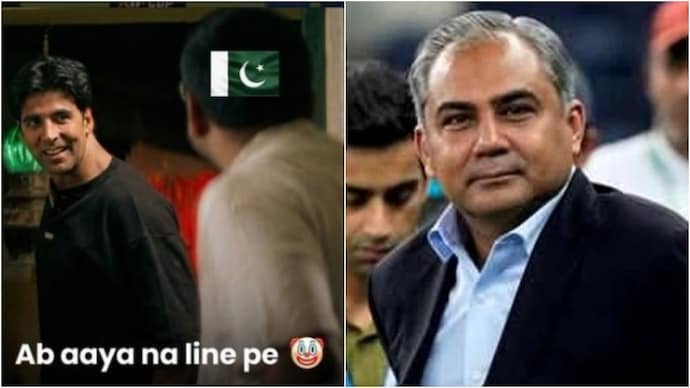
With just five days left for the highly anticipated T20 World Cup clash between India and Pakistan, the focus has shifted from the Cricket field to social media timelines. Pakistan’s decision to withdraw its earlier boycott announcement sparked a storm of reactions — particularly on X (formerly Twitter), where users turned memes, satire, and sharp commentary into a public referendum on the episode.
As political negotiations unfolded behind closed doors, Pakistani users online were conducting what many described as a “digital audit” of the reversal. AI-generated spoofs, sarcastic threads, and pointed commentary reflected a nation grappling with optics, pride, and pragmatism.
The online reactions broadly fell into three camps. One group framed the U-turn as a pragmatic correction — replacing what they described as an emotionally charged and impractical decision with realism. Another expressed embarrassment, suggesting that Pakistan had once again become the subject of global ridicule. A third cluster of accounts amplified AI-generated content and unverified narratives, further muddying the information landscape.
A significant number of posts targeted Pakistan Cricket Board (PCB) chairman Mohsin Raza Naqvi. Several users revived past controversies, including the Asia Cup episode in which Naqvi was widely criticised online. On X, critics accused him of mismanaging optics and damaging Pakistan cricket’s credibility.
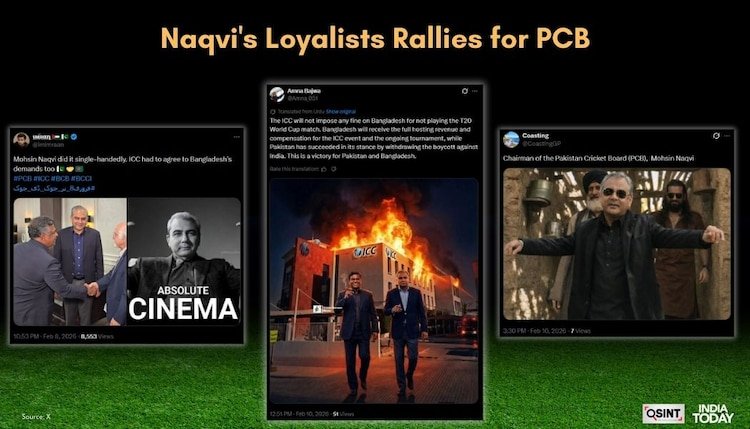
While satire dominated much of the conversation, some loyalist accounts circulated claims that Naqvi had successfully pressured the International Cricket Council (ICC) into altering its stance on Bangladesh. These posts suggested that Pakistan’s broader demands had been accepted — a narrative not supported by official ICC communications.
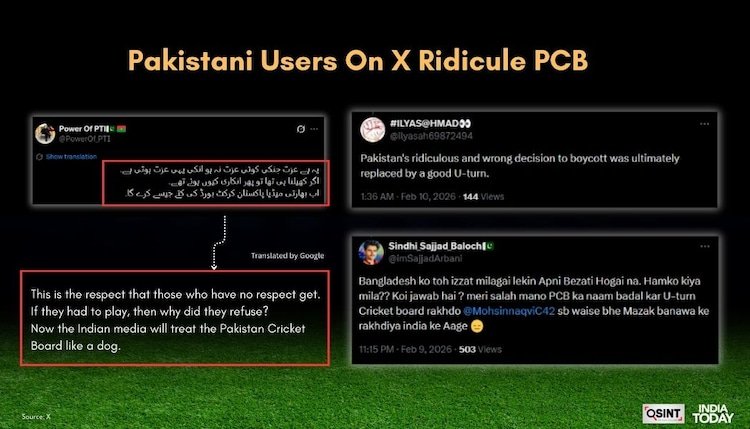
Overall, the PCB chairman faced intense scrutiny. Users dissected the sequence of decisions, questioning internal governance, strategic foresight, and communication strategy at the top of Pakistan cricket. Many posts argued that the initial boycott announcement lacked clarity and long-term planning, thereby weakening institutional credibility.
The controversy began when Pakistan announced it would boycott the India match in solidarity with Bangladesh after the ICC declined Bangladesh’s request to relocate its fixtures from India. The declaration was framed as a principled stand against perceived inconsistencies in tournament management.
However, following multiple rounds of negotiations involving Pakistan, Bangladesh, the ICC, and other cricket boards — including those from the UAE and Sri Lanka — the position shifted. On Monday, the Pakistani government formally cleared the team to participate in the February 15 fixture.
“No Choice” Narrative and Financial Pressures
Indian-based users on X responded with a different tone, frequently attributing the reversal to financial pressure from the ICC and the Board of Control for Cricket in India (BCCI). Several posts argued that the commercial weight of the India-Pakistan fixture made a boycott unsustainable.
Comments highlighting economic realities gained traction. Some users suggested that the ICC’s broadcast commitments, sponsorship contracts, and global advertising revenues — heavily tied to the India-Pakistan match — left little room for disruption.
Widely circulated figures claimed that the ICC could have faced potential financial exposure exceeding $174 million had the match not taken place. While the exact numbers remain speculative, analysts agree that India-Pakistan encounters represent one of the most commercially valuable fixtures in global cricket.
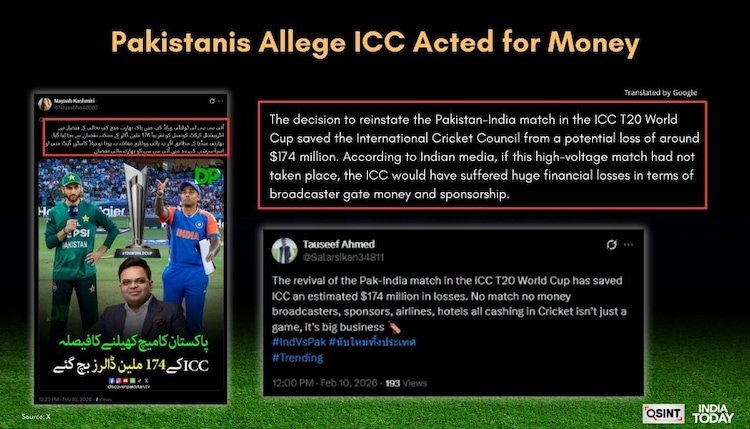
Several Pakistani users acknowledged this financial dimension, arguing that missing the match would likely have hurt Pakistan Cricket Board revenues more than it would have affected India. The economic imbalance became a central theme in online discussions.
Disappointment, Polarisation and AI-Driven Disinformation
Among Pakistani supporters, reactions were mixed. Some expressed disappointment, stating they had expected the PCB to maintain a firm stance amid political tensions. Others criticised what they described as recurring cycles of dramatic announcements followed by quiet retreats.
The online discourse also saw a surge in AI-generated imagery and manipulated visuals. Viral images depicted PCB chairman Mohsin Naqvi and Bangladesh Cricket Board president Aminul Islam walking together against a burning ICC headquarters — implying a dramatic power shift. In reality, while the ICC reportedly agreed not to impose penalties on Bangladesh, broader demands were not accepted.
Other AI-generated videos circulated online showed fictional, digitally altered scenes involving players from both teams. Some of these posts garnered tens of thousands of views, highlighting how quickly synthetic content can shape narratives during politically sensitive sporting events.
At the heart of the controversy lies a simple question: what did the boycott ultimately achieve?
Pakistan initially announced the boycott on February 1 as a gesture of solidarity after the ICC rejected Bangladesh’s relocation request. The move was presented as a principled stand. Yet, within nine days, the Pakistani government authorised the team to proceed with the match.
While the ICC reportedly agreed not to penalise Bangladesh and offered limited concessions, Pakistan’s broader demands — including resumption of bilateral India-Pakistan cricket and proposals such as a tri-series format — were not accepted.
As the February 15 showdown approaches, the political noise is gradually giving way to sporting anticipation. But on X, the episode remains a case study in how modern cricket controversies unfold — not only in boardrooms and diplomatic channels, but also in meme culture, financial analysis threads, and algorithm-driven narratives.
For many observers, the U-turn reflects the complex intersection of sport, politics, and economics in contemporary international cricket — where principle, perception, and profit are rarely separated.
For breaking news and live news updates, like us on Facebook or follow us on Twitter and Instagram. Read more on Latest Sports on thefoxdaily.com.




COMMENTS 0