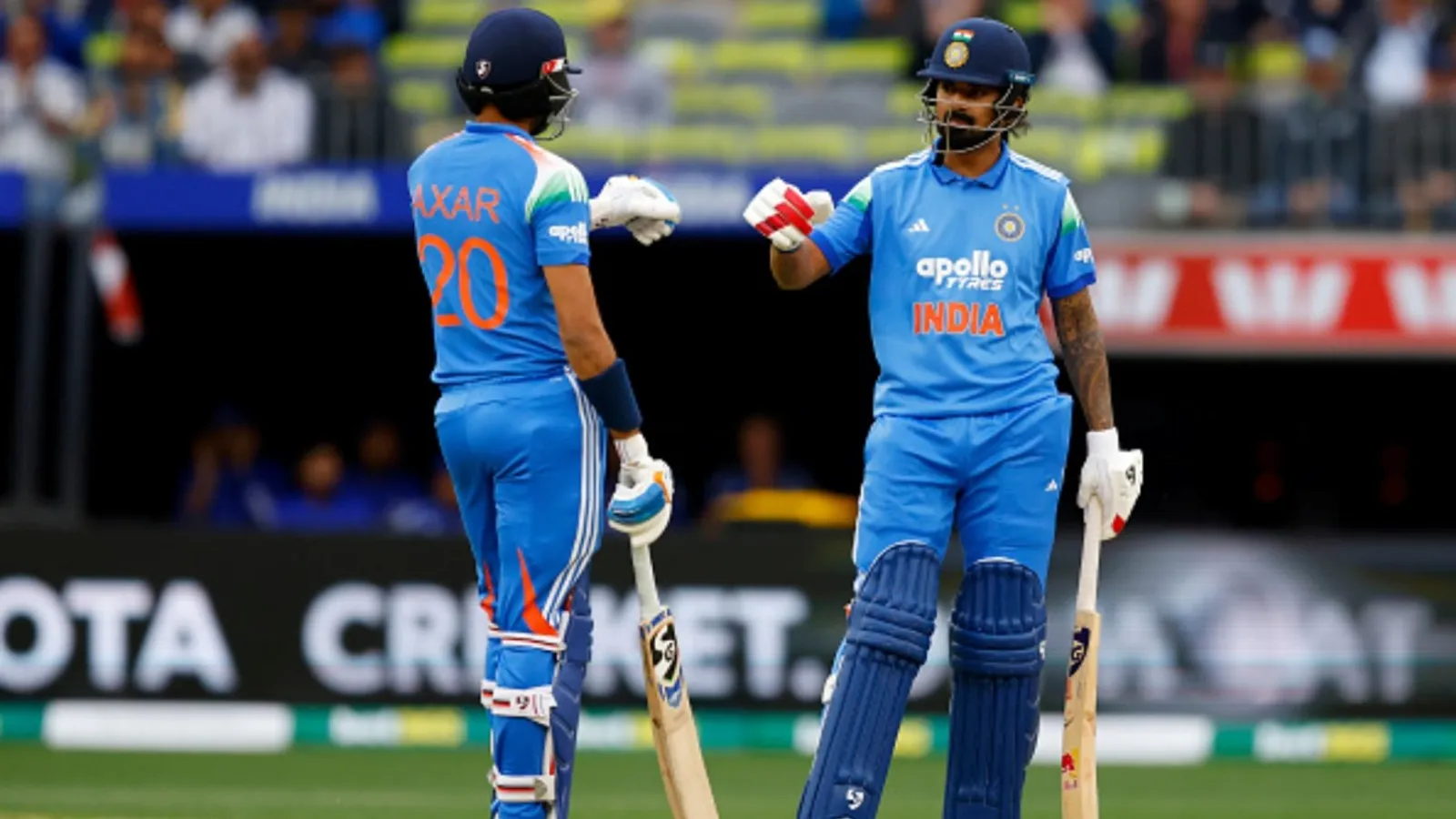
India batting coach Sitanshu Kotak has explained why Axar Patel is being preferred over KL Rahul at No. 5 in the ongoing ODI series against New Zealand. Despite Rahul’s impressive record at the position, the Indian team management has backed Axar to strengthen the middle order and maintain a left-right batting combination.
The decision has attracted attention following India’s performances in the first two ODIs, with questions being raised about Rahul’s position in the batting order. The wicketkeeper-batter previously moved from an opening role to No. 5, but the current team combination has pushed him down to No. 6.
Speaking ahead of the third ODI in Hamilton, Kotak defended the decision and highlighted both Axar’s batting ability and Rahul’s experience of finishing matches.
Why India Prefer Axar Patel at No. 5 Ahead of KL Rahul
Kotak identified the left-right batting combination as one of the main reasons behind India’s decision to send Axar ahead of Rahul. He also explained that the team recognises Rahul’s ability to finish innings, making him valuable in the lower middle order.
According to the batting coach, Axar has regularly batted at No. 5 in ODIs and possesses the ability to contribute in that position.
“Yes, one reason is definitely the left-right combination. Another factor is recognising KL’s strength in finishing games. Furthermore, Axar has often batted at number five in ODIs; he is a capable batter,” Kotak said during the pre-match press conference in Hamilton.
The explanation suggests that India’s decision is based on team balance rather than simply comparing the individual batting records of the two players. Axar’s left-handed batting provides a different option in the middle order, while Rahul can be used in a role where his finishing ability becomes important.
Axar Patel and KL Rahul’s Performances in the First Two ODIs
Although India have backed Axar at No. 5, his performances in the opening matches of the series have not produced significant runs.
In the first ODI in Auckland, Axar was dismissed for a two-ball duck by Jacob Duffy. He struggled again in the second ODI in Wellington, where Matthew Fisher dismissed him for seven runs from 17 deliveries.
Rahul, meanwhile, remained unbeaten on three runs in the series opener. In the second ODI, he entered the crease when India were struggling at 47 for four wickets during their chase of 135 runs.
With wickets falling around him, Rahul held one end together while Shreyas Iyer, Naman Dhir and Anshul Kamboj departed. Before rain interrupted the match, he had scored an unbeaten 26 from 38 deliveries, including two fours and two sixes.
India had reached 110 for the loss of four wickets after 26 overs when rain stopped play. The visitors eventually secured a four-run victory under the Duckworth-Lewis-Stern (DLS) method.
Rahul’s position in the batting order became a talking point because he was held back despite the middle-order collapse. Kotak, however, defended the tactical decision and explained how reactions often depend on the outcome.
“The reality is, if a tactic does not yield runs, people question why the player was sent up; if it works, people call it a brilliant move. That is just how it goes,” Kotak said.
Axar Patel vs KL Rahul: ODI Batting Numbers at No. 5
The statistical comparison between Axar and Rahul at No. 5 highlights the difference in their experience and performances in the role.
Axar has batted at No. 5 in 13 ODI innings, scoring 365 runs at an average of 30.41 and a strike rate of 87.11. He has registered one half-century at the position, which came during India’s tour of England.
Rahul has considerably more experience at No. 5. He has scored 1,646 runs in 36 ODI innings at an average of 68.58 and an impressive strike rate of 103.19. His record includes four centuries and 10 half-centuries.
These figures underline Rahul’s effectiveness in the position, particularly his ability to score quickly while maintaining consistency. His average of 68.58 also makes him one of India’s most productive batters at No. 5.
However, the team management appears to be prioritising its preferred batting combination and Rahul’s potential contribution further down the order.
How Has KL Rahul Performed at No. 6 in ODIs?
Rahul’s numbers at No. 6 are different from his impressive record at No. 5, but he has still made useful contributions in the position.
He has scored 374 runs from 17 ODI innings at No. 6, averaging 37.40 with a strike rate of 95.89. Unlike his record at No. 5, Rahul is yet to score an ODI century at No. 6.
His highest score in this position is 60, which came against South Africa last year. The statistics suggest that Rahul has experience batting lower down the order, although his numbers at No. 5 remain significantly stronger.
Sitanshu Kotak Praises KL Rahul’s Ability to Adapt to Different Roles
While explaining India’s batting combination, Kotak also praised Rahul’s ability to adjust according to the team’s requirements. The coach highlighted that Rahul can open in Test cricket, bat in the middle order in limited-overs cricket and contribute as a finisher when required.
“I think KL Rahul’s biggest advantage is that he can open in red-ball cricket and bat in the middle order in white-ball cricket. Whenever required, he can also go with five overs left. His record there is also very good. So, he plays according to the team’s needs,” Kotak said.
Kotak added that Rahul has consistently impressed him since he joined the Indian coaching staff. He said he could not recall many matches in which Rahul had received an opportunity to bat without making a contribution.
“Since I have joined, I cannot remember many matches in which he has got an opportunity to bat but has not contributed. He has played some unbelievable innings, and he never looks under pressure,” Kotak said.
The batting coach further described Rahul as a stable performer who rarely allows pressure to affect his game.
“You always see him looking very stable. Most of the time, probably all the time, he has never let the team down,” he added.
Kotak also highlighted Rahul’s ability to rotate the strike, find boundaries and hit sixes when the situation demands it. According to him, having a batter with such experience and temperament gives the team valuable flexibility.
KL Rahul Joins Elite List of India’s ODI Wicketkeeper-Batters
Rahul’s contribution to Indian cricket is also reflected in his record as a designated ODI wicketkeeper-batter. He has become the third Indian player to score more than 2,000 ODI runs in that role.
Former India captain MS Dhoni leads the list with 10,599 runs as a wicketkeeper-batter. Rahul Dravid occupies second place with 2,300 runs from 64 innings in the role.
Rahul has kept wickets in 60 ODIs and scored 2,054 runs from 52 innings at an average of 60.41. His record includes four centuries and 12 half-centuries.
These numbers demonstrate the value Rahul brings as a wicketkeeper-batter and explain why the coaching staff considers his experience important when deciding the team’s batting combination.
Third ODI Against New Zealand to Be KL Rahul’s Last Appearance on the Tour
The third ODI in Hamilton on November 10 will be Rahul’s final appearance in the 50-over series. After the match, the 34-year-old will join India’s preparations for the upcoming two-Test series against New Zealand.
India captain Shubman Gill, Anshul Kamboj, Mohammed Siraj and Kuldeep Yadav will also join the Test squad. Rahul’s wicketkeeping responsibilities in the ODI setup will be handed over to Ishan Kishan, with uncapped Kumar Kushagra included as cover.
The first Test is scheduled to begin on November 19 at Basin Reserve in Wellington.
KL Rahul Faces Challenge Ahead of New Zealand Test Series
Rahul will enter the Test series without ideal batting preparation. During the first unofficial Test between India A and New Zealand A in Lincoln, he was dismissed for scores of zero and four.
Before that, he also struggled in Karnataka’s Ranji Trophy 2026-27 match against Andhra, recording scores of four and one.
The upcoming Test series will also mark Rahul’s first appearance in a Test match on New Zealand soil. Although he has previously played two Tests against New Zealand, his record in those matches has been modest.
Across four innings against New Zealand, Rahul has scored 82 runs at an average of 20.50. His highest Test score against the team is 38.
Yashasvi Jaiswal Finds Form Ahead of Test Series
While Rahul looks to improve his preparation, his opening partner Yashasvi Jaiswal has found form in red-ball cricket after a disappointing performance in the first game.
Jaiswal followed his unbeaten 155 in Christchurch with another century in Lincoln during the ongoing third four-day match of the series. His recent performances provide a positive sign ahead of the senior team’s Test assignments in New Zealand.
India’s No. 5 Batting Debate Continues Ahead of Third ODI
India’s decision to back Axar Patel at No. 5 ahead of KL Rahul remains an important talking point in the ongoing ODI series. Rahul’s superior batting numbers at the position make the decision open to debate, but the team management appears focused on maintaining a left-right combination and using his experience as a finisher.
Axar has struggled to produce significant scores in the first two matches, while Rahul demonstrated his ability to hold the innings together in Wellington. However, Kotak has made it clear that the batting order is designed around the team’s overall requirements rather than individual statistics alone.
The third ODI in Hamilton will offer another opportunity to assess India’s middle-order combination before Rahul switches his attention to Test cricket. For now, the coaching staff continues to back Axar at No. 5 while valuing Rahul’s flexibility and experience in different batting positions.
For breaking news and live news updates, like us on Facebook or follow us on Twitter and Instagram. Read more on Latest Cricket on thefoxdaily.com.






COMMENTS 0