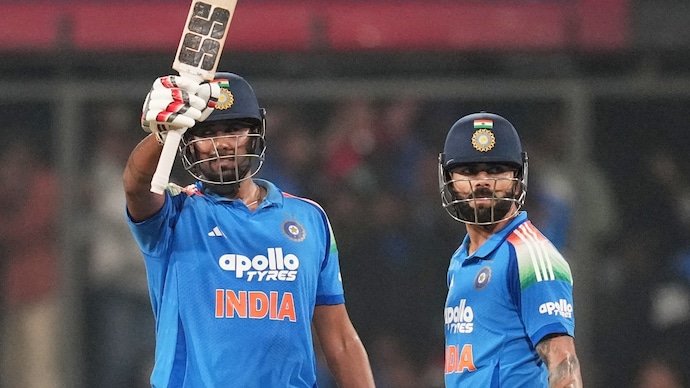
India’s ODI Series loss to New Zealand did not sit well with fans, especially after the Blackcaps breached another Indian fortress. While positives emerged in the form of Virat Kohli and KL Rahul—further cementing Rahul’s reputation as India’s most versatile utility player—another name stood out for all the right reasons.
That name was Harshit Rana.
Since making his India debut in 2024, Harshit has divided opinion. Many questioned his inclusion, with some critics accusing head coach Gautam Gambhir of favouritism towards the Delhi pacer, whom he coached at KKR in 2024. Despite often being handed demanding bowling roles, Harshit’s batting potential largely flew under the radar.
Gambhir first tested Harshit’s batting temperament in the second T20I against Australia last year, promoting him to No. 7. The 24-year-old was not thrown in unprepared. While there were no extravagant strokes, he delivered a calm and responsible 35 off 33 balls, fulfilling his role of supporting Abhishek Sharma.
In the first ODI of the New Zealand series, Harshit was again expected to play a supporting role, this time alongside KL Rahul. Instead of playing conservatively, he trusted his instincts, played his shots, and made a valuable contribution that helped India seal the game.
By the third ODI, despite Kohli still being at the crease, India appeared all but out of contention. Harshit walked in with over 150 runs still required, shortly after Ravindra Jadeja’s dismissal. While Kohli was the obvious leader of the chase, the situation demanded a dependable partner—and Harshit rose to the occasion.
He reached his maiden ODI fifty off just 41 balls, striking four boundaries and four sixes. What stood out was not reckless slogging, but his assured shot selection and confidence against quality bowling, particularly against Kyle Jamieson.
Beyond the big hits, Harshit displayed maturity—running hard between the wickets with the ever-fit Kohli. The pair added 99 runs in just 69 balls, keeping India alive in the contest longer than expected. Shubman Gill later praised Harshit’s development with the bat and underlined his importance in the lower order.
“I believe that he is making significant progress in his batting. He bats at number eight, which is a crucial position for us. Other teams bat extremely deep with specialist batters and all-rounders. It’s important to give opportunities to players who can bat. I’m very happy with how he is growing and contributing to the team,” Gill said at the press conference.
Willing to Take on the Challenge
While No. 8 currently suits him, a strong case can be made for Harshit to be tried at No. 7—a role that demands greater batting responsibility. The pacer has already shown willingness to evolve into that all-rounder role, and his numbers support the optimism.
In first-class Cricket, Harshit has scored 499 runs at an average of 31.18 in 14 matches, including a century. His ODI statistics so far read:
- Matches: 14
- Runs: 124
- Average: 24.8
- Strike Rate: 121.56
One of the most impressive aspects of his batting has been his composure against short-pitched bowling, even when he failed to connect—an observation Sunil Gavaskar was quick to highlight.
“Excellent innings. He batted carelessly, like a lower-order batsman should—free of expectations. His job was to swing his bat. If he connected, great. If not, he didn’t look frustrated. He understood that if you pitch it up or halfway down, he’ll hammer it—and that’s exactly what he did,” Gavaskar remarked.
How Harshit at No. 7 Could Solve India’s Balance Issues
India’s biggest headache lies at No. 7. Hardik Pandya is expected to occupy No. 6 when fit, while Nitish Kumar Reddy is still viewed as a work in progress. Ravindra Jadeja’s impact, meanwhile, appears to be waning.
Slotting Harshit in at No. 7 could provide India with greater flexibility. It may allow the team to field an extra all-rounder or specialist bowler. Given Jadeja’s recent struggles with economy and wicket-taking, India could explore alternative spin combinations.
Varun Chakravarthy could be recalled to partner Kuldeep Yadav, while a player like Harsh Dubey might be tried at No. 8. Such combinations could address multiple balance issues within the XI.
A Work in Progress
Despite his impressive batting displays, Harshit remains a work in progress—particularly with the ball. During the third ODI, there were phases where he lacked penetration and conceded runs in the middle overs.
India will be mindful of past examples, such as Irfan Pathan, whose increasing batting responsibilities eventually impacted his bowling. Former New Zealand pacer Simon Doull echoed similar caution while praising Harshit’s competitive edge.
“He wants to compete. He wants to be in the fight. In terms of run-scoring, he was an equal partner in that combination. My only concern is from a bowling perspective—maintaining the same intensity in his second and third spells. If India can work on his fitness and consistency, they could be developing a real power hitter who is equally valuable with the ball,” Doull said.
If Harshit Rana can continue to enhance his batting without compromising his bowling, India may well have found a long-term solution at No. 7—one capable of influencing games with both bat and ball.
For breaking news and live news updates, like us on Facebook or follow us on Twitter and Instagram. Read more on Latest Sports on thefoxdaily.com.






COMMENTS 0