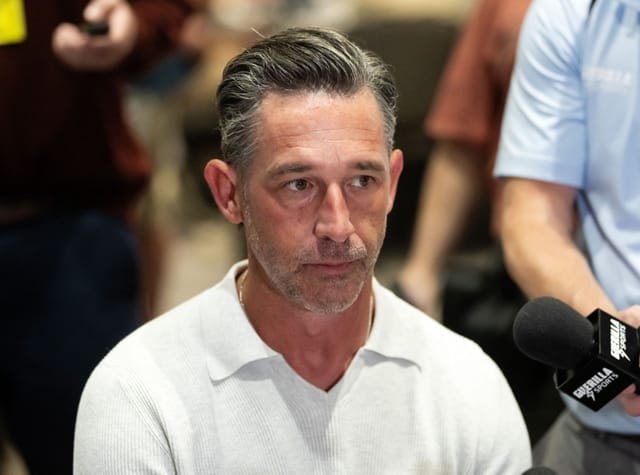
Kyle Shanahan Tesla crash controversy has intensified after the San Francisco 49ers head coach discussed the serious car accident that left him injured last month. Shanahan said he was using the autopilot feature in his Tesla Model S when the crash occurred, but acknowledged that he had taken his eyes off the road while reaching for his phone in the backseat.
His explanation quickly attracted scrutiny from 49ers podcaster Tony Farmer, who accused the veteran coach of avoiding accountability after Shanahan suggested that the vehicle’s autopilot system may have malfunctioned at the moment of the accident.
The situation is complicated because Shanahan did not definitively claim that Tesla’s technology caused the crash. Instead, he said he was uncertain whether the autopilot malfunctioned or whether he accidentally disengaged the system while trying to retrieve his phone. That distinction is central to understanding the controversy.
The incident has now become more than a personal accident involving one of the NFL‘s most prominent coaches. It raises broader questions about driver responsibility, the limitations of advanced driver-assistance technology, and how public figures should discuss accidents when the precise cause has not been established.
What happened in Kyle Shanahan’s Tesla crash?
Shanahan suffered several injuries in a car crash last month and addressed questions about the incident on Saturday. During his explanation, he revealed that he had been using the autopilot feature in his Tesla Model S when the accident happened.
According to Shanahan, he had been using some form of autopilot for approximately nine years and said he was “pretty comfortable” with the technology. However, the circumstances of this particular crash were different from simply relying on the system while maintaining full attention on the road.
Shanahan said he took his eyes off the road while attempting to find his phone in the backseat. He also indicated that he could not determine whether the autopilot system malfunctioned or whether he inadvertently turned it off while reaching for the phone.
That uncertainty has become the central point of criticism.
Because Shanahan himself acknowledged that he was looking away from the road, critics argue that the discussion should begin with driver responsibility rather than immediately focusing on the vehicle’s technology.
Tony Farmer challenges Kyle Shanahan’s explanation
49ers podcaster Tony Farmer was among the most vocal critics of Shanahan’s comments.
Farmer questioned Shanahan’s suggestion that the Tesla autopilot system may have malfunctioned precisely when the coach reached toward the backseat for his phone. He argued that the explanation did not demonstrate the kind of accountability he expected from the 49ers coach.
Farmer’s criticism does not establish that Shanahan was responsible for the accident, nor does it prove that Tesla’s system operated correctly. Instead, it highlights the difficulty of assigning blame before all available evidence is examined.
That distinction is important. A public accusation can be compelling on social media, but determining the actual cause of a vehicle crash requires considerably more than speculation based on a driver’s recollection.
The biggest issue: autopilot does not eliminate driver responsibility
The most important context surrounding the Kyle Shanahan Tesla crash is the difference between driver-assistance technology and a truly autonomous vehicle.
Modern driver-assistance systems can perform certain driving tasks, but drivers are still expected to remain attentive and ready to intervene. That makes Shanahan’s admission that he looked away from the road particularly significant.
Even if a driver has years of experience using an assistance system, familiarity should not be confused with complete independence from the vehicle.
This is where the controversy becomes relevant beyond Shanahan himself. Technology can make driving feel easier and more predictable, which may encourage drivers to become psychologically less engaged. A driver who becomes comfortable with automation may be tempted to treat the system as a substitute for attention even when it is not designed to function that way.
Shanahan’s statement that he has used autopilot for years illustrates this potential problem. Long-term familiarity may increase confidence, but it does not necessarily eliminate the possibility of a mistake, system limitation or misunderstanding.
Did Shanahan blame Tesla?
That question requires a careful answer.
Based on his comments, Shanahan did not definitively state that Tesla caused the crash. He said he was unsure whether autopilot malfunctioned or whether he inadvertently turned it off while reaching for his phone.
That is materially different from saying that the vehicle’s technology was definitely responsible.
However, Farmer’s criticism focuses on how the explanation sounded rather than only on what Shanahan definitively claimed. By raising the possibility of a malfunction, Shanahan introduced Tesla’s technology into the public discussion before the exact circumstances of the crash had been established.
This is why the issue has generated such strong reactions. If a public figure mentions a possible technical failure while simultaneously acknowledging that they were looking away from the road, audiences may naturally question which factor deserves greater emphasis.
Accountability versus uncertainty: both can exist at the same time
The controversy presents a false choice if it is reduced to either “Shanahan caused the crash” or “Tesla caused the crash.” The available information does not establish either conclusion.
A more responsible approach is to recognize that multiple factors could potentially be relevant.
Shanahan can acknowledge that taking his eyes off the road created a risk. At the same time, a vehicle malfunction, if independently confirmed, could also be relevant to understanding what happened.
The key is evidence.
There is a major difference between identifying a potentially risky driver behavior and proving that the behavior directly caused the collision. Likewise, mentioning a possible technology malfunction is not the same as proving that the technology malfunctioned.
This distinction is especially important because the incident has become a public story before all technical and investigative questions have necessarily been answered.
Why the phone detail matters so much
Among all the details in Shanahan’s account, the phone may be the most consequential.
According to his explanation, he took his eyes off the road to find the device in the backseat. That means the controversy is not solely about autonomous-driving technology. It is also about distraction.
Looking away from the road introduces a separate risk regardless of whether a driver is using an assistance system.
The problem with distractions is that they can occur during precisely the moments when a driver needs to respond to an unexpected situation. Even a system that handles many routine driving tasks may encounter circumstances requiring immediate human intervention.
That makes the phone detail central to any objective analysis of the accident.
Why Kyle Shanahan’s explanation is receiving extra attention
Shanahan is not an ordinary driver involved in a private accident. He is the head coach of the San Francisco 49ers, one of the NFL’s most prominent franchises.
His public profile means that even a personal incident can quickly become a major sports-media story.
There is also a football connection to the issue of accountability. Coaches routinely demand responsibility from players after mistakes. They review decisions, identify errors and emphasize the importance of learning from failures.
That makes Farmer’s criticism particularly pointed. His argument is essentially that the same standard of accountability expected within professional football should apply to the coach himself.
Whether that criticism is ultimately fair depends on what further evidence shows. But the principle is understandable: acknowledging one’s own role in an accident does not require ignoring other possible contributing factors, while mentioning outside factors should not become a substitute for acknowledging personal responsibility.
What Shanahan’s long experience with autopilot does and does not prove
Shanahan said he had been using autopilot in some form for about nine years and was comfortable with the technology.
That statement provides useful context but should not be interpreted as proof that the system was safe in every circumstance or that Shanahan fully understood every possible limitation.
Experience can make someone more familiar with a system. It can also create overconfidence.
This is one of the most important human factors surrounding driver-assistance technology. A system may perform consistently for thousands of miles, encouraging the driver to trust it more heavily. But a rare failure or unexpected situation can expose the difference between assistance and complete automation.
Therefore, Shanahan’s years of experience with autopilot are relevant to the story, but they cannot independently establish what caused the crash.
A closer look at the competing explanations
| Possible factor | What is currently known | Why it matters |
|---|---|---|
| Driver distraction | Shanahan said he took his eyes off the road while trying to find his phone. | Driver attention is critical even when assistance technology is active. |
| Autopilot status | Shanahan said he was using the system but was unsure whether it malfunctioned or was inadvertently disengaged. | The system’s exact status could be important in determining what happened. |
| Technical malfunction | Shanahan raised the possibility of a malfunction but did not establish that one occurred. | A technical claim requires evidence rather than assumption. |
| Accountability debate | Tony Farmer criticized Shanahan for what he viewed as avoiding responsibility. | The public discussion now extends beyond the crash itself. |
| Public scrutiny | Shanahan’s position as 49ers head coach has amplified attention surrounding the incident. | Statements from prominent coaches can quickly become national sports stories. |
The bigger lesson for NFL coaches and athletes
The Shanahan situation also highlights a broader issue facing professional athletes and coaches: public statements can become almost as important as the events themselves.
When a high-profile person explains an accident, every detail can be analyzed. A phrase intended to describe uncertainty may be interpreted as an attempt to shift blame. Acknowledging another possible factor may be perceived as making excuses.
This is particularly true on social media, where complex explanations are often reduced to short headlines.
Farmer’s criticism demonstrates how quickly a coach’s comments can become a separate story. Instead of the conversation being limited to Shanahan’s recovery, attention has shifted toward whether he accepted enough responsibility for what happened.
That dynamic is unlikely to disappear. Professional sports figures increasingly communicate directly with fans, but direct communication also means there is less protection from immediate public judgment.
What evidence would actually settle the Tesla controversy?
The most useful next step would be evidence rather than competing opinions.
Determining what happened would require establishing the vehicle’s status at the relevant moment, examining available vehicle data, reviewing the circumstances surrounding the crash and assessing Shanahan’s account against objective information.
Without that evidence, claims that either Shanahan or Tesla was definitively responsible remain premature.
This is where the controversy has arguably gone ahead of the facts. Social media rewards certainty, while crash investigations often involve uncertainty and technical details that take time to evaluate.
For that reason, the strongest conclusion available right now is not that Shanahan definitely caused the crash or that autopilot definitely failed. It is that both driver behavior and technology are relevant areas that deserve careful examination.
Could the controversy affect Shanahan’s 49ers season?
From a football perspective, the biggest question will be whether Shanahan’s injuries affect his ability to prepare for the upcoming season.
The 49ers enter every season with substantial expectations, and Shanahan remains central to the team’s offensive identity and overall preparation.
If his recovery allows him to return to his normal coaching responsibilities, the crash may eventually become a footnote in the larger story of the 2026 season. If his injuries or recovery process interfere with his work, however, the incident could have a more direct football impact.
At this stage, the most responsible approach is to avoid assuming a football consequence that has not been established.
Final outlook on the Kyle Shanahan Tesla crash controversy
The Kyle Shanahan Tesla crash controversy is ultimately about more than one accident. It sits at the intersection of driver responsibility, technology, public accountability and the intense scrutiny placed on NFL figures.
Shanahan has acknowledged that he took his eyes off the road while trying to retrieve his phone and said he was uncertain whether autopilot malfunctioned or whether he inadvertently disengaged it. Tony Farmer has criticized that explanation, arguing that Shanahan should take greater responsibility instead of emphasizing a possible technology failure.
But the available information does not establish that Tesla’s technology caused the crash, just as it does not provide enough evidence to conclusively assign the entire incident to driver distraction.
The most important distinction is between possibility and proof. A possible malfunction is not a confirmed malfunction. Likewise, acknowledging a moment of distraction does not by itself answer every technical question surrounding an accident.
The controversy will likely continue until more objective information becomes available. For Shanahan, the immediate priority remains his recovery and his responsibilities with the 49ers. For everyone watching the story, the larger lesson is clear: advanced driving technology can assist a driver, but it does not remove the importance of attention, judgment and accountability.
For breaking news and live news updates, like us on Facebook or follow us on Twitter and Instagram. Read more on Latest NFL on thefoxdaily.com.




COMMENTS 0