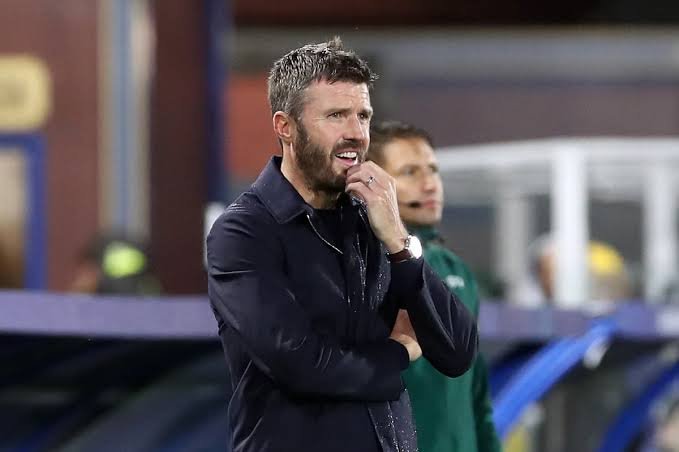
Michael Carrick opened his Friday press conference with an unusually lengthy 5-minute, 27-second speech about the values he believes must define Manchester United, delivering a pointed message about accountability, sacrifice and the responsibility of representing one of football’s most decorated clubs.
The Manchester United head coach spoke without first being asked a question, emphasising humility, resilience and the need to earn victories rather than assume success is guaranteed by the club’s history. His remarks followed a difficult start to the season, public criticism of the team’s tactics and tensions surrounding the club’s football leadership.
United have won only two of their opening 11 matches and sit 13th in the Premier League, according to the figures provided in the original report. A 4-1 Champions League defeat at Como intensified scrutiny, particularly after captain Bruno Fernandes questioned Carrick’s tactical approach. Earlier criticism from Lisandro Martínez of director of football Jason Wilcox’s recruitment decisions had added to the attention surrounding the club.
Against that backdrop, Carrick sought to present a clear picture of what he expects from his players and the wider organisation. He insisted he was confident of improving United’s form, confirmed that conversations had taken place with players and club officials, and used an umbrella metaphor to describe his willingness to absorb pressure on behalf of the team.
His comments were both a defence of his leadership and a reminder that nobody at Manchester United should consider themselves more important than the club. With Bournemouth approaching, the immediate test will be whether that message translates into improved performances on the pitch.
Why Carrick Chose to Address the Media Before Taking Questions
The unusual opening to Carrick’s press conference was significant because it allowed him to establish his priorities before journalists could focus on individual controversies. Rather than begin with questions about tactics, selection or his future, he presented his own explanation of what Manchester United must change.
The speech followed two developments that had placed the club under intense scrutiny. United’s defeat by Como exposed weaknesses in their performance, while public comments from senior players raised questions about the relationship between the coaching staff and the squad.
By focusing on values, Carrick attempted to move the discussion towards collective responsibility. His argument was that individual talent, reputation and historical achievements cannot compensate for a failure to work effectively as a team.
That message also carried an implicit challenge to the players. Carrick said everyone in the squad must share his determination, warning that anyone who did not belong in that collective effort should reconsider whether Manchester United was the right environment for them.
His approach was direct, but the effect of the speech remains a separate question. A manager can explain expectations clearly in a press conference, yet the players must demonstrate those standards through their movement, work rate, decision-making and performances during matches.
The Bournemouth fixture therefore represents an opportunity to assess whether the message has had a practical impact. The speech itself cannot resolve the problems that have contributed to United’s poor results.
Manchester United’s Traditional Values and the Ferguson Legacy
Carrick repeatedly returned to Manchester United’s history, referring to former players Ryan Giggs and Wayne Rooney and former managers Sir Alex Ferguson and Sir Matt Busby. His references were intended to illustrate a central point: the club’s achievements were built through collective commitment rather than individual status.
Carrick spent 12 years as a Manchester United player, remaining at the club until 2018. His experience gives him a personal connection to the period and people he cited, although his playing career does not by itself guarantee that he can reproduce the same standards as a manager.
Giggs and Rooney were prominent figures in United’s history, but Carrick’s emphasis was not simply on their individual achievements. He presented their willingness to serve the team as an example for the current squad.
His praise for Ferguson carried a similar message. Carrick described the former manager as the greatest of all time in his own view and argued that Ferguson’s priority was always Manchester United.
He also invoked Busby and Bobby Charlton when discussing the resilience shown by the club after the Munich air disaster of 1958. The tragedy killed 23 people, including eight Manchester United players, and became a defining moment in the club’s history. The subsequent rebuilding effort remains an important part of the team’s identity.
The historical comparison is powerful because it connects the current crisis to a longer institutional story. However, the circumstances are different. Rebuilding after a tragedy and correcting a poor run of football results are not equivalent challenges. Carrick’s point was about the qualities required to respond to adversity, not a claim that the situations are identical.
Can Carrick Turn Manchester United’s Season Around?
When asked whether he believed he could improve United’s form, Carrick answered with complete confidence, saying, “One hundred per cent, yeah.”
The statement was a clear rejection of the idea that the current run of results had made a recovery impossible. It also showed that Carrick intended to continue taking responsibility for the team’s performances rather than publicly retreat from the challenge.
Nevertheless, confidence in a turnaround and evidence that one is happening are different things. United’s record of two wins in 11 matches, as reported in the supplied account, highlights the scale of the immediate problem. The team needs results as well as a convincing explanation of what has gone wrong.
A credible recovery would require progress in several areas. United must become more consistent in their defensive organisation, improve their response when opponents press them and find a reliable balance between attacking ambition and protection against counterattacks.
Work rate and tactical clarity are also closely connected. Players need to understand when to press, when to maintain their positions and how to support teammates when possession is lost. If individuals follow different interpretations of the game plan, even a talented squad can struggle to perform as a coherent unit.
These are areas in which Carrick’s leadership will be judged. His public emphasis on humility and resilience may help establish expectations, but the most persuasive evidence will come from whether United execute their approach more effectively and begin collecting points consistently.
Bruno Fernandes’ Comments Put the Spotlight on Tactical Decisions
The relationship between Carrick and captain Bruno Fernandes has become a major talking point following the defeat at Como. Fernandes questioned aspects of United’s tactical approach, particularly the decision not to press opponents man-to-man in certain situations.
The midfielder’s comments brought an important footballing issue into the public discussion. Pressing is not simply a question of whether a team should work harder. It involves coordinated decisions about positioning, timing, covering spaces and the risks associated with pushing players forward.
A high press can disrupt an opponent’s build-up and force mistakes, but it can also leave space behind the defensive line if the first wave of pressure is bypassed. A more measured approach can help preserve defensive shape, although it may give technically capable opponents additional time to control possession.
Neither approach is automatically successful. The right choice depends on the opposition, the players available and the team’s ability to move together. Fernandes’ criticism therefore raises questions about tactical execution as well as the original plan.
Carrick did not rule out making changes to the team or reconsidering Fernandes’ captaincy. He said his priority was doing what was best for Manchester United, with particular attention to the squad and its internal dynamics.
That response left the midfielder’s immediate status unresolved. It would be inaccurate to interpret Carrick’s comments as confirmation that Fernandes will be dropped or stripped of the armband.
For the manager, the challenge is to address disagreements without allowing them to distract from preparation. For Fernandes, the focus must return to contributing on the pitch. A productive outcome would require the coaching staff and players to reach a workable understanding of their responsibilities, even if they have different views about particular tactical decisions.
The Umbrella Remark Reveals Carrick’s Leadership Approach
One of the most memorable moments of the press conference came when Carrick described his willingness to hold an umbrella so that others could remain dry while he took the rain.
The image offered a simple explanation of how he views managerial responsibility. The head coach is the person expected to answer for poor performances, face questions about results and provide direction when the team is struggling.
By saying he was willing to get wet on behalf of others, Carrick signalled that he did not intend to shift the blame onto his players. He described the position as a privilege and presented leadership as a duty rather than a status symbol.
There is a practical distinction between accepting responsibility and removing accountability from everyone else. A manager can acknowledge that the final responsibility for a team’s performance rests with him while still expecting players to meet professional standards.
Carrick’s speech suggests that he wants both principles to operate together. He is prepared to take criticism, but he also expects every player to demonstrate commitment to the collective effort.
Whether that balance works will depend on the environment inside the dressing room. Players need clear expectations and confidence in the coaching staff, while managers must be willing to make difficult decisions when performance levels fall short.
Is Manchester United’s Dressing Room Divided?
Carrick rejected the suggestion that the squad was divided, insisting that the team simply needed to return to doing what it did best. His comments were an attempt to counter concerns that public criticism had developed into a deeper breakdown in relationships.
Public disagreement does not necessarily prove that a dressing room has fractured. Players can question tactical choices while remaining committed to their teammates and the club. Equally, a manager’s denial of division cannot establish by itself that every internal relationship is functioning well.
The more useful indicators will be visible in how the squad responds during matches. Players must continue to cover for one another, follow the team’s tactical plan and maintain their effort when results turn against them.
United’s next performance will not reveal every detail of the dressing room, but it can provide evidence about the team’s organisation and collective response. A disciplined display would offer a positive sign, while repeated communication problems or a lack of coordinated effort would leave further questions unanswered.
Carrick’s insistence that the squad shares his determination is therefore an expectation rather than a guarantee. The responsibility now extends to the players, coaching staff and club leadership to turn that expectation into practical improvement.
Manchester United vs Bournemouth: What to Watch
Sunday’s Premier League meeting with Bournemouth provides the immediate setting for Carrick’s attempt to restore confidence. The match will be important because United need to respond to their recent struggles, but it should not be treated as a definitive verdict on the entire season.
Several aspects of the performance will be worth watching:
- Intensity without the ball: United need to show that pressing and defensive work are coordinated rather than dependent on isolated efforts.
- Response to pressure: The team must demonstrate that it can retain composure when Bournemouth challenge its build-up play.
- Defensive concentration: Better organisation and communication could reduce the opportunities created by avoidable errors.
- Leadership on the pitch: Senior players will need to help maintain discipline and focus throughout the match.
- Collective reaction: The players’ response to setbacks will provide a practical test of Carrick’s message about resilience.
Fernandes’ role will attract particular attention because of the discussion surrounding his comments and captaincy. However, the manager has not confirmed a disciplinary decision, so the focus should remain on the team selection and performance rather than assumptions about a potential punishment.
A strong result could ease some immediate pressure and provide a foundation for improvement. Another disappointing performance would intensify scrutiny of Carrick’s methods and the team’s ability to respond to criticism.
What Happens Next for Carrick and Manchester United?
Carrick’s five-minute monologue was an unusually direct attempt to define the standards he believes Manchester United must recover. By invoking the club’s history, accepting responsibility and stressing the importance of collective commitment, he sought to present a route out of the current crisis.
But speeches have limited value without corresponding action. United need to improve their results, establish greater tactical consistency and demonstrate that the players and coaching staff are working towards the same objectives.
The Bournemouth fixture is the next opportunity to show progress. Beyond that match, the sustainability of any recovery will depend on whether United can maintain their standards across successive fixtures rather than produce an isolated response.
Carrick remains confident that he can turn the situation around, but the pressure surrounding his position makes performances increasingly important. His willingness to absorb criticism may strengthen his message, yet it cannot substitute for improvements on the pitch.
For Manchester United, the central question is whether the values Carrick described can become visible in the team’s football. Humility, resilience and collective responsibility are not measured by a press conference. They are demonstrated through disciplined performances, shared effort and the ability to respond when the club faces adversity.
For breaking news and live news updates, like us on Facebook or follow us on Twitter and Instagram. Read more on Latest Football on thefoxdaily.com.






COMMENTS 0