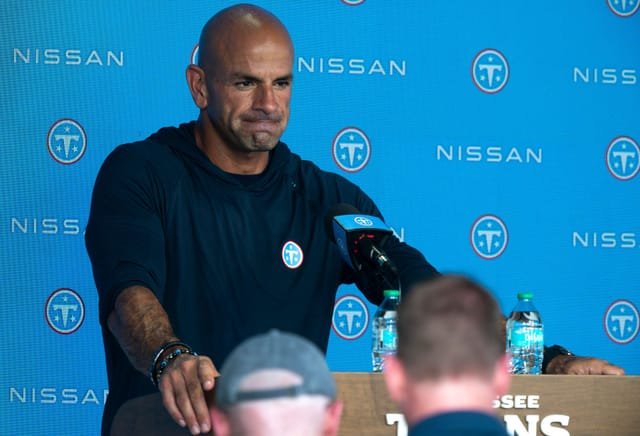
Robert Saleh’s reaction to the Wan’Dale Robinson hit quickly became one of the biggest talking points from the Tennessee Titans’ joint practice with the Chicago Bears, after a physical play triggered pushing and shoving between the two teams.
Robinson was attempting to make a catch when Bears player Xavier Woods delivered a heavy hit. The play immediately attracted attention from players around the field, with several Titans teammates coming to Robinson’s defense before the situation escalated into a confrontation.
Saleh was later asked about the incident and offered an unusually short answer. His assessment was simply: “Cheap.”
The comment reflected the Titans coach’s frustration with a play that occurred during practice rather than a regular-season game. It also highlighted one of the difficult balancing acts of NFL joint practices: teams want valuable competitive repetitions, but coaches must prevent unnecessary incidents from turning into injuries or full-scale fights.
What happened to Wan’Dale Robinson?
Robinson was involved in the controversial play while trying to complete a catch during the joint practice. He was hit by Woods, creating an immediate reaction from players on both sides.
Although Robinson was able to leave the field under his own power, the Titans subsequently evaluated him for a possible concussion. He did not continue participating in the practice.
The fact that Robinson was removed from the session naturally became more important than the confrontation itself. Joint practices are designed to prepare players for the regular season, but losing an important offensive player to an injury concern can quickly overshadow any competitive benefit.
The Titans will therefore be particularly interested in Robinson’s medical status before making decisions about his availability for upcoming preseason and regular-season preparations.
Why Robert Saleh called the hit “cheap”
Saleh’s one-word response provides a clear indication of how he viewed the play, but it does not establish whether the hit violated a specific NFL rule.
There is an important distinction between a coach describing a play as unacceptable and an official determination that a player committed a penalty.
In joint practices, coaches often have different standards for physical contact because players are not competing in an actual game. Offensive and defensive players still need to work at realistic speeds, but unnecessary contact away from the normal context of a game can create serious risks.
From Tennessee’s perspective, the primary concern would naturally be protecting a receiver during a controlled practice environment. From Chicago’s perspective, the play may have been viewed differently depending on how Woods interpreted the situation in real time.
That difference in perception is precisely why joint practices can become heated.
The hit sparked a confrontation between the teams
Robinson’s teammates quickly reacted after the contact.
Players from the Titans came to the receiver’s defense, and the incident developed into pushing and shoving involving members of both teams.
These confrontations are not unusual during NFL training camp, particularly when teams practice against one another for multiple sessions. Familiarity increases the competitive intensity, while players are also fighting for roster spots and trying to establish themselves before the regular season.
However, coaches generally have to step in before that competitiveness crosses a line.
A fight during practice can create a second problem after the original incident: players who were not involved can become injured, and the session can lose its intended purpose.
Why joint practices can become so intense
Joint practices are valuable because they give teams an opportunity to face opponents other than their own teammates.
That can provide a different defensive scheme, unfamiliar personnel and more realistic competition than a normal training session.
For quarterbacks and receivers, for example, facing another team’s coverage concepts can reveal weaknesses that might remain hidden during internal practices.
Defenders also benefit from seeing different blocking techniques and offensive formations.
But there is a trade-off.
- More competition: Players receive higher-quality game-like repetitions.
- Different matchups: Coaches can evaluate players against unfamiliar opponents.
- Greater physical intensity: Players may naturally compete harder against another team.
- Injury risk: Increased intensity can lead to unwanted contact.
- Emotional reactions: A single controversial play can quickly involve multiple players.
The Robinson incident demonstrated that final point particularly clearly.
Wan’Dale Robinson’s availability becomes a key concern
The most important development for Tennessee is not the disagreement between Saleh and the Bears. It is Robinson’s health.
The Titans reportedly evaluated the receiver for a possible concussion after the hit, meaning his status must be determined through the appropriate medical process.
If Robinson is unavailable, Tennessee would have to adjust its receiver rotation and redistribute opportunities among the remaining players.
The source material indicates that Calvin Ridley and Carnell Tate could take on greater responsibility if Robinson is unable to participate.
That would give the Titans an opportunity to evaluate their depth, but losing a key player is never an ideal outcome during preparations for the season.
Calvin Ridley and Carnell Tate could see more work
Robinson’s absence could create additional opportunities for other Tennessee receivers.
For a coaching staff, that can be useful from an evaluation standpoint because it provides additional repetitions to players competing for roles on the depth chart.
However, there is a difference between creating opportunities and replacing a specific player’s skill set.
Receivers bring different combinations of route-running, speed, size, hands and after-catch ability. A replacement may therefore perform well while still requiring the offense to adjust certain concepts.
That makes Robinson’s medical update particularly important as the Titans continue building their offensive identity.
NFL fans were divided over Saleh’s comment
Saleh’s assessment generated a mixed reaction among NFL fans.
Some supporters agreed with the Titans coach and believed the hit was unnecessarily aggressive for a joint practice. Others criticized Saleh and argued that the Titans had also been involved in physical plays during the session.
The debate illustrates a familiar problem in professional football: supporters rarely interpret controversial contact neutrally.
A fan supporting the team that loses a player may see a dangerous or unnecessary hit, while the opposing fan may see ordinary football contact.
That disagreement becomes even stronger during training camp because there is no regular-game officiating environment to provide an immediate ruling.
The bigger issue: protecting players before Week 1
One reason coaches can be particularly frustrated by unnecessary contact during joint practices is that the risk-reward calculation is different from an actual game.
During the regular season, every play has a direct competitive consequence. In practice, the objective is evaluation and preparation.
That means coaches have to ask whether an aggressive action provides enough football value to justify the potential consequences.
If a starting receiver suffers an injury during a practice because of a questionable collision, the team could lose a player for meaningful games without gaining anything that could not have been achieved through controlled competition.
That is the context behind Saleh’s reaction.
Comparison: joint practice intensity vs regular-season football
| Factor | Joint Practice | Regular-Season Game |
|---|---|---|
| Primary objective | Evaluation and preparation | Winning the game |
| Physical contact | Competitive but generally controlled | Full game intensity |
| Coaching priority | Development and player evaluation | Execution and result |
| Risk of confrontation | Can increase because teams compete closely | Managed through game officials and penalties |
| Value of unnecessary contact | Generally limited | Depends on the game situation |
This comparison explains why a hit that might be accepted as part of football during a game can receive a much stronger reaction during practice.
Why this matters for the Titans
The Titans cannot afford distractions as they continue preparing for the regular season.
Every training-camp session is an opportunity to establish offensive timing, defensive communication and roster roles. An incident involving a potentially injured player can interrupt that process.
It also places greater pressure on the coaching staff to manage the remaining practices carefully.
Players need enough physical competition to be ready for the regular season, but they also need to reach Week 1 healthy. Finding that balance is one of the most difficult jobs for NFL coaching staffs during preseason.
What the incident means for Chicago
The Bears will also have to manage the aftermath carefully.
When a play triggers a confrontation with another team, the immediate focus is often on who started the incident. The more useful question for a coaching staff is whether the situation could have been avoided.
Chicago will want its players to compete aggressively while maintaining discipline. That becomes particularly important when joint practices involve repeated sessions against the same opponent.
A physical practice can be beneficial. A practice dominated by unnecessary confrontations is not.
Robert Saleh’s response keeps the focus on player safety
Saleh’s response was only one word, but it carried more weight because of the circumstances.
Rather than offering a lengthy explanation, the Titans coach made his position clear immediately.
The comment also reflects the broader responsibility coaches have during training camp. They are not simply trying to create the most competitive environment possible; they are responsible for ensuring that competition remains productive.
That becomes especially important when a player has to undergo a concussion evaluation.
What to watch next
- Robinson’s medical status: His ability to return to practice will be the most important immediate development.
- Receiver rotation: Calvin Ridley and Carnell Tate could receive additional opportunities if Robinson misses time.
- Further Titans-Bears practices: Coaches will likely want to prevent another confrontation from escalating.
- Regular-season preparation: Tennessee must keep its focus on building the roster and offensive system.
- Week 1 readiness: The priority remains getting key players healthy for meaningful games.
Conclusion
Robert Saleh’s “cheap” comment has added another layer to an already heated Titans-Bears joint practice, but the bigger story remains Wan’Dale Robinson’s health after the collision.
The receiver was able to leave the field on his own, but his subsequent concussion evaluation made the incident more significant than a routine training-camp disagreement.
Joint practices are designed to provide valuable competitive preparation, and physicality is an unavoidable part of football. However, coaches must ensure that intensity does not turn into unnecessary risk.
For Tennessee, the immediate priority is determining Robinson’s availability and ensuring the rest of the roster remains healthy. For Chicago, the challenge is maintaining competitive aggression without allowing individual plays to derail the purpose of practice.
Saleh may have needed only one word to describe what he saw, but the incident raises a much bigger question for both teams: how physical is too physical when there is no regular-season game on the line?
For breaking news and live news updates, like us on Facebook or follow us on Twitter and Instagram. Read more on Latest NFL on thefoxdaily.com.



COMMENTS 0