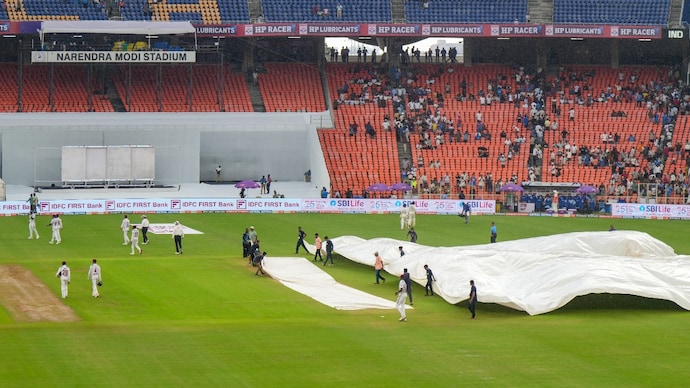
Three completely different Cricket matches have been played in India‘s last three home Test matches: a rank turner in Wankhede, a sports field in Ahmedabad, and a surface in Delhi that didn’t support sharp twists. Two of those were easy victories, both against the West Indies. However, Ajaz Patel’s left-arm wizardry caused India to collapse for 121 while chasing 147 in the 2024 Test match against New Zealand at Wankhede.
No two Indian home Tests seem the same anymore, if there is one lesson to be learned.
You can discover how diverse India has developed by traveling around its Test map. Nagpur and Chennai have always been connected. The soil and season can cause Bengaluru and Kolkata to fluctuate between being quick and slow. Then there are the exceptions, like the Cuttacks and the Guwahatis, where the red ball seems almost alien.
Thus, the concept of home advantage starts to become hazy when India plays Test matches all throughout the nation.
Ravichandran Ashwin has brought attention to this same anomaly on his YouTube channel. The off-spinner contended that because Test cricket is played in new places, the Indian side is frequently left just as in the dark as their rivals.
“Maybe India will cause them problems when you play South Africa in Guwahati. However, Ashwin noted that a game does not necessarily become a true home game just because it is included in the Indian map. “As the home team, we didn’t know what to expect.”
He’s got a point. Playing at home is one thing. Knowing your house is a different matter.
Thus, the concept of home advantage starts to become hazy when India plays Test matches all throughout the nation.
However, Ashwin isn’t the only one considering pitches. Head coach Gautam Gambhir expressed his own annoyance with India’s playing surface, not where they play, following their victory over the West Indies in Delhi.
He referred to the Delhi surface as a “disservice” to the fast bowlers of India.
“There has to be something for the fast bowlers as well,” Gambhir stated. “You want both of your good pacers, like Bumrah and Siraj, to be in the game. It must be carried. Its absence was troubling.
Gambhir was upset about much than simply that particular Test. It concerned the type of cricket that India ought to represent.
“All of us have the responsibility of keeping Test cricket alive,” he stated. “The first thing to do that is by playing on good surfaces.”
Gambhir and Ashwin are essentially explaining two pieces of a single puzzle. One is concerned about the locations. The wickets are the other person’s concern. When taken as a whole, they reveal something more significant: a nation that leads the world in Test cricket yet is unsure about its home ground and preferred style of play.
THE ROTATING HOME IN INDIA
It’s important to examine the locations where India has hosted their most formidable opponents over the past ten years in order to get a sense of how dispersed the Test scene has become. TEST DATA
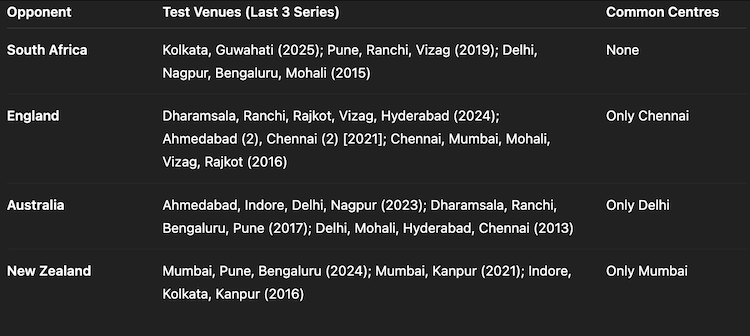
If you pay close attention, you will see the pattern—or rather, the absence of one.
From one series to the next, India’s Test locations are always changing. No opponent’s center is set in stone. Rather, Tests are dispersed wherever time on the schedule permits due to the rotation policy, BCCI politics, and practical trade-offs.
It is doubtful that Dharamsala will receive a Test match that season if it hosts a T20I match. It’s that easy: if a state association deserves a turn, it gets one. And there are repercussions for that randomness.
THE CHANGE OF FAMILY PITCHES TO FOREIGN
Consider the 2023 Australia series: four Test matches on four distinct fields. From Day 1, a conventional surface where India prevailed, Nagpur began to change. Delhi was slow and low, a surface that India was familiar with and had conquered. It was a furious turner that had a tremendous backlash in Indore. The level surface was sufficient for a 500-run draw by Ahmedabad.
India turned the tide against England a year later. India won the series 4-1 with four sporting wickets following a sluggish turner in Hyderabad. The only Test in the series that India lost was at Hyderabad. In contrast, following a lackluster opening in Chennai in 2021, England was given three rank turners.
No through-line exists. No philosophy of pitch. It is merely a response to the opposing parties.
India had a completely different mindset under Virat Kohli. Instead of chasing averages, the team sought results. The command was to spin from day one. In order to keep Bumrah and Siraj relevant, Rohit Sharma made an attempt to balance the surfaces. Both strategies have advantages and disadvantages.
Because you invite chaos when you start to manipulate nature, making Bengaluru or Pune into spinning tracks that weren’t supposed to be there.
Ashwin is well aware of that. India’s performance in the 2024 home Test series against New Zealand was dismal; they lost to Tom Latham’s team 3-0.
“In Pune, the ball doesn’t turn naturally that much,” he stated. “The bounce becomes unpredictable if you attempt to generate spin by breaking the wicket. We have lost both of our Test matches there against Australia and New Zealand.
He did, however, offer something more illuminating after that.
“The surface of Nagpur is naturally arid. It helps turn. Batters are aware of what to anticipate. It is therefore a true home advantage.
It’s more than just seam or spin. Predictability is key. Home is defined by knowing what a pitch will do on Day 1, Day 2, Day 3, Day 4, and Day 5.
WHAT PITCH ROADMAP SHOULD INDIA HAVE?
What is India’s next course of action? Strategic mapping, or setting up specific locations for specific opponents, is one possibility.
Play a team like England or the West Indies at Chennai, Nagpur, or Delhi if they have trouble with spin. Take a squad with top-tier spinners, such as Australia or New Zealand, to Dharamsala, Bengaluru, or Mumbai.
In this manner, India maintains its tactical advantage and builds familiarity; hitters understand their tempo, bowlers learn their distances.
The alternative is philosophical: strive for equilibrium everywhere. Create level, high-quality surfaces all around the nation and allow the top team to prevail. Players would get stability, while fans would get variation. India’s bowler Jasprit Bumrah during the home Test series against the West Indies (AP Photo)

Either way is acceptable. However, India is currently caught between shifting venues, shifting pitches, and shifting perspectives.
According to Ashwin, “Sometimes it feels like India are playing away from home, even at home.”
Where the matches are played is a surprisingly straightforward problem at the heart of India’s home Test problems. Currently, limited-overs scheduling, logistics, and rotation policies—rather than a long–term strategy—determine venue selection. The outcome? Even at home, India and its opponents frequently feel like guests, and they hardly ever play consecutive series at the same stadium.
A simple fix could make a big difference. The pitches start to make sense when you designate fixed centers for particular tours, such as Delhi, Pune, Chennai, and Kolkata for Australia, or Dharamsala, Bengaluru, and Mumbai for New Zealand. Teams can better prepare, players are aware of what to expect, and the competition feels more even.
The issue of the pitches themselves then arises. Without unexpected collapses or wild turners, balanced surfaces that provide something for bowlers and batters would guarantee that the top team in every category wins. Fans may see a greater range of international teams instead of just a select few at the same grounds if fixed locations were to cycle between opponents over time.
To put it succinctly, fix the locations before the pitches. If you do so, India’s home advantage would no longer feel like a guessing game but rather like the true advantage it is supposed to be, for both the players and the spectators.
For breaking news and live news updates, like us on Facebook or follow us on Twitter and Instagram. Read more on Latest Sports on thefoxdaily.com.






COMMENTS 0