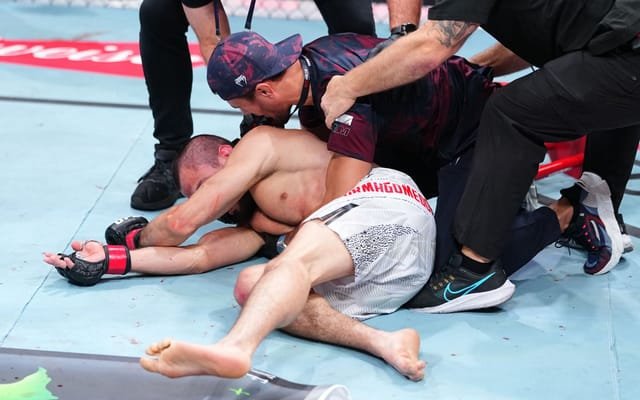
Umar Nurmagomedov’s KO loss to Song Yadong at UFC Shanghai has triggered a wider debate about expectations, family legacy and whether elite fighters should receive additional consideration when assessing a defeat. Former UFC fighter Zac Pauga challenged Daniel Cormier’s sympathetic assessment of Umar, arguing that losing is part of combat sports and that every athlete enters the cage carrying personal pressure.
The disagreement comes after Cormier discussed the UFC Shanghai main event on his YouTube channel. The former two-division UFC champion highlighted the difficulty of building a career while carrying the famous Nurmagomedov surname, particularly because Umar has often been viewed through the lens of Khabib Nurmagomedov and Islam Makhachev.
But Pauga offered a much different perspective. He questioned why Umar’s defeat should be treated differently from those of other fighters and argued that pressure exists across the UFC roster.
The debate is bigger than one knockout. It raises an important question about modern MMA: when a fighter comes from an iconic fighting family, should the legacy surrounding their name be considered when judging their performances?
Why Umar Nurmagomedov’s KO loss became such a major talking point
Umar entered the UFC Shanghai main event with enormous expectations surrounding his name and reputation. As a member of the Nurmagomedov fighting family, he has operated under a spotlight that few fighters experience.
That attention intensified because his career has frequently been compared with the achievements of Khabib, one of the most influential fighters in UFC history, and Islam, another elite member of the Dagestani MMA system.
Instead of another step forward, Umar suffered a stoppage defeat against Song Yadong. The result immediately changed the conversation surrounding his career.
For an ordinary fighter, a defeat might simply lead to questions about tactics, preparation and the next opponent. For Umar, the discussion quickly became connected to the much larger Nurmagomedov legacy.
That is precisely where Cormier and Pauga disagree.
Daniel Cormier focuses on the pressure of the Nurmagomedov name
Cormier believes the circumstances surrounding Umar deserve consideration when evaluating his defeat.
During his discussion of UFC Shanghai, Cormier pointed out that Umar is not simply trying to win fights. He is also attempting to establish himself while carrying a surname associated with one of MMA’s most dominant eras.
According to Cormier, Umar has faced criticism from people who believe his opportunities have been influenced by his connection to Khabib. At the same time, he has been expected to become the next major star associated with the Nurmagomedov name.
This creates a difficult balancing act.
Umar has to develop his own identity while constantly being compared with fighters who have already established extraordinary legacies.
Cormier’s argument is therefore not necessarily that Umar should be excused for losing. Instead, his point is that the psychological environment surrounding the fighter is unusually demanding.
Zac Pauga strongly disagrees with Cormier
Pauga takes the opposite position.
His argument is straightforward: every professional fighter has pressure, and a loss should not receive special treatment simply because of a famous surname.
Pauga questioned why Umar’s defeat should be considered uniquely difficult compared with the losses suffered by other UFC athletes.
From this perspective, the cage creates an equal competitive environment. Regardless of family background, reputation or expectations, the fighter still has to perform once the contest begins.
That argument has considerable relevance to combat sports because fighters frequently deal with different forms of pressure. Some are fighting to preserve their careers, others are attempting to reach a title shot, while others are trying to establish themselves as prospects.
Umar’s pressure may be unusually visible, but Pauga’s point is that pressure itself is universal in professional MMA.
The real issue: legacy can be both an advantage and a burden
The disagreement becomes more interesting when the Nurmagomedov name is viewed from both sides.
A famous surname can provide opportunities. It can attract attention, create relationships within the sport and generate immediate interest from fans.
But the same name can also increase expectations.
When a fighter is associated with an iconic champion, fans naturally compare them with that champion. Every defeat can therefore appear larger than it otherwise would.
Umar is effectively attempting to build an individual career while operating inside a pre-existing narrative.
That is one of the most important factors to consider when discussing his future.
Umar is not Khabib — and that comparison matters
One of the biggest analytical mistakes in evaluating fighters from famous families is assuming that they must reproduce the exact career path of their predecessors.
Khabib established an extraordinary UFC legacy through his distinctive grappling-heavy style, relentless pressure and remarkable consistency.
Umar is a different fighter with his own strengths, career trajectory and challenges.
Expecting him to become another Khabib creates an unrealistic benchmark.
The same applies to comparisons with Islam Makhachev. Although the fighters share a broader Dagestani wrestling and combat-sports culture, they are not identical athletes.
A fighter should ultimately be evaluated according to what they accomplish inside their own career.
What the Song Yadong fight changes for Umar
A knockout loss does not automatically erase everything a fighter has achieved before it.
Instead, it provides new information.
For Umar, the result creates questions about how he responds to adversity, what adjustments he makes in training and whether his team can identify the tactical problems that contributed to the defeat.
The most important part of his career may now be the period immediately after the loss.
Elite fighters are rarely defined by one difficult night alone. Their ability to analyze setbacks and return with improvements can tell fans much more about their long-term potential.
Comparison: how fighters are judged after major losses
| Factor | Umar Nurmagomedov | Other UFC Fighters |
|---|---|---|
| Public expectations | Extremely high because of his family name | Varies according to ranking and reputation |
| Legacy comparisons | Frequently compared with Khabib and Islam | Usually judged against their own career standards |
| Pressure after a loss | Likely intensified by the Nurmagomedov connection | Often linked to rankings, contracts and title ambitions |
| Career response | Must rebuild momentum after the setback | Similar challenge after any significant defeat |
| Main question | How does Umar adapt and rebuild? | How does the fighter respond and improve? |
The Usman Nurmagomedov octagon incident adds another layer
The controversy surrounding Umar’s defeat did not end when the fight was stopped.
Umar’s brother, Usman Nurmagomedov, rushed into the octagon after the knockout to check on his brother.
The incident generated additional discussion because of his interaction with Song Yadong.
Some observers questioned whether Usman had attempted to strike or elbow Yadong during the moment, but Cormier rejected that interpretation.
Cormier argued that Usman was reacting instinctively because he wanted to reach his brother after seeing him stopped.
At the same time, Cormier acknowledged an important point: entering the octagon during the aftermath of a fight is not permitted.
That distinction is significant. Understanding the emotional reason behind an action does not necessarily mean the action itself complies with the rules.
Cormier defends Usman’s reaction while acknowledging the rule
Cormier’s position on the incident is consistent with his broader comments about the Nurmagomedov family.
He believes the context matters.
From Cormier’s perspective, Usman saw his brother in serious distress and immediately tried to reach him. Cormier described the interaction with Yadong as a reaction rather than a deliberate attempt to attack the fighter.
However, he also made clear that fighters and members of their teams are not normally allowed to enter the cage in that situation.
This creates another balance between rules and emotion.
MMA is an intensely emotional sport, but competitive regulations exist precisely because uncontrolled reactions can create additional risks immediately after a fight.
Why the Nurmagomedov family attracts such scrutiny
The Nurmagomedov name has become closely associated with elite-level MMA, particularly because of Khabib’s historic UFC career and the continued success of fighters from the same broader training culture.
That means family members and associated fighters receive attention before they have necessarily created their own legacy.
For Umar, this can be a double-edged sword.
The surname generates immediate interest, but it also means that every major performance is analyzed through a historical lens.
A dominant win can be interpreted as confirmation of the family’s reputation. A loss can produce questions about whether the next generation can match what came before.
Why Pauga’s criticism matters
Pauga’s criticism introduces an important principle into the discussion: fair evaluation should not become special treatment.
If analysts constantly explain a fighter’s losses through external circumstances, they risk taking attention away from the technical reasons behind the result.
In MMA, understanding why a fight was lost is crucial.
Was the problem defensive awareness? Timing? Distance management? Conditioning? Tactical decision-making? Or did the opponent simply execute better?
Those questions remain relevant regardless of a fighter’s surname.
Pauga’s argument therefore pushes the discussion back toward competitive accountability.
But Cormier’s argument also has value
At the same time, completely ignoring the psychological environment surrounding a fighter would also oversimplify the sport.
Elite competition is not played in a vacuum.
Media expectations, family reputation, rankings, championship pressure and public criticism can influence how athletes experience competition.
Umar has had to deal with comparisons that most fighters never encounter.
The key is to recognize that pressure without allowing it to become an excuse for performance.
That middle ground may be the fairest way to evaluate his defeat.
What should Umar Nurmagomedov do next?
The priority for Umar should be development rather than reputation management.
His next phase should focus on identifying what went wrong against Yadong and building a technical response.
A strong comeback would also help separate Umar from the shadow of his famous relatives.
Instead of asking whether he can become the next Khabib, the more useful question is whether he can become the best version of Umar Nurmagomedov.
That shift in perspective could reduce some of the unnecessary pressure surrounding his career.
Prediction: Umar’s next fight could be more important than his last
The biggest indicator of Umar’s long-term prospects may not be the knockout loss itself but what happens afterward.
If he returns with clear technical improvements and performs confidently, the defeat could eventually become a valuable turning point rather than a defining moment.
If the same vulnerabilities appear again, however, questions about his ability to compete at the highest level will become more difficult to dismiss.
In other words, the next performance can provide more useful evidence than endless arguments about whether the loss deserves special sympathy.
UFC Shanghai changes the conversation around Umar
Before the defeat, much of the discussion surrounding Umar centered on potential, pedigree and expectations.
Now the conversation has shifted toward resilience and adaptation.
That is normal for elite sport.
Every highly rated fighter eventually reaches a moment when expectations collide with reality. How the athlete responds often determines whether that moment becomes a setback or a turning point.
Umar now has the opportunity to define his own answer.
Conclusion: The debate is bigger than one knockout
Umar Nurmagomedov’s KO loss to Song Yadong has created a fascinating disagreement between Daniel Cormier and Zac Pauga.
Cormier believes Umar deserves additional recognition for competing under the enormous pressure attached to the Nurmagomedov surname. Pauga rejects that idea, arguing that every UFC fighter faces pressure and that Umar’s defeat should not be treated as uniquely significant simply because of his family background.
Both perspectives highlight different realities of professional MMA.
Umar undoubtedly carries a famous surname, and that brings expectations few fighters experience. But once the cage door closes, his performance still has to stand on its own.
The same applies to the controversy involving Usman Nurmagomedov after the fight. Cormier understood the emotional reason for Usman entering the octagon while also acknowledging that such an action is against the rules.
Ultimately, Umar’s future will not be decided by debates surrounding his surname. It will be determined by how he responds to adversity, what he learns from the Song Yadong defeat and whether he can build a legacy that belongs uniquely to him.
The most interesting chapter of Umar Nurmagomedov’s career may therefore begin after his first major setback.
For breaking news and live news updates, like us on Facebook or follow us on Twitter and Instagram. Read more on Latest MMA on thefoxdaily.com.






COMMENTS 0