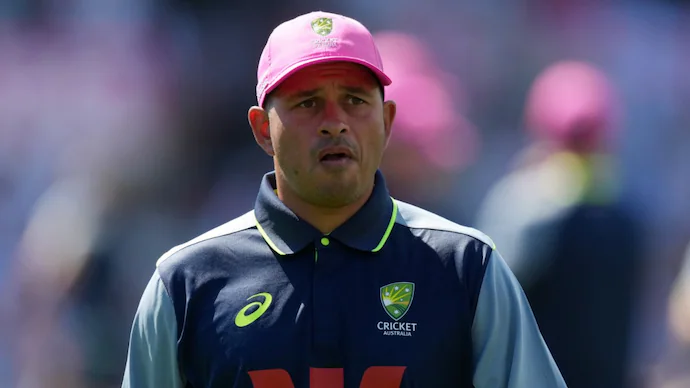
Former Australian cricketer Usman Khawaja has defended his decision to revisit the controversial Sandpapergate scandal in his upcoming autobiography, Sabr, insisting that his intention was never to blame individual teammates. Instead, Khawaja says he wants Australia to acknowledge its collective responsibility for the events of the 2018 South Africa tour and ensure that those who carried the heaviest burden finally receive justice.
His revelations have reignited debate across the cricketing world, particularly after he suggested that the ball-tampering controversy was not simply the responsibility of the three players who received punishments. According to Khawaja, the incident involved a wider team failure, with several members of the Australian setup aware of discussions about changing the ball’s condition to assist reverse swing.
The former opener’s comments have received mixed reactions. While some have praised him for speaking openly about an episode that damaged Australian Cricket‘s reputation, others have accused him of dragging former teammates into a controversy that many believed had already been put behind them.
In a two-part video shared on Instagram, Khawaja responded directly to the criticism and explained why he had chosen to speak publicly now. He also revealed that he had attempted to address Australia’s collective involvement shortly after the Cape Town Test in 2018 and again in 2021, but both efforts failed.
Khawaja retired from international cricket in January 2026. With his playing career behind him, he says he is now able to explain his perspective without worrying about how his comments might affect the Australian dressing room.
Usman Khawaja Responds to Media Reaction Over Sandpapergate
Khawaja began his response by criticising the way sections of the media had presented his autobiography’s revelations. He argued that his comments about collective responsibility had been misunderstood and that some headlines had suggested he was speaking on behalf of every Australian player involved in the 2018 tour.
He clarified that his intention was to explain how the entire team should accept responsibility for what happened, rather than identify individual players as guilty. However, he also refused to deny his belief that other members of the team knew about the discussions surrounding the ball-tampering incident.
“Time to clear some facts, because the media is taking us to the moon, as expected.”
Khawaja explained that his reference to the incident being a collective failure was about the responsibility shared by the team as a group. He maintained that his book presented his own experiences and did not claim to represent the views of every former teammate.
“I stayed quiet yesterday, but number one, if you read my article, you would have seen that when I mentioned it was all of us, I was implying that, whether we like it or not, we’re all responsible for what happened together. As a team, we need to take that collectively. That is all.”
He also made it clear that he would not withdraw his belief that other players knew about the incident. Khawaja said readers should examine the full account in his autobiography instead of relying only on headlines and interpretations circulating in the media.
“But now that everyone’s talking, am I going to deny that everyone knew? No, I won’t deny that either. But I never speak on behalf of anyone else in my book, contrary to what the clickbait media headlines would have you think. Have a read yourself. I’ll put it up.”
His response highlights the central argument behind his revelations: the scandal should be understood as a wider failure rather than an incident for which only three players carried the consequences.
Khawaja Reveals He Tried to Expose Australia’s Involvement in 2018
One of the most significant details from Khawaja’s video was his claim that he had considered speaking publicly about Australia’s involvement shortly after the Cape Town Test in March 2018.
He revealed that he had written down everything he remembered about the incident just days after it happened. According to the former batter, the notes formed an early record of his experiences and helped him preserve his recollection of the events before the controversy developed further.
Khawaja said he became particularly uncomfortable after seeing the punishments handed to Steve Smith, David Warner and Cameron Bancroft. He believed the responsibility should not have rested on those three players alone and wanted to tell the media that the wider team needed to accept its share of the blame.
He approached Smith, who was Australia’s captain at the time, and explained that he intended to come forward publicly. However, Smith reportedly persuaded him not to proceed, choosing instead to accept responsibility for the incident himself.
“When the other guys got their penalties, I told Smudge that I was going to come clean to the media. I couldn’t believe the penalties they got. But Smudge, being the man and the leader he was, talked me out of it. You can read it. It’s in my book. He wanted to take the blame. I argued with him, but he was having none of it. That’s the first time I tried to come out.”
Khawaja described Smith’s decision as an act of leadership, although he disagreed with the approach. He believed that allowing three individuals to shoulder the consequences did not reflect the wider responsibility he felt the team needed to acknowledge.
His account adds another perspective to the aftermath of Sandpapergate. While Smith, Warner and Bancroft became the most visible figures in the controversy, Khawaja says he had wanted the team to confront the issue together from the beginning.
Second Attempt in 2021 Failed After Australia’s Bowlers Issued Statement
Khawaja’s efforts to address the scandal did not end with his conversation with Smith. He revealed that he made another attempt in 2021, when Sandpapergate returned to public discussion and questions surrounding the involvement of Australia’s bowling group resurfaced.
During that period, Khawaja said he spent several hours speaking with former Australia head coach Justin Langer. He wanted Langer to encourage the team to accept collective responsibility for what had happened during the Cape Town Test.
The former batter also contacted Todd Greenberg, who was then the chief executive of the Australian Cricketers’ Association. Khawaja hoped to find a way to address the controversy through discussions involving the players’ representative organisation.
However, the situation became more complicated after Australia’s bowling group released a statement distancing itself from the ball-tampering episode.
The bowlers insisted that they had not known about the use of sandpaper to alter the condition of the ball until the footage appeared on the big screen at Newlands. They also pointed out that the umpires, Nigel Llong and Richard Illingworth, had inspected the ball after the incident became public but had not replaced it because there was no visible sign of damage.
Although the bowling group acknowledged that the actions on the field were wrong, it rejected suggestions that every member of the attack must have known about the use of a foreign substance. The players also asked for rumours and speculation about their involvement to stop.
Khawaja said the statement made it difficult for him to continue pushing for collective accountability. He did not want to enter into a public confrontation with his teammates, particularly while he remained part of the Australian setup.
“So again, in 2021, it reared its ugly head, and I once again called JL on the phone for hours. ‘Come on, JL, let’s take it together. Cop it as a team. We have another opportunity. We can finally take this, squash this once and for all.'”
He explained that he had also been in contact with Greenberg before the bowling group’s statement changed the situation.
“I was on the phone to Todd Greenberg, who was the ACA CEO back then, too. He’s with our players’ union. But then that statement came out from the guys and, pretty much, what could I do? I wasn’t going to go to war with those guys back then. I wasn’t comfortable. That’s the truth.”
The second unsuccessful attempt reinforced Khawaja’s belief that the issue had not been properly resolved. However, he chose not to challenge his teammates publicly while he was still playing international cricket.
Why Khawaja Stayed Silent While Playing for Australia
Khawaja also addressed why he did not speak openly about Sandpapergate during the four years following his 2021 attempt. He admitted that he was uncomfortable becoming the first Australian player to publicly challenge the established account while still representing the national team.
His biggest concern was the possible effect his comments could have on the dressing room. Khawaja said he was always conscious that his personal statements and actions could influence the wider team, particularly when Australia was competing internationally.
He pointed to his public comments about Palestine in 2023 as an example of how he approached sensitive issues while remaining an active member of the national side. Before continuing with those comments, he spoke to captain Pat Cummins and offered to stop if his actions were likely to affect the team negatively.
According to Khawaja, Cummins encouraged him to continue expressing his beliefs, assuring him that the matter would not affect the team’s environment.
“You know what? I never wanted to be the first guy to chat about this. Call me a chicken or whatever you want. I didn’t know how to do it because I was still on the team. How was I ever supposed to bring it up when I knew some of my teammates didn’t want to talk about it?”
Khawaja said his responsibility towards the Australian team influenced how he handled public controversies. He did not want his personal position to create unnecessary problems for teammates or become a distraction during international assignments.
“Because I knew everything I did or said always influenced and affected the team. I knew this, even when I spoke out in 2023 about the Palestinians. The first day the story broke, I saw Patty in the hotel, and I said, ‘Patty, first and foremost, I’m an Australian cricketer. If you want me to stop, I will stop right now. I promise you.'”
He credited Cummins for allowing him to continue, saying the captain understood that his personal beliefs did not necessarily have to affect the team.
“And to his credit, he looked at me and said, ‘It doesn’t affect us. You believe in it? Keep going.’ And I appreciate that.”
Now that he has retired from international cricket, Khawaja believes the circumstances are different. He no longer has to consider whether his statements could influence the dressing room or affect the team’s preparations.
“I was always conscious of putting my team first, but I’m not in that team anymore. What I say now isn’t a reflection of them, and my words don’t influence the team at all. I speak for myself.”
Khawaja Denies Using Sandpapergate Revelations to Promote His Autobiography
Another criticism surrounding Khawaja’s revelations has focused on their timing. Some have questioned whether he chose to discuss the controversial episode now to generate publicity for his upcoming autobiography, Sabr.
The former Australian batter rejected that suggestion, arguing that he had deliberately waited until Australia’s recent tour of South Africa had concluded before making his account public.
Khawaja said he contacted Cummins before publishing the revelations because he did not want the controversy to distract the Australian players while they were still in South Africa.
He also questioned why he would deliberately avoid what could have been a major promotional opportunity if increasing book sales had been his primary motivation.
“But even so, I refused to publish any of this while the boys were still in South Africa. That’s why I called Pat. Why would someone who really wants to increase the sales of his books refuse the greatest marketing opportunity he had? Literally the greatest. Everyone would have been talking about my book over there, all over the world, during that series. But that was never my goal. I waited until it was over.”
His explanation reinforces his argument that the decision was driven by a desire to address the past rather than create publicity. Khawaja maintained that protecting the Australian team from unnecessary distractions remained important to him even after retirement.
David Warner, Steve Smith and Cameron Bancroft Are the Real Victims, Says Khawaja
Khawaja’s strongest defence centred on the three players who received the most severe public criticism following Sandpapergate: David Warner, Steve Smith and Cameron Bancroft.
He argued that the trio had carried the burden of the scandal for years while other members of the Australian setup had gradually moved on. According to Khawaja, the public humiliation, criticism from crowds and repeated accusations of cheating had affected their lives long after the original incident.
The former batter acknowledged that the episode had also affected him personally. He recalled experiencing sleepless nights and questioning whether he would be able to return to the Australian dressing room after the controversy.
However, he insisted that Smith, Warner and Bancroft had endured a level of scrutiny that other members of the team did not experience.
“And you know what? I haven’t thrown anyone under the bus. The guys who are currently in the team, and the other people who were there on the South African tour, including you, including me, we’re not the victims. These three guys took the blame for all of us. They’re the victims.”
Khawaja explained that the impact of the scandal did not disappear simply because the team had moved forward. He said he had spoken to the three players and understood that the controversy continued to affect them years after the Cape Town Test.
“Yes, it was tough for everyone, including me. I had sleepless nights, too. I told Rachel and Justin Langer, ‘I’m not sure if I can ever go back into the change rooms again.’ But those three are the ones who have had to endure this for the last eight years. Why? People telling them that they’re cheats, getting nailed by the crowd, public humiliation. None of us had to deal with that.”
He also referred to conversations with Bancroft and Warner, suggesting that the experience continued to have a personal impact on both players. Bancroft reportedly spoke to him at length about how difficult the recent period had been, while Warner had continued dealing with the consequences of the scandal and its effect on his family.
“And I’m glad everyone else has moved on, but I promise you, those guys have not moved on. How can they, if the truth has never come out? And I know this because I’ve been told by them.”
Khawaja’s comments underline why he believes the issue should be revisited. In his view, the public narrative has focused heavily on three individuals without fully addressing the wider circumstances surrounding the team’s involvement.
Khawaja Says He Promised Childhood Friend David Warner to Tell the Truth
The most personal part of Khawaja’s explanation came when he revealed that his decision to speak publicly was connected to a promise he had made to David Warner.
Khawaja and Warner share a long-standing friendship dating back to their childhood. The former opener said he had promised Warner that he would tell the truth about what happened during the 2018 South Africa tour so his friend could have the opportunity to tell his own story.
He insisted that he had no regrets about publishing his account and rejected the suggestion that he was attempting to shift blame onto other players. Instead, he described his position as an effort to ensure that everyone involved accepted responsibility.
“But lastly, and most importantly, I made a promise to my childhood friend, David Warner, that I would tell the truth so he could tell his story. I’m absolutely, 100 per cent unapologetic for that.”
Khawaja added that his decision was consistent with his previous efforts to stand up for fellow cricketers through the Australian Cricketers’ Association. He said he believed Smith, Warner and Bancroft deserved justice after years of dealing with the consequences of the scandal.
“I’ve stood up for all cricketers in the past, with the ACA, fighting for what I thought was right. This is no different. These three guys deserve justice.”
He concluded by repeating that he was not interested in pointing fingers at individual teammates. His objective, he said, remained the same as it had been in 2018: to encourage the Australian team to accept collective responsibility so everyone could finally move forward.
“And I haven’t pointed fingers at anyone. I’m still searching for what I was searching for all those years ago: for us, me included, to take the blame together as a team, so we can all move on from this once and for all.”
Khawaja made it clear that he would make the same decision again, despite the criticism surrounding his revelations.
“And you know what? I would do it again in a heartbeat. I was always conscious of putting the team first.”
Sandpapergate Debate Returns as Khawaja’s Autobiography Draws Attention
Khawaja’s revelations have reopened an uncomfortable chapter in Australian cricket history. The 2018 Cape Town ball-tampering scandal resulted in major punishments for Smith, Warner and Bancroft and became one of the most damaging controversies involving the national team.
His upcoming autobiography, Sabr, offers his personal account of the events and the conversations that followed. His latest comments also explain why he believes the issue was never fully resolved, despite the punishments and public statements made in the aftermath.
At the centre of the debate is the question of collective responsibility. Khawaja argues that the three players who received the harshest consequences should not have been left carrying the burden alone. His account also raises questions about why his earlier attempts to address the matter did not lead to a wider discussion among the team.
By explaining his conversations with Smith, Langer, Greenberg and Cummins, Khawaja has provided further insight into why he remained silent for so long and why he eventually decided to speak.
His promise to Warner appears to have been a decisive factor in his decision. Now retired from international cricket, Khawaja says he is ready to tell his side of the story without worrying about the impact his words might have on the current Australian team.
Whether his revelations change the wider understanding of Sandpapergate remains to be seen. However, Khawaja has made his position clear: he believes the truth should be discussed openly, responsibility should be shared and the players who endured years of public humiliation deserve the opportunity to move forward.
For breaking news and live news updates, like us on Facebook or follow us on Twitter and Instagram. Read more on Latest Cricket on thefoxdaily.com.






COMMENTS 0