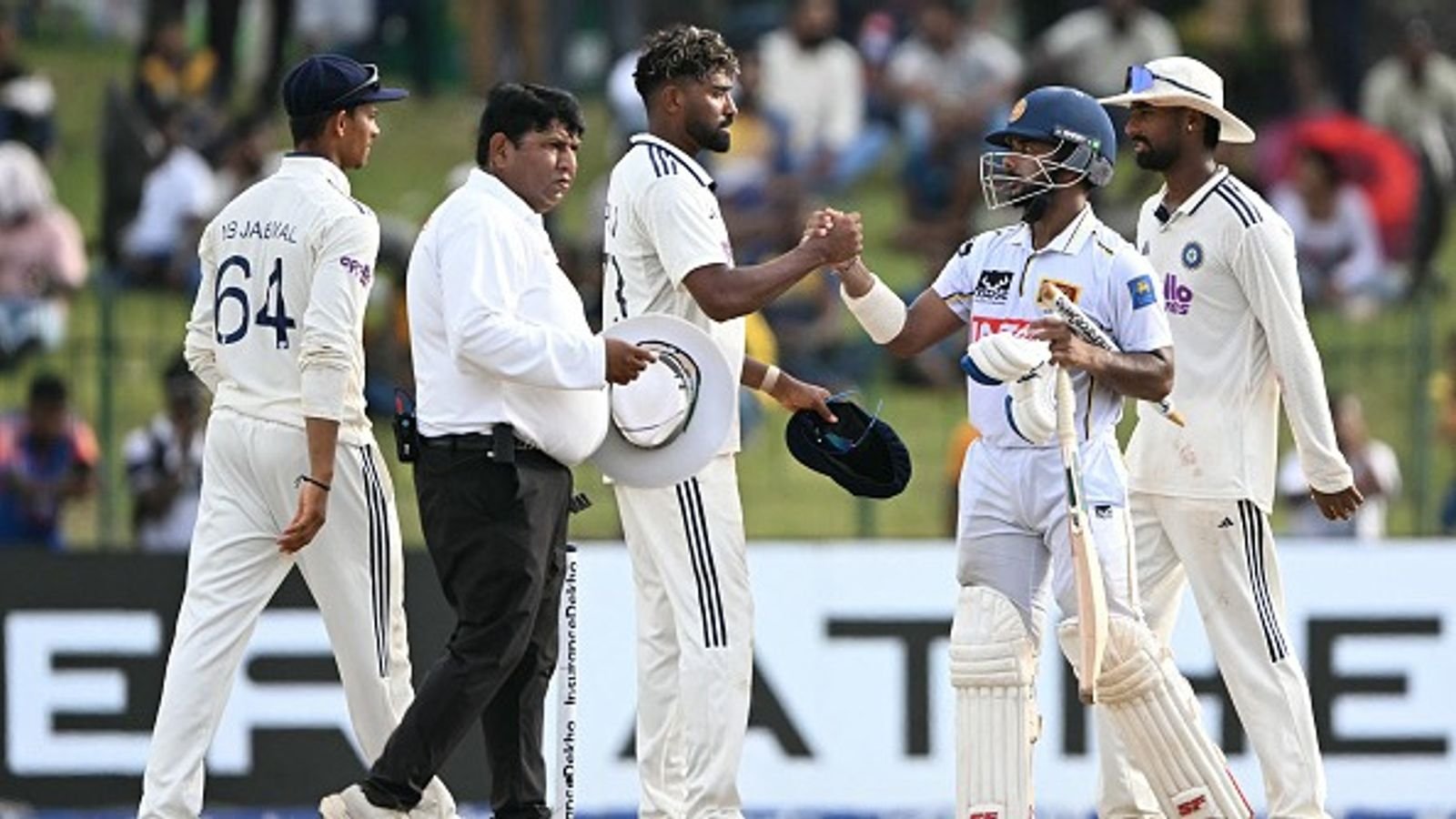
The WTC Points Table 2025-27 underwent another important change after India and Sri Lanka played out a dramatic draw in the second Test in Colombo. India appeared to be firmly in control after taking a 213-run first-innings lead, but Sri Lanka produced a remarkable fightback on the final day to save the match.
India declared on 503/9 in the first innings before bowling Sri Lanka out for 290. With a substantial lead available, India enforced the follow-on and appeared to be closing in on victory after reducing the hosts to 229/6 by the end of the fourth day.
However, Sri Lanka’s lower order refused to surrender. Sonal Dinusha produced a remarkable unbeaten 133 from 264 balls, guiding his team to 429/9 before the match ended in a draw.
The result proved costly for India in the World Test Championship 2025-27 points table. India’s points percentage dropped from 53.33% to 51.52%, leaving Shubman Gill’s side fifth in the current standings.
Australia remain at the top with an 80.00% points percentage, followed by South Africa on 75.00% and New Zealand on 72.22%. Bangladesh occupy fourth place with 55.56%, meaning India now sits only 3.04 percentage points behind them.
WTC Points Table 2025-27 After India vs Sri Lanka Test
| Position | Team | Played | Won | Draw | Lost | Penalties | Points | Points Percentage |
|---|---|---|---|---|---|---|---|---|
| 1 | Australia | 10 | 8 | 0 | 2 | 0 | 96 | 80.00% |
| 2 | South Africa | 4 | 3 | 0 | 1 | 0 | 36 | 75.00% |
| 3 | New Zealand | 6 | 4 | 1 | 1 | 0 | 52 | 72.22% |
| 4 | Bangladesh | 6 | 3 | 1 | 2 | 0 | 40 | 55.56% |
| 5 | India | 11 | 5 | 2 | 4 | 0 | 68 | 51.52% |
| 6 | England | 16 | 7 | 1 | 8 | -14 | 74 | 38.54% |
| 7 | Sri Lanka | 6 | 1 | 3 | 2 | 0 | 24 | 33.33% |
| 8 | West Indies | 12 | 2 | 2 | 8 | -2 | 30 | 20.83% |
| 9 | Pakistan | 9 | 2 | 0 | 7 | -8 | 16 | 14.81% |
Why the Colombo Draw Was So Costly for India
India’s problem was not simply that they failed to win. The larger issue was the opportunity they had created before the final day.
After scoring 503/9 declared, India dismissed Sri Lanka for 290. That gave the visitors a 213-run advantage and allowed them to enforce the follow-on.
India then reduced Sri Lanka to 229/6, putting themselves in a commanding position to take the match-winning wickets.
Instead, Dinusha and the remaining Sri Lankan batters resisted for long enough to take the game beyond India’s reach. The draw meant India received only the points associated with a drawn Test rather than the much larger reward available for victory.
In a WTC cycle, those missed points can become extremely important because qualification is determined by points percentage rather than simply the number of points accumulated.
India’s WTC Points Percentage Falls to 51.52%
India now have 68 points from 11 Tests, with five wins, two draws and four defeats. Their current points percentage stands at 51.52%.
The previous figure of 53.33% meant India were already operating with limited room for error. The Colombo draw has reduced that margin further.
The situation becomes more significant when India’s position is compared with the teams above them.
Bangladesh are fourth at 55.56%, only slightly ahead of India. New Zealand, however, have a much stronger 72.22%, while South Africa and Australia are also comfortably ahead.
This creates a two-part challenge for India: they need to win their own matches while also hoping that teams above them drop points.
Australia Continue to Lead the WTC Standings
Australia remain the strongest team in the current WTC table with 96 points from 10 Tests and an impressive 80.00% points percentage.
They have won eight matches and lost only two, giving them a substantial advantage over the rest of the field.
South Africa are second with 75.00%, having won three of their four Tests. New Zealand are third with 72.22% after four victories, one draw and one defeat from six matches.
These numbers highlight the importance of India’s remaining fixtures. A strong percentage is much easier to maintain when a team consistently converts Test opportunities into victories.
Bangladesh Are Currently Ahead of India
One of the most interesting aspects of the updated WTC table is Bangladesh’s position above India.
Bangladesh have played six Tests, winning three, drawing one and losing two. Their 40 points translate into a 55.56% points percentage.
Although the difference between Bangladesh and India is relatively small, it demonstrates how even a handful of results can significantly influence the WTC race.
India’s remaining matches therefore carry greater importance because there is little room for another result that fails to produce a substantial points return.
Sri Lanka’s Fightback Changed the Entire Narrative
For Sri Lanka, the Colombo draw was a major achievement.
The hosts had been under enormous pressure after conceding a 213-run first-innings deficit. Being asked to bat again after following on made the challenge even more difficult.
Yet Sri Lanka managed to survive long enough to finish on 429/9.
Dinusha’s unbeaten 133 became the defining innings of the match. His ability to remain at the crease for 264 deliveries gave Sri Lanka exactly what they needed: time.
In a WTC match, time can be as valuable as runs when a team is attempting to save a Test. Sri Lanka did not need to win the game; they simply needed to prevent India from taking the remaining wickets.
India’s Qualification Equation Has Become Tougher
Based on the current scenario, India have seven Tests remaining in this WTC cycle: two against New Zealand and five against Australia.
The supplied report indicates that India may need at least five wins from those seven matches to remain strongly in contention for a place in the WTC final, while also depending on results involving rival teams.
That is a demanding requirement.
Winning five of seven Tests would give India an excellent late-cycle surge, but the schedule also includes a five-match series against Australia. That series could become the defining stage of India’s WTC campaign.
India vs New Zealand Could Be a Turning Point
The upcoming two-Test series against New Zealand offers India an immediate opportunity to recover some of the points lost in Colombo.
Two victories would provide a significant boost to India’s points percentage and reduce the pressure before the five-Test Australia series.
However, New Zealand currently occupy third place with a 72.22% points percentage, making them one of the strongest teams in the championship cycle.
That means India’s next assignment is not simply about collecting points. It is also about preventing a direct rival from strengthening its own position.
The Australia Series Could Decide India’s WTC Fate
The five-Test series against Australia could become the most important part of India’s remaining WTC schedule.
Australia currently lead the standings, meaning India will face the team with the strongest points percentage in the competition.
A successful series against Australia could dramatically transform India’s qualification prospects. On the other hand, a poor result could make the WTC final race extremely difficult.
This is where the Colombo draw becomes particularly frustrating for India. Had the visitors converted their dominant position into victory, they would have entered the remaining schedule with a healthier points percentage.
Why Points Percentage Matters More Than Raw Points
The WTC uses Points Percentage System to rank teams because participating teams do not necessarily play the same number of Tests.
That means raw points alone can create a misleading picture.
For example, England have 74 points, which is more than India’s 68. However, England’s points percentage is only 38.54% because they have played 16 matches and suffered eight defeats.
India’s 68 points therefore place them above England despite having fewer total points.
This is why India’s 51.52% figure is more important than simply looking at their 68 points.
Comparison: India’s Position Versus the Top Three
| Team | Points Percentage | Key Record |
|---|---|---|
| Australia | 80.00% | 8 wins from 10 Tests |
| South Africa | 75.00% | 3 wins from 4 Tests |
| New Zealand | 72.22% | 4 wins, 1 draw, 1 loss |
| India | 51.52% | 5 wins, 2 draws, 4 losses |
The comparison makes India’s challenge clear. India are not simply chasing one team. They currently sit well behind the top three and must produce a strong sequence of results to close the gap.
What India Need to Do From Here
- Win consistently: India need to maximise their points return from the seven remaining Tests.
- Avoid unnecessary draws: The Colombo result showed how costly a missed victory can become when a team is already ahead in the standings.
- Perform against Australia: The five-Test series could have enormous consequences for India’s WTC campaign.
- Beat direct competitors: Results against teams near the top of the table can have a double impact on the qualification race.
- Monitor rival results: India’s qualification prospects will also depend on how Australia, South Africa, New Zealand and Bangladesh perform.
What the Colombo Test Reveals About India’s WTC Campaign
The most important lesson from the Colombo Test is that dominance does not automatically translate into WTC points.
India created an enormous advantage by scoring 503/9 declared and taking a 213-run lead. They then reduced Sri Lanka to six wickets down in the second innings.
But Test cricket is ultimately decided by all 20 wickets, and Sri Lanka found a way to deny India the final breakthrough.
That makes the result more than just a frustrating draw. It is a reminder of how narrow the margins can be in the WTC.
WTC Final Race: What Happens Next?
India remain alive in the WTC final race, but their route has become considerably more difficult after the Colombo draw.
The immediate objective will be to maximise results in the remaining seven Tests. A strong run against New Zealand would restore some momentum, while the subsequent Australia series could determine whether India can challenge the leading teams.
There is also a mathematical reality India cannot ignore: even winning five of their remaining seven matches may not be enough on its own if competing teams continue to collect points at a high rate.
That makes every future Test important.
Conclusion: India Can Still Recover, But the Margin for Error Is Small
The WTC Points Table 2025-27 now shows India in fifth position with 68 points and a 51.52% points percentage after the dramatic draw against Sri Lanka in Colombo.
Sri Lanka’s remarkable resistance, led by Sonal Dinusha’s unbeaten 133, denied India a victory that once looked highly likely. The result reduced India’s points percentage and increased the pressure surrounding their remaining schedule.
Australia, South Africa and New Zealand currently occupy the top three positions, while Bangladesh are narrowly ahead of India in fourth.
India’s path to the WTC final is therefore still open, but it has become much less forgiving. With seven Tests remaining, including two against New Zealand and five against Australia, Shubman Gill’s side needs a strong winning run and favourable results elsewhere.
The Colombo draw may have cost India a valuable opportunity, but the WTC campaign is far from over. The next seven Tests will determine whether India can turn a difficult position into another push for the World Test Championship final.
For breaking news and live news updates, like us on Facebook or follow us on Twitter and Instagram. Read more on Latest Cricket on thefoxdaily.com.






COMMENTS 0