- From Scarcity to Overproduction: A New Coding Reality
- The Rise of AI Coding Tools and Agents
- The Code Review Crisis
- Security Risks in the Age of AI Coding
- The Human Factor: Stress and Organizational Impact
- Open Source Platforms Under Pressure
- AI vs Engineers: Replacement or Reinvention?
- Solutions: Fighting Code Overload with More AI
- Analysis: A Broken System or a New Beginning?
- Conclusion
The rise of Artificial Intelligence in software development has triggered what many in the tech industry are calling a “Big Bang” moment. AI-powered coding tools are enabling developers-and even non-developers-to produce software at speeds previously unimaginable. But this surge in productivity has created a new and growing problem: code overload.
In one striking example, a financial services company using an AI coding tool saw its monthly output jump from 25,000 lines of code to 250,000. While this tenfold increase may sound like a productivity dream, it quickly turned into a logistical nightmare. The company soon faced a backlog of nearly one million lines of code waiting to be reviewed.
This situation highlights a critical shift in the software industry: generating code is no longer the bottleneck-managing it is.
From Scarcity to Overproduction: A New Coding Reality
Not long ago, writing software was a meticulous and time-consuming process. Developers carefully crafted and tested small amounts of code each day, ensuring reliability and stability.
Today, AI Tools have flipped that model entirely. With minimal input, developers can now generate large volumes of code in hours. Even individuals without formal programming backgrounds can create functional applications using AI assistance.
As one industry leader put it:
“The blessing and the curse is that now everyone inside your company becomes a coder.”
This democratization of coding has unlocked creativity and Innovation-but it has also introduced chaos.
The Rise of AI Coding Tools and Agents
AI coding tools from leading Technology companies have evolved rapidly. Early versions acted as assistants, helping developers write snippets of code or fix errors. Newer systems, however, function more like autonomous agents capable of building entire applications with minimal supervision.
These tools can:
- Generate full software programs from simple prompts
- Automate repetitive coding tasks
- Suggest optimizations and improvements
- Integrate multiple systems and workflows
The result is a dramatic increase in output. What once took weeks or months can now be completed in days-or even hours.
But speed comes with trade-offs.
The Code Review Crisis
As code production accelerates, the ability to review and validate it has not kept pace. This has created a growing backlog of unreviewed code, increasing the risk of bugs, vulnerabilities, and system failures.
The challenge is simple but significant: there are not enough experienced engineers to review the massive volume of AI-generated code.
This has led to a surge in demand for senior developers and application Security engineers-professionals skilled at identifying errors, assessing risks, and ensuring code quality.
However, supply is limited. Companies are struggling to fill these roles, creating a bottleneck that threatens to slow down the very productivity gains AI has enabled.
Security Risks in the Age of AI Coding
One of the most serious concerns associated with code overload is security. AI-generated code can introduce vulnerabilities that are difficult to detect, especially when produced at scale.
Some of the key risks include:
- Undetected bugs leading to system crashes
- Security flaws that expose sensitive data
- Compliance issues with regulatory standards
- Unclear ownership of code responsibility
In traditional development, the person who wrote the code was responsible for maintaining and fixing it. With AI-generated code, this responsibility becomes less clear, complicating accountability.
A particularly unexpected risk has emerged from how developers use these tools. Many engineers are downloading entire codebases onto local machines to work more effectively with AI tools. This creates potential vulnerabilities if devices are lost or compromised.
As one expert noted, this is “a risk no one thought of six months ago.”
The Human Factor: Stress and Organizational Impact
The effects of AI-driven coding extend beyond engineering teams. As development speeds increase, other departments-such as sales, marketing, and customer support-are forced to keep up.
This creates organizational pressure, as teams must adapt to faster product cycles and more frequent updates. While AI enhances productivity, it also raises expectations across the board.
In essence, AI doesn’t just change how code is written-it changes how entire companies operate.
Open Source Platforms Under Pressure
The impact of code overload is particularly visible in open source communities. Platforms that allow public contributions have seen a surge in activity, much of it driven by AI tools.
However, not all contributions are useful. Some are incomplete, poorly structured, or even spam-like. In certain cases, projects have had to limit or shut down external contributions to protect their codebases.
This represents a significant shift from the collaborative spirit that has traditionally defined open source development.
AI vs Engineers: Replacement or Reinvention?
The rapid advancement of AI coding tools has sparked concerns about job displacement. Some companies have already reduced their workforce, citing efficiency gains from AI.
Projects that once required large teams can now be handled by smaller groups, supported by AI systems. Tasks that took months can be completed in days.
However, this does not necessarily mean the end of engineering roles. Instead, the nature of these roles is evolving.
Developers are increasingly focusing on:
- Designing and overseeing AI-generated systems
- Reviewing and validating code
- Managing risks and ensuring security
- Strategic problem-solving and innovation
In other words, the role of the engineer is shifting from builder to supervisor.
Solutions: Fighting Code Overload with More AI
Ironically, one of the most promising solutions to code overload is more AI. Companies are developing tools specifically designed to review, analyze, and prioritize code.
These systems can:
- Automatically detect bugs and vulnerabilities
- Highlight critical areas requiring human review
- Streamline the code validation process
- Improve overall development efficiency
By combining human expertise with AI-powered review systems, organizations aim to create a balanced approach that maximizes productivity while minimizing risk.
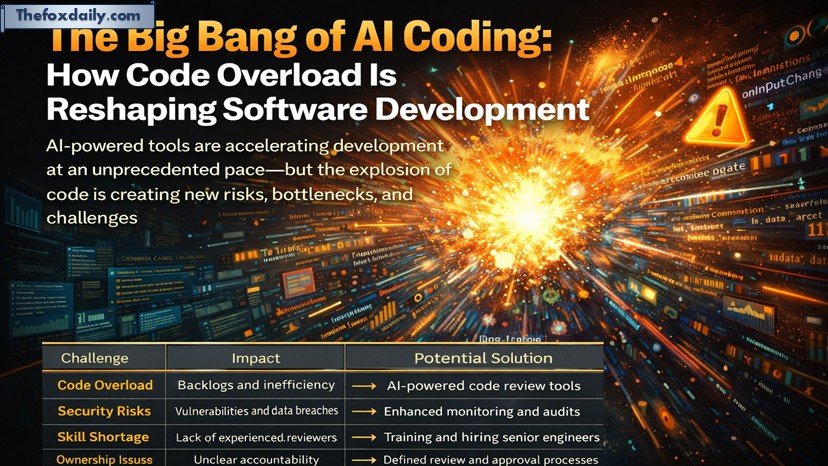
| Challenge | Impact | Potential Solution |
|---|---|---|
| Code Overload | Backlogs and inefficiency | AI-powered code review tools |
| Security Risks | Vulnerabilities and data breaches | Enhanced monitoring and audits |
| Skill Shortage | Lack of experienced reviewers | Training and hiring senior engineers |
| Ownership Issues | Unclear accountability | Defined review and approval processes |
Analysis: A Broken System or a New Beginning?
The current situation can be seen in two ways. On one hand, the traditional software development model appears to be breaking under the pressure of rapid AI-driven change.
On the other hand, this disruption may represent the early stages of a new and more efficient system.
The key challenge is adaptation. Companies must rethink workflows, redefine roles, and implement new processes to manage the increased volume of code.
And here’s a bit of grounded humor: developers once joked about writing less code to avoid bugs. Now, the problem is writing too much code-and not knowing which part will break first.
Conclusion
The rise of AI-powered coding tools has transformed software development, turning code generation into an almost limitless resource. But this abundance has created new challenges that the industry is still learning to manage.
Code overload, security risks, and skill shortages are not just temporary issues-they are structural changes that will shape the future of technology.
The solution lies in balance: leveraging AI for productivity while maintaining human oversight for quality and safety.
In the end, the Big Bang of AI coding is not just about more code-it’s about redefining how software is built, managed, and understood in an increasingly automated world.
For breaking news and live news updates, like us on Facebook or follow us on Twitter and Instagram. Read more on Latest Technology on thefoxdaily.com.






COMMENTS 0