- Why the CIA Is Turning to AI Now
- What These “AI Co-Workers” Will Actually Do
- Human Analysts Still in Charge
- Speed and Scale: A Game-Changer in Intelligence
- AI in Military Operations: Lessons from the Battlefield
- Geopolitical Competition: Keeping Pace with China
- Tensions with AI Companies: The Anthropic Issue
- Are Intelligence Jobs at Risk?
- Risks and Ethical Considerations
- The Future of Intelligence Work
- Conclusion: Evolution, Not Replacement
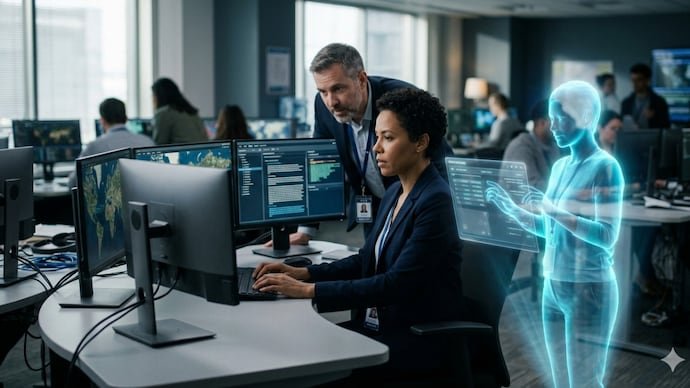
The Central Intelligence Agency (CIA) is taking a major step into the future by deploying Artificial Intelligence (AI) systems to assist its intelligence analysts. The move aims to speed up the processing of vast amounts of intelligence data while improving the accuracy and depth of analysis. Announced by CIA Deputy Director Michael Ellis, the initiative focuses on creating “AI co-workers” that will support not replace human analysts. While the Technology is already being tested and used in select cases, the agency has emphasized that final decision-making will remain firmly in human hands.
Why the CIA Is Turning to AI Now
Modern intelligence work involves processing enormous volumes of data from satellite imagery and intercepted communications to human intelligence reports. Traditionally, analysts would spend hours, sometimes days, piecing together this information.
AI changes that equation.
By leveraging advanced machine learning and generative AI Tools, the CIA aims to analyze data in seconds, identify patterns, and generate insights that would otherwise take significantly longer. The goal is not just speed, but also precision.
In simple terms: AI acts like a highly efficient assistant that never sleeps, helping analysts focus on critical thinking rather than repetitive tasks.
What These “AI Co-Workers” Will Actually Do
According to reports, the CIA is building a classified version of generative AI that will be integrated into its analytical platforms. These AI systems are designed to assist with a range of tasks.
Key Functions of CIA’s AI Systems
- Drafting intelligence reports: Creating initial versions of key assessments
- Testing conclusions: Evaluating the strength and consistency of analytical judgments
- Identifying patterns: Detecting trends across large datasets
- Language translation: Processing foreign-language intelligence quickly
- Data synthesis: Combining multiple sources into a unified analysis
The agency has already produced its first autonomous intelligence report using AI an early sign of how this technology could reshape intelligence workflows.
Human Analysts Still in Charge
Despite the growing role of AI, the CIA has made it clear that humans will remain at the center of intelligence decision-making.
“AI will assist, but not replace, human judgment,” officials emphasized, underscoring the importance of accountability in National Security decisions.
This distinction is crucial. Intelligence analysis often involves nuanced interpretation, ethical considerations, and strategic thinking areas where human expertise remains indispensable.
Think of AI as a co-pilot, not the captain.
Speed and Scale: A Game-Changer in Intelligence
One of the biggest advantages of AI is its ability to process massive datasets almost instantly. In modern intelligence and geopolitical competition, speed can be the difference between proactive action and delayed response.
For example, AI systems can analyze thousands of data points such as troop movements, communication signals, and economic indicators in real time. This allows Intelligence Agencies to build a more comprehensive and timely picture of global events.
The CIA has reportedly tested around 300 AI projects over the past year, many focused on handling large-scale data and improving analytical efficiency.
AI in Military Operations: Lessons from the Battlefield
The use of AI is not limited to intelligence agencies. It is already being deployed in military operations.
In recent developments, US Central Command (CENTCOM) has used AI to help process battlefield data. This technology enables faster decision-making by analyzing complex information streams in seconds.
During ongoing conflicts, AI has reportedly helped US forces gain an operational edge by:
- Quickly identifying threats
- Improving situational awareness
- Enhancing strategic planning
This real-world application reinforces why intelligence agencies like the CIA are rapidly adopting similar technologies.
Geopolitical Competition: Keeping Pace with China
The CIA’s push toward AI is also driven by global competition, particularly with china. According to Michael Ellis, maintaining a technological edge is essential as rival nations rapidly advance their own capabilities.
China has been investing heavily in AI across sectors, including defense and surveillance. The CIA’s initiative is part of a broader effort by the United States to stay ahead in this high-stakes technological race.
In intelligence terms, falling behind in AI could mean slower analysis, weaker insights, and reduced strategic advantage.
Tensions with AI Companies: The Anthropic Issue
The CIA’s AI plans come amid tensions between the US Government and private AI companies. One notable case involves Anthropic, an AI firm that has faced scrutiny over restrictions on how its models can be used.
The US government has reportedly blacklisted the company, labeling it a Supply Chain risk after it attempted to limit the use of its technology for certain applications, including those related to lethal operations and mass surveillance.
Michael Ellis addressed this issue directly, stating that the CIA will not allow private companies to dictate how it uses legally permissible technologies.
This highlights a growing debate: Who controls AI the developers or the users?
Are Intelligence Jobs at Risk?
The big question especially for analysts and aspiring intelligence professionals is whether AI will replace human jobs.
The short answer: Not anytime soon.
While AI can automate repetitive tasks and enhance efficiency, it lacks the contextual understanding, intuition, and ethical reasoning required for high-level intelligence work.
What Will Change
- Routine tasks will be automated
- Analysts will focus more on interpretation and strategy
- Productivity and output will increase
What Will Not Change
- Human oversight and accountability
- Final decision-making authority
- Need for critical thinking and expertise
In fact, AI could make intelligence jobs more impactful by freeing analysts from time-consuming tasks and allowing them to focus on higher-value work.
So, rather than replacing jobs, AI is more likely to redefine them.
Risks and Ethical Considerations
As with any powerful technology, the use of AI in intelligence comes with risks.
- Algorithmic bias: Incomplete or skewed data can lead to inaccurate conclusions
- Over-reliance on AI: Blind trust in automated systems can be dangerous
- Privacy concerns: Increased surveillance capabilities raise ethical questions
- Security risks: AI systems themselves could become targets for cyberattacks
These challenges highlight the importance of maintaining human oversight and implementing robust safeguards.
The Future of Intelligence Work
The integration of AI into intelligence operations marks a turning point. Agencies like the CIA are moving toward a hybrid model where humans and machines work together.
This approach combines the strengths of both:
- AI: Speed, scale, and data processing
- Humans: Judgment, ethics, and strategic thinking
As the technology evolves, we can expect even deeper integration, with AI becoming a standard tool in intelligence workflows.
And yes, the job description of an intelligence analyst may soon include something like: “Experience working with AI tools preferred.”
Conclusion: Evolution, Not Replacement
The CIA’s move to deploy AI co-workers represents a significant evolution in intelligence operations. By combining advanced technology with human expertise, the agency aims to improve speed, accuracy, and strategic insight.
While concerns about job Displacement are understandable, the reality is more nuanced. AI is not replacing human analysts it is enhancing their capabilities.
Looking ahead, the success of this initiative will depend on how well the balance is maintained between automation and human control. If done right, it could redefine intelligence work for the better making it faster, smarter, and more effective.
In a world where information is power, having the right tools and the right people using them makes all the difference.
For breaking news and live news updates, like us on Facebook or follow us on Twitter and Instagram. Read more on Latest Technology on thefoxdaily.com.






COMMENTS 0