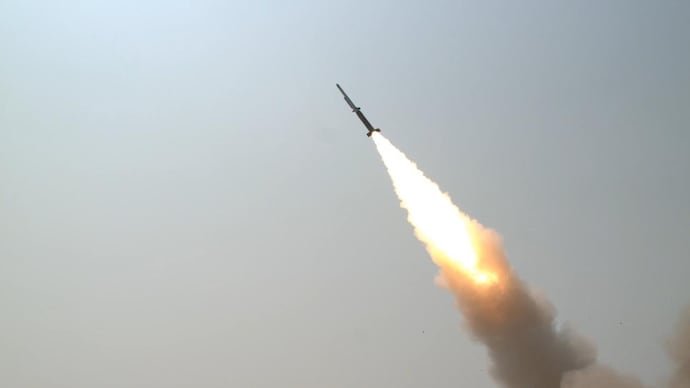
India has taken a major leap in advanced missile propulsion with the Defence Research & Development Organisation (DRDO) successfully testing Solid Fuel Ducted Ramjet (SFDR) technology. This capability, mastered by only a handful of countries worldwide, marks a critical milestone in strengthening India’s indigenous defence ecosystem.
The test was carried out on February 3, 2026, at around 10:45 am at the Integrated Test Range (ITR), Chandipur, located off the Odisha coast. According to DRDO, the trial met all mission objectives and validated several key subsystems under real flight conditions.
With this achievement, India joins a select group of technologically advanced nations that possess ramjet-powered missile know-how. This technology is considered vital for the development of long-range, high-speed air-to-air missiles capable of dominating beyond-visual-range (BVR) combat scenarios.
Announcing the success, DRDO stated that the flight test of SFDR technology was conducted from ITR, Chandipur, and that the system is central to the future development of advanced air-to-air missile platforms.
Ramjet Technology Explained: What Is It?
A ramjet is a type of air-breathing jet engine that operates without moving parts such as compressors or turbines. Unlike conventional jet engines, ramjets rely on the high forward speed of the missile to compress incoming air before combustion.
In a Solid Fuel Ducted Ramjet, solid fuel is burned in a controlled manner while atmospheric air flows through the engine duct. This design enables sustained thrust at supersonic speeds, making it far more efficient than traditional rocket motors during prolonged high-speed flight.
Conventional rocket-powered missiles burn their fuel rapidly in the initial phase and then coast toward the target. In contrast, ramjet-powered missiles continue generating thrust during the later stages of flight, particularly in the terminal phase.
This sustained propulsion allows such missiles to maintain high speed, greater maneuverability, and higher energy just before impact—making them extremely difficult for enemy aircraft to evade.
How DRDO Tested the Ramjet Technology
During the SFDR flight test, a ground-based booster was first used to accelerate the missile to the required supersonic speed. Once the necessary Mach number was achieved, the ramjet propulsion system was activated.
DRDO confirmed that all critical subsystems functioned flawlessly throughout the test. These included the solid fuel ducted ramjet motor, the fuel flow control system, and the nozzle-less booster, all of which performed exactly as designed.
The missile’s flight and performance parameters were closely monitored using multiple tracking instruments positioned along the Bay of Bengal coastline. The data collected during the trial confirmed stable combustion, controlled propulsion, and effective system integration.
Senior scientists from key DRDO laboratories—including the Defence Research & Development Laboratory (DRDL), High Energy Materials Research Laboratory (HEMRL), Research Centre Imarat (RCI), and ITR—were present to witness the test.
Why Ramjet Technology Is Crucial for India
The successful testing of SFDR technology has far-reaching strategic implications for India’s air combat capabilities. Ramjet-powered air-to-air missiles can engage targets at much longer ranges while retaining high kinetic energy during the final moments of interception.
This capability allows Indian Air Force pilots to strike enemy aircraft from safer distances, significantly enhancing survivability and combat dominance in beyond-visual-range engagements.
Ramjet technology is notoriously complex, particularly due to the challenges involved in maintaining stable combustion at supersonic speeds. This is why only a limited number of countries worldwide have been able to master it.
For India, this breakthrough strengthens self-reliance in defence manufacturing and reduces dependence on foreign suppliers for critical missile technologies.
Looking ahead, SFDR technology is expected to play a central role in future Indian missile programmes. Its integration will enhance the operational effectiveness of the Indian Air Force and reinforce India’s position as a rising power in advanced defence research, development, and innovation.
For breaking news and live news updates, like us on Facebook or follow us on Twitter and Instagram. Read more on Latest Technology on thefoxdaily.com.






COMMENTS 0