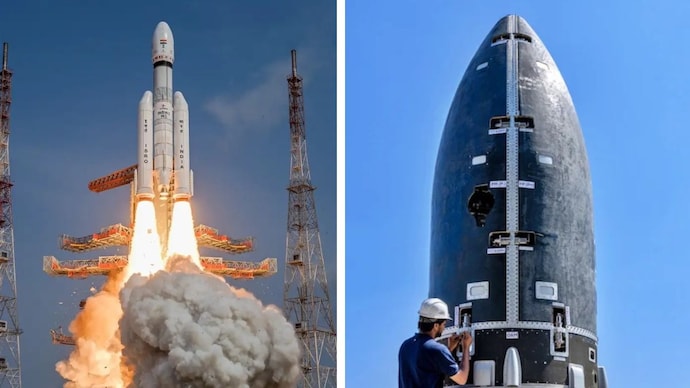
Indian space research Organisation (ISRO) Chairman V. Narayanan has outlined an expansive and forward-looking roadmap for 2026, underlining India’s rapid transition from a dependable space-faring nation to a key global leader in space technology and commercial launches.
Speaking after the successful completion of the LVM3-M6 mission—the sixth operational flight of India’s heavy-lift Launch Vehicle Mark-III—Narayanan said the coming year would be “transformational” for India’s space ambitions. The roadmap reflects a balanced focus on human spaceflight, advanced technology development, and the growing role of private industry.
From the much-anticipated Gaganyaan human spaceflight programme to the expanding commercial launch ecosystem led by startups such as Skyroot Aerospace, 2026 is expected to define India’s long-term standing in the global space economy.
THE SECOND GAGANYAAN LEG: A CRUCIAL TEST
The centrepiece of ISRO’s 2026 schedule will be the unmanned Gaganyaan mission, a critical precursor to India’s first crewed spaceflight. This mission represents the final and most demanding validation phase of the Gaganyaan programme.
ISRO plans to place an unmanned orbital module into space and safely bring it back to Earth, comprehensively testing the systems that will one day carry Indian astronauts. These include life-support systems, crew escape mechanisms, mission control protocols, and re-entry and recovery technologies.
According to Narayanan, the success of this mission will demonstrate India’s readiness for human spaceflight and place it among an elite group of nations capable of independently sending humans into orbit and safely returning them.
“Every subsystem must work flawlessly. This mission will validate years of research, engineering, and safety analysis,” the ISRO chief noted, adding that lessons learned will directly feed into the final crewed Gaganyaan launch.
PRIVATE SPACE SECTOR TAKES CENTRE STAGE
Narayanan also highlighted that ISRO is no longer the sole driver of India’s space journey. The country’s private space industry is emerging as a powerful force, growing at an unprecedented pace under the government’s new space policy framework.
Among the most closely watched players is Skyroot Aerospace, the Hyderabad-based startup that made history by launching India’s first privately developed rocket. The company is expected to conduct its next launch mission in the coming weeks, further strengthening confidence in private launch capabilities.
Parallelly, ISRO’s Small Satellite Launch Vehicle (SSLV) will play a major role in 2026. Designed for rapid, low-cost, and on-demand launches, the SSLV is aimed at serving the booming global small-satellite market.
Together, SSLV missions and private launch vehicles signal a shift toward frequent, affordable, and commercially competitive access to space, positioning India as a preferred launch destination for international customers.
INNOVATION AND FUTURE TECHNOLOGIES
Innovation remains at the heart of ISRO’s 2026 agenda. Narayanan announced a major technology demonstration mission that will carry nearly thirty indigenously developed technologies into space.
These include next-generation sensors, advanced avionics, improved thermal protection materials, and cutting-edge propulsion systems. Many of these technologies are designed to enhance the sustainability, efficiency, and reliability of future deep-space and planetary missions.
The chairman emphasized that these demonstrations are essential not only for scientific exploration but also for strengthening India’s competitiveness in the global space market.
With a packed schedule of scientific, strategic, and commercial launches, ISRO aims to strike a balance between national scientific pride and the demands of a rapidly evolving global space economy.
As the “New Space” era accelerates, 2026 is shaping up to be the year when India firmly asserts its long-term presence beyond Earth—moving steadily toward a future where Indian technology, astronauts, and private companies operate confidently among the stars.
For breaking news and live news updates, like us on Facebook or follow us on Twitter and Instagram. Read more on Latest Technology on thefoxdaily.com.




COMMENTS 0