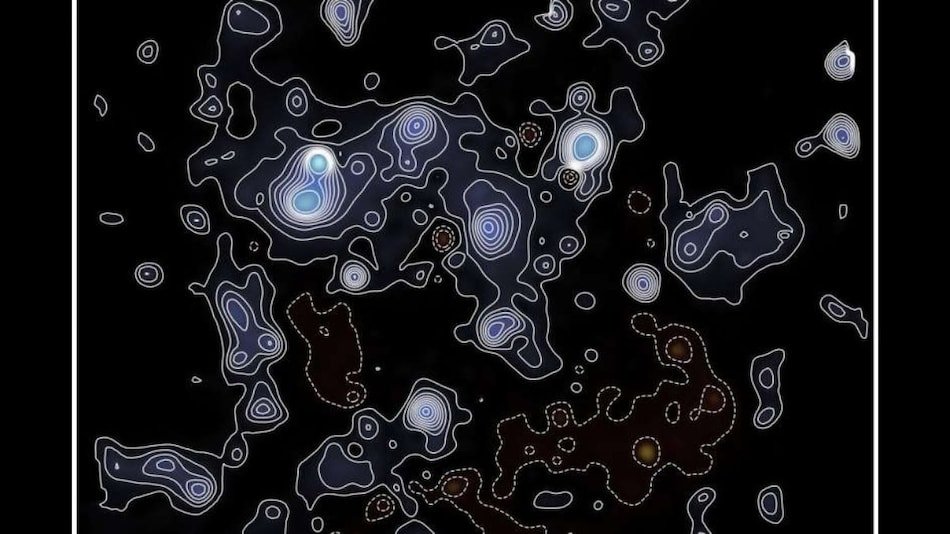
Astronomers have produced the most comprehensive map of dark matter in the Universe to date—an elusive substance that makes up nearly 85% of all matter but remains invisible to conventional telescopes. The breakthrough study, published in Nature Astronomy, was led by an international collaboration of scientists from Durham University, NASA’s Jet Propulsion Laboratory (JPL), and the swiss Federal Institute of Technology (ETH Zurich).
By analysing deep-space images captured by NASA’s James Webb Space Telescope (JWST), the researchers were able to trace the gravitational imprint of dark matter across a vast region of the sky. Rather than observing dark matter directly, the team mapped how its gravity subtly bends and distorts the light from distant galaxies—a phenomenon known as gravitational lensing.
Sharper and More Detailed Dark Matter Mapping
The observations focused on the COSMOS field, located in the constellation Sextans. Spanning an area nearly 2.5 times the size of the full Moon, this region is one of the most intensively studied patches of the sky. Over 255 hours of Webb imaging were dedicated to the survey, enabling astronomers to identify nearly 800,000 galaxies.
This unprecedented dataset allowed scientists to construct an ultra-high-resolution dark matter map, revealing structures at scales never before achieved. “This is the largest dark matter map we’ve ever created using Webb,” said Diana Scognamiglio, an astrophysicist at NASA’s JPL. “It is also about twice as sharp as dark matter maps produced by previous observatories.”
Compared with earlier surveys, the James Webb observations captured nearly ten times more background galaxies. This density provided the precision needed to detect small-scale clumps of dark matter, offering fresh insight into how matter is distributed across the Universe.
The Role of Dark Matter in Galaxy Formation
Although dark matter does not emit, absorb, or reflect light, its gravitational influence plays a crucial role in shaping the cosmos. By analysing lensing-induced distortions in the shapes of more than 250,000 distant galaxies, the researchers confirmed that visible galaxy clusters are embedded within massive dark matter halos.
“Dark matter and ordinary matter have always been found in the same locations,” explained Professor Richard Massey of Durham University. “This strongly supports the idea that dark matter provided the original scaffolding of the Universe.”
According to this widely accepted theory, dark matter began clumping together shortly after the Big Bang. Over time, its gravitational pull drew in gas and dust, eventually igniting star formation and giving rise to galaxies. The new Webb-based map reinforces this model by showing a near-perfect alignment between dark matter concentrations and visible cosmic structures.
Beyond confirming existing theories, the findings also offer a powerful tool for testing alternative models of dark matter and refining simulations of cosmic evolution. As James Webb continues to observe deeper into space and further back in time, astronomers expect even more precise insights into the invisible framework that governs the Universe.
For breaking news and live news updates, like us on Facebook or follow us on Twitter and Instagram. Read more on Latest Technology on thefoxdaily.com.




COMMENTS 0