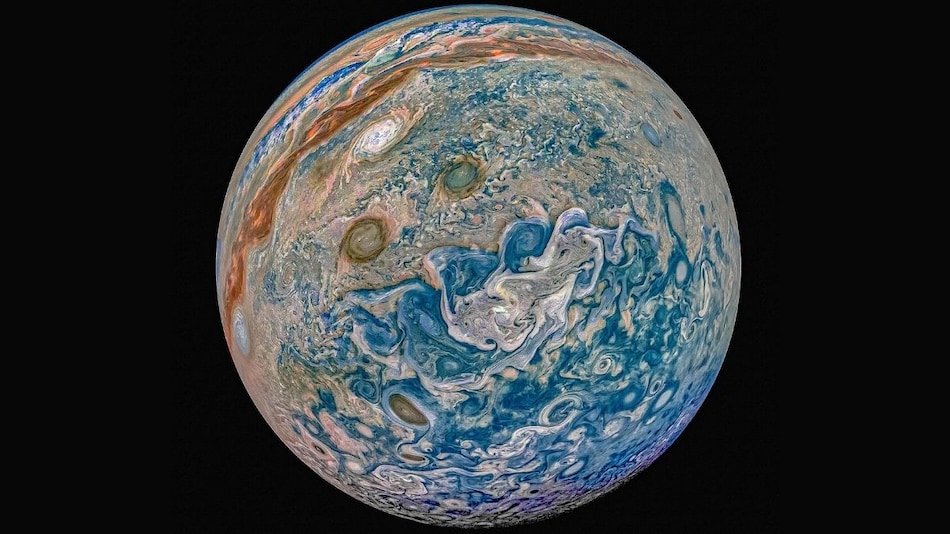
Fresh insights from NASA’s Juno mission have prompted scientists to reassess long-standing models of Jupiter’s interior structure and atmospheric dynamics. According to newly published research, the solar system’s largest planet is marginally smaller and more flattened at the poles than previously estimated.
Using high-precision data collected by the Juno spacecraft, researchers have determined that Jupiter’s polar radius at the 1-bar pressure level measures approximately 66,842 kilometers, while its equatorial radius stands at about 71,488 kilometers. These figures are roughly 12 kilometers and 4 kilometers smaller, respectively, than earlier estimates derived from the Pioneer and Voyager missions of the 1970s.
Although the differences may appear minor on a planetary scale, scientists emphasize that even subtle geometric adjustments carry major implications for understanding Jupiter’s deep interior and atmospheric mechanics.
Radio Occultation Technique Enhances Measurement Accuracy
The breakthrough comes from repeated radio occultation observations conducted by Juno. This technique tracks how radio signals transmitted between the spacecraft and Earth bend as they pass through Jupiter’s dense atmosphere. By analyzing these distortions, researchers can precisely determine atmospheric temperature, density, and pressure variations — ultimately refining measurements of the planet’s overall shape.
Earlier radius estimates were largely based on just six radio occultation observations collected during NASA’s Pioneer and Voyager missions in the late 1970s. The limited dataset left considerable uncertainty, particularly because those early measurements did not fully account for the influence of Jupiter’s intense zonal winds.
These powerful east-west jet streams significantly reshape the planet’s upper atmospheric layers, subtly altering its apparent dimensions. Modern analysis using Juno’s far more extensive dataset allows scientists to incorporate these wind-driven distortions into updated structural models.
Improved Orbital Dynamics and Data Processing Make the Difference
Advances in spacecraft navigation, gravitational mapping, and data processing techniques have enabled researchers to achieve unprecedented precision. Juno’s highly elliptical orbit repeatedly brings it close to Jupiter’s cloud tops, allowing continuous refinement of gravitational and atmospheric measurements.
The updated findings indicate that Jupiter’s poles are slightly more flattened than previously thought, while the equatorial radius is modestly reduced. These refinements improve our understanding of how rapid planetary rotation and atmospheric circulation interact to shape gas giants.
Scientists note that Jupiter’s rotation rate, internal density distribution, and atmospheric flow patterns are all interconnected. Even small corrections in measured radius can significantly alter simulations of the planet’s deep interior, including its core structure and the distribution of metallic hydrogen believed to exist beneath its thick cloud layers.
Why Small Changes Matter for Planetary Science
Experts stress that precise planetary measurements are foundational to astrophysical modeling. Jupiter serves as a benchmark for understanding not only gas giants within our own solar system but also the thousands of exoplanets discovered orbiting distant stars.
More accurate interior models help scientists interpret gravitational data, magnetic field observations, and atmospheric dynamics. In turn, this improves predictions about the formation and evolution of massive planets across the universe.
By refining Jupiter’s dimensions, the Juno mission is helping researchers recalibrate theoretical models that have stood for decades. These updated insights will influence future studies of Saturn, Uranus, Neptune, and gas giants in distant planetary systems.
As Juno continues its extended mission, scientists expect even more detailed revelations about Jupiter’s structure, composition, and dynamic atmosphere — ensuring that the gas giant remains central to planetary science research for years to come.
For breaking news and live news updates, like us on Facebook or follow us on Twitter and Instagram. Read more on Latest Technology on thefoxdaily.com.






COMMENTS 0