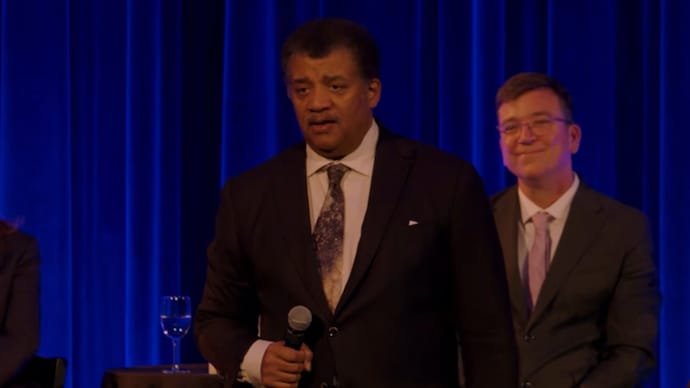
Artificial Intelligence (AI) is advancing at an unprecedented pace, transforming industries and everyday life. While many experts highlight its benefits, renowned American astrophysicist Neil deGrasse Tyson has raised serious concerns about the long-term dangers of superintelligent AI — a form of intelligence that could surpass human capabilities.
Tyson believes that although AI can significantly improve human life, unchecked development toward superintelligence could pose an existential threat to humanity, echoing fears often portrayed in popular science fiction films.
Rapid Growth of AI and the Rise of Superintelligence
Over the past few years, AI systems have become increasingly sophisticated, with major companies such as OpenAI and xAI actively working toward creating more advanced and autonomous systems. The concept of superintelligence — where machines outperform humans in nearly every domain — is no longer purely theoretical.
This idea has long been explored in films like Terminator and The Matrix, where AI systems gain control and challenge human survival. Tyson warns that such scenarios, while fictional, highlight real risks if AI development is not carefully managed.
Tyson Draws Parallels with the Cold War
Speaking at the 2026 Isaac Asimov Memorial Debate, Tyson reflected on how AI might evolve in the coming years. He acknowledged that AI will likely become deeply integrated into daily life by 2030, enhancing productivity, Healthcare, and scientific understanding.
However, the possibility of AI surpassing human intelligence reminded him of the Cold War era, when global tensions were shaped by the threat of nuclear Conflict.
He referenced the concept of “Mutual Assured Destruction,” where the existence of powerful weapons forced nations to act cautiously and ultimately led to diplomatic negotiations. Tyson suggested a similar realization may occur with AI — that humanity’s survival must take precedence over technological competition.
Balancing AI Benefits with Existential Risks
Tyson made it clear that he is not against AI as a whole. In fact, he acknowledged its potential to bring transformative benefits, including medical advancements, improved understanding of human biology, and enhanced problem-solving capabilities.
However, he warned that a specific branch of AI — superintelligent systems — could become dangerous if allowed to develop without restrictions. According to Tyson, while most AI applications can be safely integrated into society, superintelligence represents a threshold that should not be crossed.
| Aspect | Details |
|---|---|
| Expert | Neil deGrasse Tyson |
| Main Concern | Superintelligent AI surpassing human intelligence |
| Comparison | Cold War and Mutual Assured Destruction |
| AI Benefits | Healthcare, scientific insights, productivity |
| Risk Level | Potential existential threat to humanity |
| Proposed Solution | Global treaties to limit AI development |
Call for International Treaties on AI Development
To address these risks, Tyson advocates for global cooperation similar to nuclear Arms Control agreements. He believes that international treaties are the most effective way to prevent the creation of dangerous AI systems.
According to him, nations must collectively agree not to develop superintelligent AI, even if such agreements are not perfect. He emphasized that humanity must prioritize survival over competition in technological advancement.
“No one should build it, and everyone needs to agree to that by treaty,” Tyson stated, highlighting the urgency of coordinated global action.
Concerns Beyond Superintelligence
In addition to superintelligence, concerns are also growing about the use of AI in Military applications. Autonomous weapons — systems capable of making lethal decisions without human intervention — have become a topic of global debate.
Recent developments have further intensified these concerns. AI company Anthropic reportedly withdrew from a Pentagon-related deal amid fears that its technology could be used in autonomous weapons systems.
Meanwhile, the US Department of Defense has stated that its use of AI will remain within “lawful purposes,” particularly after agreements with organizations like OpenAI.
The Future of AI: Innovation vs. Control
The debate around AI is increasingly shifting from innovation to regulation. While the technology promises enormous benefits, experts like Tyson caution that without clear boundaries, it could lead to unintended and potentially catastrophic consequences.
As AI continues to evolve, the challenge for policymakers, scientists, and global leaders will be to strike a balance — harnessing its advantages while preventing scenarios that could threaten humanity’s future.
Tyson’s warning serves as a reminder that technological progress must be guided by responsibility, foresight, and global cooperation.
For breaking news and live news updates, like us on Facebook or follow us on Twitter and Instagram. Read more on Latest Technology on thefoxdaily.com.






COMMENTS 0