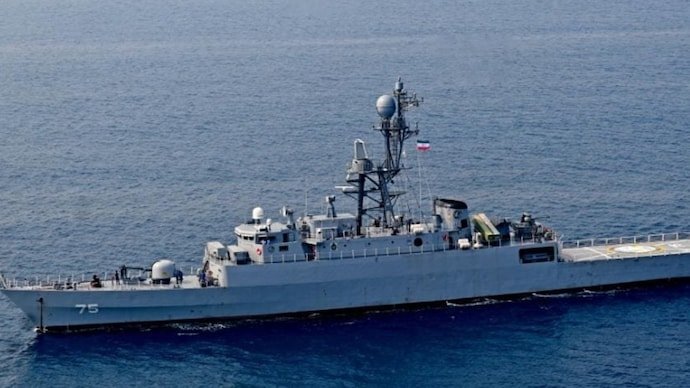
At least 80 people were killed after a United States submarine struck and sank an Iranian naval vessel in the Indian Ocean, off the southern coast of Sri Lanka, according to Sri Lankan officials. The incident has significantly escalated tensions in an already volatile geopolitical environment.
US Defence Secretary Pete Hegseth confirmed on Wednesday that an American submarine carried out the strike on the Iranian warship near Sri Lanka. The vessel has been identified as IRIS Dena, a Moudge-class frigate of the Iranian Navy.
About 180 Personnel Were On Board
Sri Lanka’s Foreign Minister Vijitha Herath informed Parliament that approximately 180 individuals were on board the Iranian vessel at the time of the sinking. The ship reportedly went down about 40 nautical miles off Sri Lanka’s coast after issuing a distress call.
Deputy Foreign Ministry officials stated on local television that at least 80 people were confirmed dead, while more than 100 were initially reported missing.
| Incident Detail | Information |
|---|---|
| Vessel Name | IRIS Dena (Moudge-class frigate) |
| Location | 40 nautical miles off southern Sri Lanka |
| Total Personnel Onboard | Approx. 180 |
| Confirmed Deaths | At least 80 |
| Rescued | 32 (initial reports) |
| Cause Confirmed By | US Defence Secretary Pete Hegseth |
US Confirms Submarine Strike
Hours after Sri Lankan authorities acknowledged that an Iranian military vessel had sunk in international waters, Pete Hegseth stated publicly, “A US submarine sank an Iranian warship off the southern coast of Sri Lanka.”
He clarified that the strike was conducted by a US military submarine but did not immediately provide further operational details.
Prior to this confirmation, Sri Lankan defence sources had suggested that the ship may have been attacked by a submarine, though it was unclear who was responsible.
Ship Was Returning From India Naval Exercise
The Iranian frigate had recently participated in the International Fleet Review 2026 in India before beginning its return journey. According to official exercise records, the vessel also took part in a multinational naval drill held in the Bay of Bengal from February 18 to February 25.
Two weeks before the incident, IRIS Dena had made a port call at Visakhapatnam, where it was welcomed by India’s Eastern Naval Command.
In a post on X, the command had written: “Indian Navy welcomes IRIS Dena of the Iranian Navy on her arrival at Visakhapatnam to participate in IFR2026_India and MILAN2026, reflecting long-standing cultural links between the two nations.”
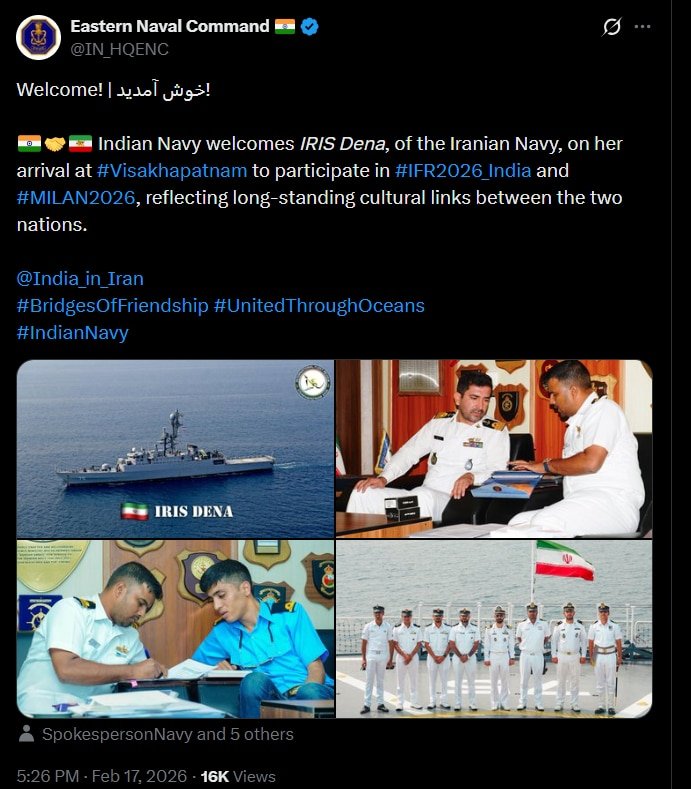
The timing of the sinking — shortly after its participation in Indian naval exercises — has added another layer of complexity to the situation.
Rescue Operations Underway
Sri Lankan authorities launched an extensive search-and-rescue operation after receiving the distress signal from the Iranian vessel.
Commander Buddhika Sampath, spokesperson for the Sri Lankan Navy, confirmed that multiple bodies had been recovered from the sea and that 32 survivors were rescued. The injured were being treated at a state-run hospital in the southern coastal city of Galle.
“We are hopeful we can rescue more people and will continue operations until we are sure,” Sampath said, adding that officials could not immediately confirm the final death toll.
Rescue teams reported seeing an oil slick at the site of the sinking but no visible remains of the ship. The Sri Lanka Navy and Air Force coordinated aerial and maritime search efforts in the area.
Authorities stated that no other ships or aircraft were observed in the vicinity at the time of the distress call.
Earlier Uncertainty Over Cause
Before Hegseth’s confirmation, Sri Lankan naval and defence ministry sources had cautioned against speculation. A navy spokesperson had earlier rejected unverified reports about the cause of the sinking, emphasizing that the priority was saving lives.
“Focusing on saving lives on the ship, afterwards we can conduct investigations into other details,” the spokesperson had said.
The official confirmation by the US defence chief that an American submarine carried out the strike marks a significant escalation. The episode had initially raised questions about whether the sinking resulted from an attack, a technical malfunction, or another maritime incident.
Geopolitical Implications
The sinking of an Iranian warship by a US submarine near Sri Lanka could have far-reaching diplomatic and military consequences. The Indian Ocean is a strategically sensitive region, with multiple naval powers maintaining active presence.
The fact that the vessel was returning from an international naval event further underscores the delicate geopolitical balance in the region.
As rescue operations continue and more details emerge, the incident is expected to draw international scrutiny and intensify diplomatic exchanges between the United States, Iran, and regional stakeholders.
For breaking news and live news updates, like us on Facebook or follow us on Twitter and Instagram. Read more on Latest World on thefoxdaily.com.





COMMENTS 0