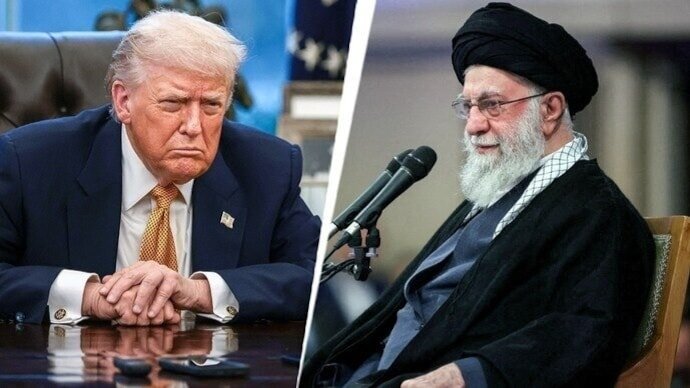
Washington is attempting to carefully balance pressure and persuasion as the US Navy’s Abraham Lincoln Carrier Strike Group (CSG-3) continues its deployment in the Arabian Sea, underscoring the fragile security environment ahead of renewed diplomatic engagement with Iran.
The White House has reiterated that President Donald Trump remains committed to a diplomatic solution but is prepared to exercise military options if negotiations with Tehran fail to deliver tangible outcomes. The talks, scheduled to take place in Muscat, Oman, are being closely watched by allies and adversaries alike.
Speaking on Thursday, White House Press Secretary Karoline Leavitt emphasised that diplomacy remains the administration’s preferred course of action. She reiterated President Trump’s long-standing position that Iran must have “zero nuclear capability” and said the upcoming meeting would test whether Tehran is serious about reaching an agreement.
Leavitt cautioned, however, that if diplomacy fails, the president retains “many options” as commander-in-chief, signalling that Washington’s military posture in the region remains an integral part of its negotiating strategy.
During the press briefing, Leavitt made it clear that the White House views the Iranian leadership with deep scepticism, noting that the administration expects concrete commitments rather than rhetorical assurances from Tehran.
The US Central Command (CENTCOM) confirmed that the flagship of Carrier Strike Group 3, the Nimitz-class nuclear-powered aircraft carrier USS Abraham Lincoln (CVN-72), has been conducting routine flight operations as part of its scheduled deployment.
Tensions rose sharply earlier this week after an Iranian drone was reported to have “aggressively approached” the carrier in the Arabian Sea, prompting US fighter jets to intercept and shoot it down. The incident has further heightened concerns about miscalculation in an already volatile region.
Sharp Differences Cast a Shadow Over Oman Talks
Despite persistent disagreements over the scope of negotiations, officials confirmed that the United States and Iran have agreed to proceed with talks in Oman on Friday. Washington is pushing for a broader framework that includes Iran’s missile programme, regional activities, and Human Rights record, while Tehran insists that discussions remain confined strictly to nuclear issues.
According to Iran’s Foreign Ministry, Foreign Minister Abbas Araqchi has departed for Muscat at the head of a senior diplomatic delegation to participate in the talks. Officials on both sides say preparations for the meeting are in their final stages.
US officials argue that any sustainable agreement must address Iran’s ballistic missile capabilities and its influence across the Middle East, including support for proxy groups. Tehran, however, has rejected these demands, calling them non-negotiable and beyond the scope of the nuclear file.
Iranian media reported that Araqchi is expected to meet senior US representatives, including Steve Witkoff, President Trump’s special envoy, during the Muscat discussions.
Military Signalling and Show of Force on Both Sides
On the eve of the negotiations, Iranian state media reported that Tehran conducted a test launch of a Khorramshahr-4 long-range ballistic missile toward an underground facility linked to the Islamic Revolutionary Guard Corps, a move widely interpreted as a calculated show of strength.
The United States has repeatedly urged Iran to drastically reduce the range and capabilities of its missile arsenal, arguing that such weapons pose a direct threat to regional stability and international security.
In parallel, Washington has reinforced its military footprint across the region, deploying additional troops, warships, aircraft carriers, and intelligence-gathering assets as part of what officials describe as a deterrence posture.
Global Concerns and Regional Diplomacy Intensify
As tensions rise, regional and global leaders have stepped up diplomatic efforts to prevent the situation from spiralling into open conflict. Turkish President Recep Tayyip Erdoğan said Ankara is actively working to ensure that the standoff does not escalate into war.
china has urged restraint and opposed the use of force, while German Chancellor Friedrich Merz expressed “great concern” during a visit to the Gulf, highlighting Europe’s unease over the deteriorating security situation.
Gulf Arab states remain particularly anxious that any military confrontation could trigger retaliatory Iranian strikes on US bases located within their borders, dragging the wider region into conflict.
President Trump has warned that Iran’s Supreme Leader Ayatollah Ali Khamenei should be “very worried,” cautioning that “bad things” would happen if diplomacy fails. US Secretary of State Marco Rubio has insisted that any future agreement must comprehensively address missiles, proxy networks, and domestic repression.
Iran, for its part, continues to maintain that its nuclear programme is entirely peaceful – a claim that remains deeply contested by the United States and its allies, including Israel.
For breaking news and live news updates, like us on Facebook or follow us on Twitter and Instagram. Read more on Latest World on thefoxdaily.com.




COMMENTS 0