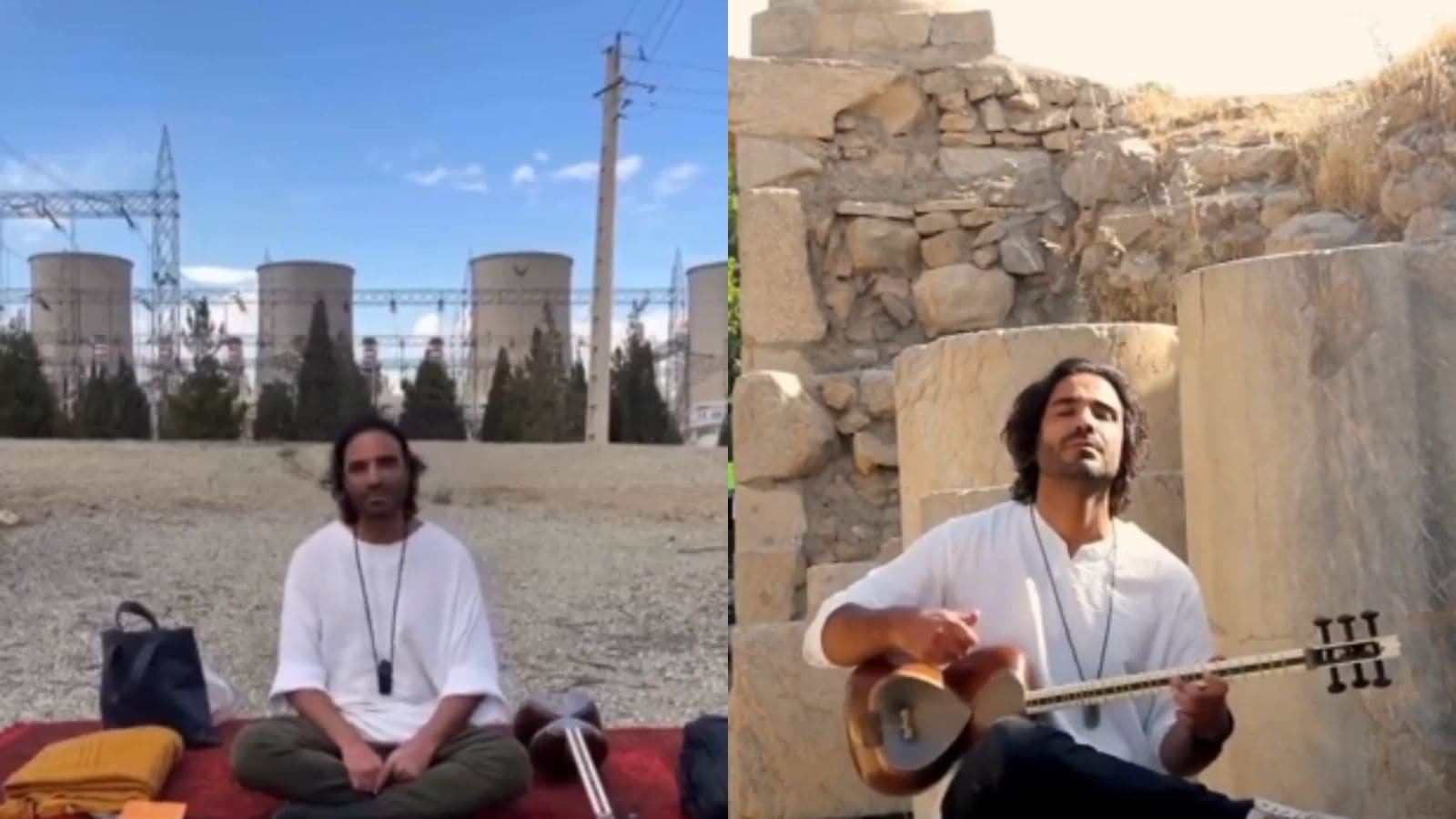
Iranian musician Ali Ghamsari, a renowned composer and master of the traditional Persian instrument
Ali Ghamsari’s Musical Protest at a Strategic Location
Ali Ghamsari is widely respected in Iran and internationally for his contributions to Persian classical music. Known for blending traditional compositions with contemporary expression, Ghamsari chose an unconventional stage for his latest performance-the grounds of the Damavand Power Plant, one of Iran’s most critical energy facilities.
Seated on a traditional mat and holding his tar, Ghamsari performed a calm and emotional recital against a backdrop of industrial infrastructure. The contrast was striking: centuries-old musical heritage meeting modern geopolitical tension.
The Damavand Power Plant is not just any facility. It plays a vital role in supplying electricity, reportedly providing a significant portion of power to Tehran, Iran’s capital. By selecting this location, Ghamsari’s performance carried a deeper message-highlighting the potential human cost of targeting essential infrastructure.
Why the Damavand Power Plant Matters
Energy infrastructure is often considered a high-value target during conflicts. However, such facilities are also lifelines for civilians, supporting hospitals, homes, and essential services. Ghamsari’s decision to perform at this site underscores the broader implications of military action.
- Electricity supply: Supports millions of residents in Tehran
- Economic importance: Critical for industrial and commercial operations
- Human impact: Power disruptions can affect healthcare, communication, and daily life
By placing himself at the site, Ghamsari symbolically positioned art as a shield-an attempt, however modest, to humanize the consequences of conflict.
A Message of Peace Through Music
In the widely circulated video, Ghamsari addressed viewers directly. His tone was calm, reflective, and deeply human. He acknowledged the gravity of the situation while expressing hope that his music could serve as a force for peace.
“Hello my dear friends. I am currently at the Damavand Power Plant. I can’t say I wish you were here with me, since this is the site that has been threatened with attack. I hope the sound of my tar can have an impact on peace and help keep the lights in homes from going out.”
His words resonated with audiences online, where the video quickly gained traction. In an era dominated by political rhetoric and military posturing, Ghamsari’s approach stood out for its simplicity and sincerity.
Iranian musician Ali Ghamsari, a composer and Tar player, announced that starting today, he will stay at Damavand power plant responsible for providing half of Tehran’s electricity with his instrument for some time, creating music to help prevent attacks on Iran’s infrastructure. pic.twitter.com/DxzOkbofqj
— Iran Embassy in Australia (@IraninAustralia) April 7, 2026
The Role of Art in Times of Conflict
Throughout History, artists have often responded to war and political tension with acts of expression aimed at unity and reflection. Ghamsari’s performance fits into this broader tradition.
- Art as protest: Non-violent expression of dissent or concern
- Art as diplomacy: Encouraging dialogue and understanding
- Art as documentation: Capturing emotional realities of conflict
While it is unlikely that a single performance can alter geopolitical decisions, such acts can influence public perception and remind audiences of the human stakes involved.
Trump’s Warning and Escalating Tensions
The backdrop to Ghamsari’s performance is a sharp escalation in rhetoric from Donald Trump. In a statement posted online, Trump warned of severe consequences if Iran failed to meet a deadline tied to a proposed agreement.
The warning included references to potential strikes on energy infrastructure, as well as dramatic language suggesting catastrophic outcomes. The deadline-set for early morning hours in India Standard Time-added urgency to an already tense situation.
Key Elements of the Warning
| Aspect | Details |
|---|---|
| Target | Iran’s energy and power infrastructure |
| Deadline | Early morning IST on April 8, 2026 |
| Condition | Acceptance of US-backed ceasefire proposal |
| Additional Demand | Reopening of the Strait of Hormuz |
| Tone | Strong, urgent, and highly escalatory |
Such statements have raised concerns among analysts and observers, particularly regarding the potential humanitarian and economic consequences of targeting infrastructure.
Global Reactions and Online Response
The video of Ghamsari’s performance quickly spread across Social Media platforms, amplified by official channels and public users alike. Many viewers praised the musician’s courage and creativity, while others saw the act as a poignant reminder of the human cost of geopolitical conflict.
Online reactions ranged from admiration to skepticism. Some users described the performance as “powerful” and “deeply moving,” while others questioned whether symbolic gestures could influence real-world decisions.
Why the Video Went Viral
- Visual contrast: Traditional music against an industrial backdrop
- Timeliness: Direct response to a high-profile political threat
- Emotional appeal: A message centered on peace and humanity
- Accessibility: Easily shareable short video format
In today’s digital landscape, such moments can quickly transcend borders, reaching global audiences within hours.
Broader Implications: Infrastructure, Conflict, and Civilians
The situation highlights a critical issue in modern conflict: the vulnerability of civilian infrastructure. Power plants, water systems, and communication networks are often deeply intertwined with everyday life, making their targeting particularly controversial.
Experts often warn that attacks on such facilities can have cascading effects, including:
- Disruption of healthcare services
- Economic instability
- Humanitarian crises
- Long-term recovery challenges
Ghamsari’s performance, while artistic in nature, indirectly brings attention to these concerns. By choosing a power plant as his stage, he draws a line between abstract political decisions and tangible human consequences.
The Symbolism of the Tar Instrument
The tar, a long-necked string instrument central to Persian classical music, carries deep cultural significance. Its sound is often associated with introspection, storytelling, and emotional expression.
In this context, the instrument becomes more than a musical tool-it becomes a symbol. Ghamsari’s use of the tar reinforces the cultural dimension of his message, connecting centuries-old traditions with present-day challenges.
Cultural Significance of the Tar
- Historical roots: Integral to Persian musical heritage
- Emotional range: Capable of conveying complex feelings
- Symbol of identity: Represents cultural continuity
By bringing this instrument to a modern industrial site, Ghamsari effectively bridges past and present, Culture and conflict.
Conclusion: A Quiet Act Amid Loud Tensions
Ali Ghamsari’s performance at the Damavand Power Plant stands as a quiet yet powerful response to a moment of heightened geopolitical tension. While political leaders exchange warnings and deadlines, his music offers a different perspective-one rooted in humanity, culture, and hope.
The situation remains fluid, with significant uncertainty surrounding potential outcomes. However, Ghamsari’s act serves as a reminder that even in times of crisis, individuals can find creative ways to advocate for peace.
Looking ahead, the intersection of art and geopolitics is likely to remain relevant. As global audiences continue to engage with such moments online, the power of symbolic actions-especially those grounded in authenticity-may play an increasingly important role in shaping public discourse.
In a world often dominated by noise, sometimes it is a simple melody that captures attention-and perhaps, just perhaps, inspires reflection.
For breaking news and live news updates, like us on Facebook or follow us on Twitter and Instagram. Read more on Latest World on thefoxdaily.com.




COMMENTS 0