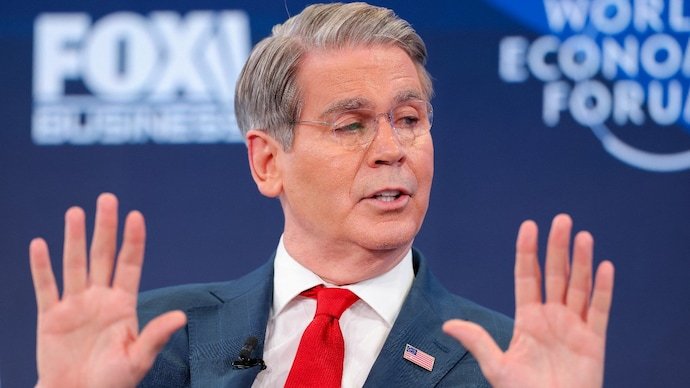
US Treasury Secretary Scott Bessent has accused European nations of indirectly financing the Russia–Ukraine war, even as they publicly distance themselves from Moscow, by continuing to purchase oil products refined in India using Russian crude.
Speaking amid heightened transatlantic trade tensions, Bessent argued that although Europe has sharply reduced its direct energy imports from Russia, money continues to flow to Moscow through indirect channels. His remarks come despite the United States maintaining sanctions on India over its purchases of Russian oil.
Bessent’s comments arrive at a sensitive moment, as India and the European Union are set to formally announce the conclusion of negotiations on a long-awaited comprehensive free trade agreement (FTA) at a high-level summit scheduled for Tuesday.
In an interview with ABC news on Sunday, Bessent defended the Trump administration’s decision to impose steep tariffs on Indian goods, contending that European governments are weakening their own security posture through continued energy-linked trade.
“We’ve imposed a 25 per cent tax on India’s purchases of Russian oil. And what happened just last week? Europeans signed a commercial agreement with India,” Bessent said.
Elaborating further, he added, “Russian oil goes into India, gets refined, and then gets sold to Europeans. In effect, they are funding the war against themselves.”
Bessent framed the issue as a stark imbalance in the sacrifices made by the United States compared to its allies. He maintained that while Washington has absorbed significant political and economic costs by enforcing sanctions and pushing for energy decoupling from Moscow, Europe continues to benefit economically from loopholes in global oil trade.
He also asserted that the US has borne a disproportionate share of the burden arising from the Russia–Ukraine conflict and reiterated that President Donald Trump has actively sought a negotiated settlement to end the war.
“Under President Trump’s leadership, we will eventually end this war,” Bessent said.
The remarks highlight how trade, energy security, and sanctions enforcement have once again become central points of friction between Washington and its European partners, with the US expressing frustration over what it views as Europe’s selective approach to economic restrictions on Russia.
India–EU Free Trade Agreement Nears Completion
The forthcoming India–EU free trade agreement, negotiations for which began in 2007, is widely seen as a cornerstone of a broader economic and strategic partnership between New Delhi and Brussels amid shifting global trade dynamics.
Officials familiar with the deal say the agreement is likely to grant duty-free or preferential access to a wide range of Indian exports, particularly in labour-intensive sectors such as textiles, chemicals, gems and jewellery, electrical machinery, leather goods, automobiles, and footwear.
Tariffs, Signals, and Possible Relief Ahead
The Trump administration has imposed tariffs of up to 50 per cent on certain Indian goods, including a 25 per cent levy directly linked to India’s purchases of Russian oil. Trade tensions between Washington and New Delhi escalated further when these sanctions were doubled in August.
However, Bessent has recently signalled that tariff relief may be possible. Speaking on the sidelines of the World Economic Forum, he told Politico that Indian refiners had significantly reduced their purchases of Russian crude.
“India’s refineries have stopped buying Russian oil. That’s a success. The 25 per cent tariffs tied to Russian oil are still in place, but I would imagine there is a path to removing them,” Bessent said.
Data cited by Reuters supports this claim, showing that India’s imports of Russian oil fell to their lowest level in two years, while the share of crude sourced from OPEC producers rose to an 11-month high in December.
For breaking news and live news updates, like us on Facebook or follow us on Twitter and Instagram. Read more on Latest World on thefoxdaily.com.




COMMENTS 0