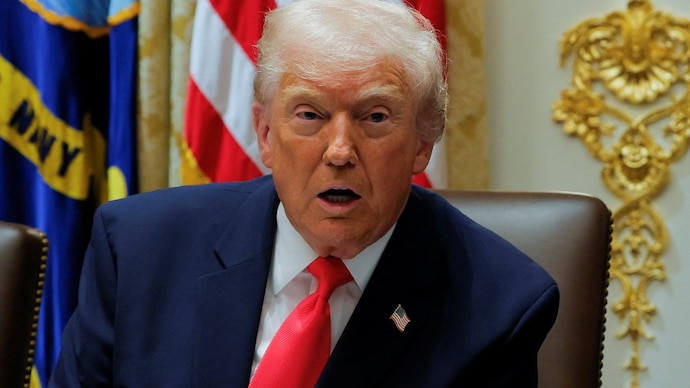
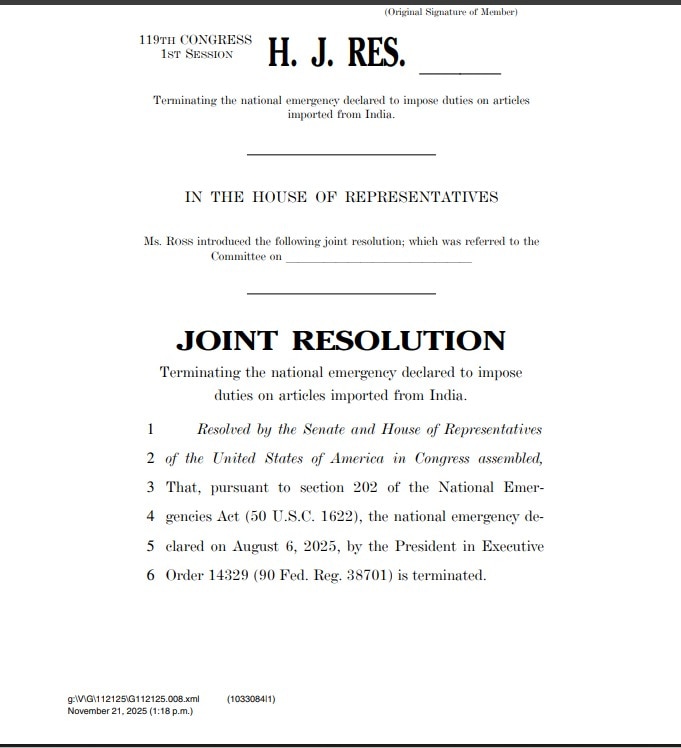
A fresh political challenge has emerged in Washington against former President Donald Trump’s tariff regime targeting India, with three US lawmakers introducing a resolution to revoke the national emergency declaration that enabled import duties to surge as high as 50%.
The lawmakers argue that the tariffs are not only legally questionable but have also failed to achieve their intended objectives, instead placing a disproportionate burden on American households, businesses, and supply chains already grappling with inflationary pressures.
Representatives Raja Krishnamoorthi, Marc Veasey, and Deborah Ross formally introduced the resolution on Friday, aiming to roll back the emergency powers invoked under the International Emergency Economic Powers Act (IEEPA). The move specifically targets the additional 25% “secondary tariffs” imposed on August 27, 2025, which were layered on top of earlier reciprocal duties.
Together, these measures significantly escalated the cost of importing a wide range of Indian-origin goods, contributing to higher retail prices across several sectors of the US economy.
The lawmakers noted that the tariffs, implemented under the authority of the IEEPA, resulted in sharp price increases for essential and consumer goods alike, with little evidence of corresponding economic or strategic benefit.
TARIFFS DESCRIBED AS A TAX ON EVERYDAY AMERICANS
Representative Deborah Ross warned that communities in her home state were already feeling the economic strain caused by the tariffs. Highlighting North Carolina’s strong commercial and cultural ties with India, she emphasized that bilateral trade supports thousands of jobs and billions of dollars in investment.
“North Carolina’s economy is deeply connected to India through trade, investment, and a vibrant Indian American community,” Ross said. “These tariffs risk undermining a critical economic partnership while increasing costs for local businesses and consumers.”
Representative Marc Veasey echoed those concerns, arguing that the tariffs effectively function as a hidden tax on households. “India is a vital cultural, economic, and strategic partner,” he said. “These illegal tariffs are a tax on everyday North Texans who are already struggling with rising living costs.”
Krishnamoorthi reinforced the criticism, describing the tariff policy as damaging to American jobs and manufacturing supply chains. He argued that reversing the measures would strengthen both economic cooperation and broader security ties between the United States and India.
“Rather than advancing American interests or National Security, these tariffs disrupt supply chains, hurt American workers, and push prices higher for consumers,” he said, adding that restoring normal trade relations would benefit both nations.
PUSHBACK AGAINST EXPANDED EMERGENCY POWERS
The House resolution follows a bipartisan effort in the US Senate to curb the President’s use of emergency powers to impose sweeping trade restrictions — a strategy Trump increasingly relied upon during trade disputes with multiple countries.
According to the lawmakers, the resolution is intended not only to repair relations with India — a key strategic ally in the Indo-Pacific — but also to reaffirm congress’s constitutional authority over trade policy.
“Ending Trump’s India tariffs is part of a broader effort by congressional Democrats to reclaim Congress’s role in trade policy and prevent the misuse of emergency powers to impose unilateral and misguided economic measures,” the lawmakers said in a joint statement.
The dispute dates back to August 1, when Trump imposed an initial 25% tariff on Indian imports, citing national security concerns. The duty was doubled days later, with the former president arguing that India’s continued purchases of Russian Oil were indirectly funding Moscow’s war in Ukraine.
Critics, however, contend that the escalation hurt American consumers far more than it altered India’s energy policy, while simultaneously straining one of Washington’s most important strategic partnerships.
For breaking news and live news updates, like us on Facebook or follow us on Twitter and Instagram. Read more on Latest World on thefoxdaily.com.






COMMENTS 0