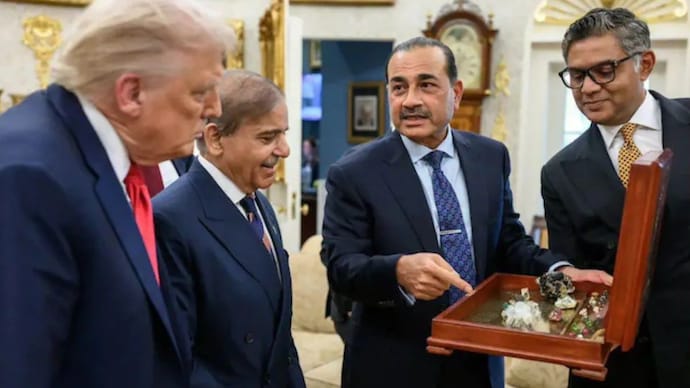
Pakistan’s most powerful military chief in decades is confronting the toughest challenge of his newly consolidated authority as the United States pushes Islamabad to contribute troops to a proposed Gaza stabilisation force. Field Marshal Asim Munir, Pakistan’s current chief of defence forces, is expected to travel to Washington in the coming weeks to meet US President Donald Trump, in what would be their third meeting in just six months.
According to two sources cited by Reuters, one closely involved in Pakistan’s military-led economic diplomacy, the Gaza stabilisation mission is expected to dominate discussions during the high-level talks. The proposal has raised alarms among analysts who warn that any Pakistani military deployment to Gaza could provoke unrest at home.
President Trump’s ambitious 20-point Gaza plan envisions a multinational force drawn largely from Muslim-majority countries to oversee a transition phase focused on reconstruction and economic recovery in the war-ravaged Palestinian territory. Gaza has been devastated by more than two years of relentless Israeli military operations.
However, the plan includes the sensitive objective of demilitarising Hamas, the Islamist group that controls Gaza. This aspect has deeply unsettled several potential contributors, who fear being dragged into an active conflict while facing outrage from pro-Palestinian and anti-Israel populations back home.
Asim Munir’s Growing Ties with Donald Trump
In a dramatic shift aimed at repairing years of strained ties between Washington and Islamabad, Asim Munir has cultivated a close personal relationship with President Trump. The bond was underscored in June when Munir was invited to a private lunch at the White House—marking the first time a US president met Pakistan’s army chief without civilian leaders present.
“Trump might be disappointed if the Pakistanis refused to participate in this expedition,” said Michael Kugelman, Senior Fellow for South Asia at the Atlantic Council. “And that could be a problem for Pakistan, because it’s very clear that Asim Munir—and broadly both the civilian and military leadership—are eager for the US to invest in Pakistan and restore security assistance, much of which has been frozen for years.”
Pakistan, the only Muslim-majority country with nuclear weapons, maintains one of the region’s largest and most battle-hardened militaries. It has fought three wars with arch-rival India, experienced a brief border skirmish this summer, and continues to battle insurgencies in its remote regions.
In addition, Pakistan’s forces are currently engaged in an intense counterinsurgency campaign against Islamist militants, which Islamabad claims are operating from bases across the Afghan border.
According to defence analyst and author Ayesha Siddiqa, Trump is particularly drawn to Pakistan’s military capabilities.
“Trump is happy with this engagement because he looks at Pakistan’s military strength and institutional capacity, and knows they can fight,” she said.
Neither Pakistan’s foreign office nor its military responded to Reuters’ requests for comment. The White House also did not issue an immediate response.
Pakistan’s Foreign Minister Ishaq Dar indicated last month that while Islamabad may consider contributing troops for peacekeeping duties, the disarmament of Hamas “is not our job,” signaling internal caution.
Unprecedented Power Concentrated in One Man
Asim Munir’s authority has expanded dramatically in recent months. He was appointed Chief of Defence Forces with a term extension running until 2030, granting him oversight of not just the army but also the air force and navy.
Recent constitutional amendments pushed through parliament by Pakistan’s civilian government have further bolstered his position, granting him lifetime immunity from criminal prosecution in addition to the ceremonial rank of field marshal.
“We’ve seen what I would argue are unprecedented constitutional changes that have resulted in what could best be described as the unbridled power of Asim Munir,” Kugelman noted.
In recent weeks, Munir has embarked on an intense diplomatic tour, holding meetings with military and civilian leaders in Indonesia, Malaysia, Saudi Arabia, Turkey, Jordan, Egypt, Azerbaijan, and Qatar. According to Siddiqa, these engagements appear closely linked to negotiations surrounding the Gaza stabilisation force.
Why Gaza Deployment Is Risky for Pakistan
| Issue | Why It Matters for Pakistan |
|---|---|
| Domestic Islamist Opposition | Strong anti-US and anti-Israel sentiment could spark mass protests |
| Hamas Demilitarisation | Risk of being drawn directly into active conflict |
| Political Instability | Opposition parties could exploit troop deployment decision |
| US Expectations | Refusal could strain improving ties with Washington |
Mounting Concerns at Home
The biggest concern within Pakistan is the likely reaction from Islamist groups that are fiercely opposed to both the United States and Israel. Analysts warn that any involvement in Gaza under a US-backed plan could reignite large-scale street protests.
Islamist groups in Pakistan possess significant mobilising power, capable of drawing thousands of supporters onto the streets. In October, the government banned a militant anti-Israel Islamist organisation known for defending Pakistan’s harsh blasphemy laws.
Authorities arrested the group’s leaders, detained more than 1,500 supporters, and seized its assets and bank accounts as part of an ongoing crackdown. Yet officials acknowledge that the group’s ideology remains deeply rooted.
Munir also faces pressure from the political movement led by former Prime Minister Imran Khan. Despite Khan’s imprisonment, his supporters emerged as the single largest bloc in Pakistan’s 2024 national elections and continue to command widespread public sympathy.
“There is a real risk of religious hardliners reacting negatively,” Kugelman warned. “That could lead to violence, which is not something the military would want to see.”
As Washington pushes harder and domestic risks mount, the Gaza question is shaping up to be the most consequential decision of Asim Munir’s career—one that could redefine Pakistan’s regional role and test the limits of his unprecedented power.
For breaking news and live news updates, like us on Facebook or follow us on Twitter and Instagram. Read more on Latest World on thefoxdaily.com.






COMMENTS 0