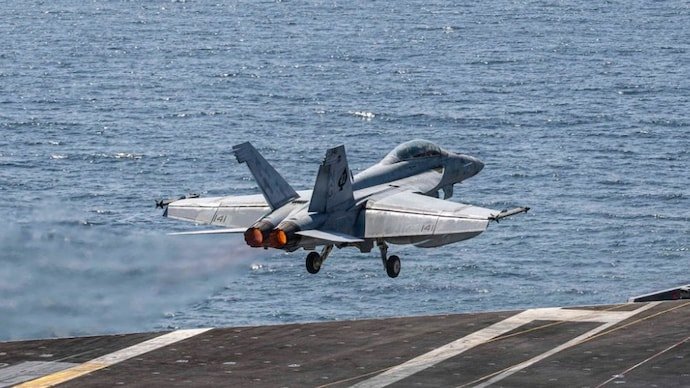
The United States launched a massive and technologically sophisticated military assault on Iran on February 28, deploying some of its most advanced air, naval, missile, and surveillance systems within just 24 hours. The coordinated operation, known as Operation Epic Fury, targeted Iran’s top leadership and key military infrastructure.
According to the US military and US Central Command (CENTCOM), the assault prioritized sites considered an “imminent threat,” striking command centers, ballistic missile facilities, naval assets, and air defense networks across the country.
The strikes reportedly killed Iran’s Supreme Leader, Ayatollah Ali Khamenei, along with several senior military officials, marking one of the most dramatic escalations in US-Iran Relations in recent history.
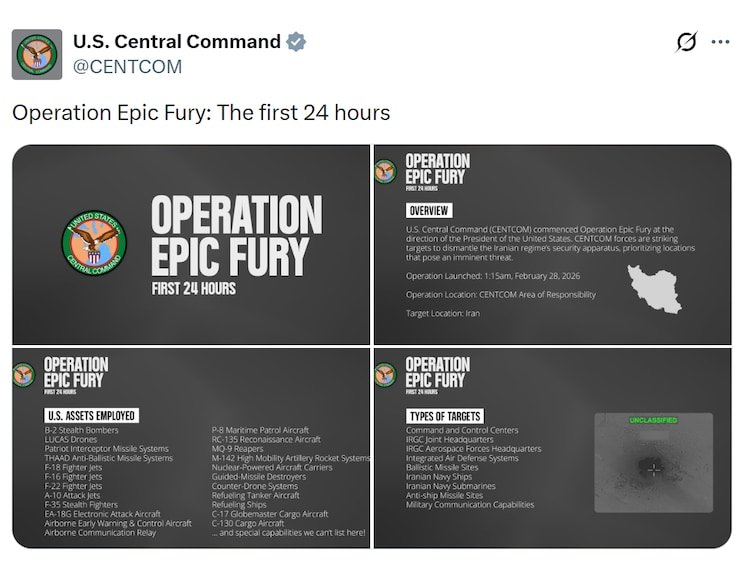
US Military Assets Used in the First 24 Hours
The scale of the deployment highlights the Pentagon’s rapid-response capability and overwhelming firepower. Below is a detailed breakdown of the assets used during the initial phase of the operation:
| Category | Assets Deployed | Primary Role |
|---|---|---|
| Strategic Bombers | B-2 Stealth Bombers | Deep-penetration strikes on hardened missile facilities |
| Stealth Fighters | F-35, F-22 | Air superiority & precision strike missions |
| Multirole Fighters | F-16, F-18 | Air-to-air and air-to-ground combat |
| Attack Aircraft | A-10 Thunderbolt II | Close air support |
| Electronic Warfare | EA-18G Growler | Radar jamming & electronic attacks |
| Missile Defense | Patriot Systems, THAAD | Intercepting ballistic missile threats |
| Unmanned Systems | MQ-9 Reapers, LUCAS Drones | Surveillance & targeted strikes |
| Naval Power | Nuclear-powered aircraft carriers, Guided-missile destroyers | Sea-based strike capability |
| Artillery | M-142 HIMARS | Precision long-range rocket strikes |
| Recon & Surveillance | RC-135, P-8, Airborne Early Warning Aircraft | Intelligence gathering & targeting |
| Logistics | C-17, C-130, Refueling tankers & ships | Troop movement & sustained operations |
B-2 Stealth Bombers Lead the Assault
At the heart of the operation were B-2 Spirit stealth bombers, capable of penetrating heavily defended airspace. Armed with 2,000-pound bunker-buster bombs, the aircraft reportedly struck Iran’s hardened ballistic missile installations.
According to US officials, the long-range bombers flew directly from the United States to Iranian airspace, demonstrating the aircraft’s global strike capability. The B-2 is specifically designed to evade radar detection and deliver massive ordnance against deeply buried targets.
US Central Command confirmed the use of these strategic bombers in social media statements, emphasizing America’s “determination” and readiness.
F-35 and Fifth-Generation Fighters in Action
The United States also deployed F-35 stealth fighters and F-22 Raptors to establish air superiority over Iranian airspace. These fifth-generation aircraft are equipped with advanced radar systems, stealth capabilities, and precision-guided munitions.
Supporting them were F-16 and F-18 multirole fighters, along with EA-18G electronic attack aircraft tasked with disabling enemy radar and communications.
This layered air strategy ensured control of the skies while enabling precision strikes against strategic military targets.
Nuclear-Powered Aircraft Carriers and Naval Dominance
The naval component of the operation featured nuclear-powered aircraft carriers and guided-missile destroyers positioned in the region. These floating airbases allowed the US to sustain round-the-clock strike missions while maintaining flexibility and rapid response capability.
Naval forces reportedly destroyed Iranian ships, submarines, and anti-ship missile installations within minutes, severely weakening Iran’s maritime defense posture.
Targets Struck Across Iran
According to CENTCOM, the following strategic locations were hit during the operation:
- Iranian Armed Forces command and control centers
- Islamic Revolutionary Guard Corps (IRGC) Joint Headquarters
- IRGC Aerospace Forces facilities
- Integrated air defense systems
- Ballistic missile launch sites
- Naval ships and submarines
- Anti-ship missile installations
- Military communication networks
Smoke plumes were reported over Tehran and other cities as explosions shook multiple regions. Iranian authorities stated that more than 200 people have died since the start of the strikes.
Iran’s Response and Regional Escalation
Iran retaliated by launching drones and missiles targeting US military bases in the Gulf region, as well as sites in Israel, Riyadh, and Dubai. The counterstrikes raised concerns about broader regional instability and the possibility of further escalation.
Following the reported death of Ayatollah Ali Khamenei, cleric Ayatollah Alireza Arafi was nominated to a three-member leadership council that will oversee governance until a new supreme leader is chosen.
A senior White House official indicated that “new potential leadership” in Iran has signaled openness to diplomatic discussions. However, President Donald Trump has made it clear that for now, the military operation “continues unabated.”
What Comes Next?
With B-2 bombers, F-35 fighters, nuclear-powered carriers, missile defense systems, and unmanned strike drones deployed in rapid succession, the first 24 hours of Operation Epic Fury demonstrated the full spectrum of US military capability.
As tensions escalate and both sides exchange strikes, global leaders are closely monitoring the situation, wary of a broader regional war that could reshape Middle Eastern Geopolitics.
For breaking news and live news updates, like us on Facebook or follow us on Twitter and Instagram. Read more on Latest World on thefoxdaily.com.




COMMENTS 0