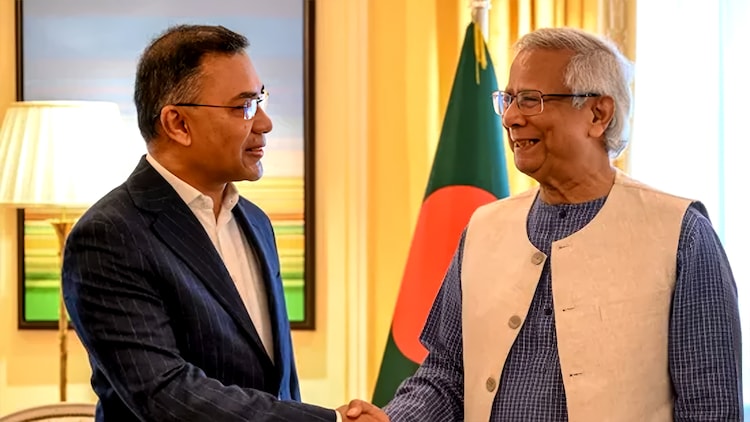
For 17 long years, Tarique Rahman’s face loomed large on Bangladesh Nationalist Party (BNP) posters across Dhaka and other cities, yet his voice remained absent from the country’s political discourse. That silence finally broke this week when Rahman landed in the capital, ending almost 20 years of exile in London. His return marks a defining political moment for a violence-scarred Bangladesh, a resurgent BNP, and an electorate preparing for a high-stakes general election scheduled for February—an election closely watched in New Delhi for its regional security ramifications.
Rahman’s homecoming assumes even greater importance for India because of the current political vacuum in Dhaka. Former Prime Minister Khaleda Zia is hospitalised and unable to actively campaign, while the traditionally pro-India Awami League has been barred from contesting the polls. Under interim leader Muhammad Yunus, Bangladesh has witnessed a worrying rise in hardline Islamist forces, many of which have openly amplified anti-India rhetoric. At a critical juncture for bilateral relations, these developments have raised alarm bells in New Delhi.
Particularly concerning for India is the resurgence of Jamaat-e-Islami, widely viewed by Indian security agencies as ideologically aligned with Pakistan’s Inter-Services Intelligence (ISI). The Islamist party, which had been banned during Sheikh Hasina’s tenure, has gradually re-entered mainstream politics following her ouster last year. Its revival signals a potential shift in Bangladesh’s political trajectory—one that could undermine India’s strategic interests in the eastern subcontinent.
Adding to India’s concerns, recent opinion surveys indicate that Jamaat-e-Islami is rapidly closing the gap with the BNP, which is still projected to emerge as the single-largest party in the elections. The unexpected victory of Jamaat’s student wing in the Dhaka University elections has further rattled policymakers in New Delhi, who see university campuses as key indicators of ideological momentum among Bangladesh’s youth.
Why Tarique Rahman’s Return Is Seen as Positive for India
Despite a historically strained relationship between the BNP and India, New Delhi increasingly views the BNP as a comparatively liberal, democratic, and pragmatic option in the current political landscape. Indian strategists are cautiously optimistic that Tarique Rahman’s return could energise the BNP and enable it to form the next government, thereby preventing radical Islamist forces from dominating Bangladesh’s power structure.
Interestingly, the student-led National Citizen Party (NCP), another electoral contender, has accused the BNP of inducting members from the Awami League—suggesting that the BNP may be attempting to broaden its political base and project itself as a national alternative rather than a purely partisan force.
Under Sheikh Hasina, Bangladesh cultivated strong ties with India while maintaining a careful distance from china and virtually freezing relations with Pakistan. That balance has shifted dramatically under interim adviser Muhammad Yunus, who has pushed for warmer engagement with Islamabad—moves that have come at the cost of fraying ties with New Delhi.
Should the BNP return to power, India will be hoping for a recalibration of Bangladesh’s foreign policy. In recent months, there have been subtle but significant signals that both the BNP and the Indian establishment are attempting to repair long-damaged bridges.
A notable example of this thaw came on December 1, when Prime Minister Narendra Modi publicly expressed concern over Khaleda Zia’s deteriorating health and extended India’s support. The BNP responded with an unusually warm note of appreciation—an exchange widely seen as a rare moment of goodwill after years of mutual suspicion.
Rahman’s own scepticism toward the Yunus administration has further reassured Indian observers. He has openly questioned the interim government’s mandate to take long-term foreign policy decisions and has firmly rejected forming electoral alliances, particularly with Jamaat-e-Islami, which he has criticised in strong terms.
Earlier this year, Rahman—who has been living in London with his physician wife—unveiled a “Bangladesh First” foreign policy doctrine, echoing former US President Donald trump’s “America First” slogan. The policy underscored his intent to prioritise national interests over external pressures.
His oft-quoted line, “Not Dilli, not Pindi—Bangladesh before everything,” reflects a deliberate attempt to project strategic autonomy, signalling that the BNP would neither blindly align with India nor fall into Pakistan’s orbit. For New Delhi, this stance is preferable to an overtly Pakistan-leaning regime in Dhaka.

The Grand Homecoming of Tarique Rahman
Projecting himself and the BNP as defenders of democracy, Tarique Rahman made a carefully choreographed return to Dhaka. According to party estimates, nearly 50 lakh BNP workers and supporters joined a massive roadshow from the airport to his residence, turning the event into a show of organisational strength.
While BNP chairperson Khaleda Zia is expected to contest once again from her traditional stronghold of Bogura-7 (Gabtali–Shajahanpur), party sources indicate that Rahman may be fielded from Bogura-6 (Sadar), cementing his role as the party’s principal electoral face.
However, Rahman’s dramatic comeback has not been welcomed by all. Sources told India Today that radical groups are deeply unhappy with the BNP’s display of strength, raising the possibility of pre-election clashes between BNP supporters and Jamaat cadres.
Anticipating unrest, authorities enforced the highest level of security across Dhaka. Local media reported that over three lakh BNP supporters were ferried into the capital using nearly ten special trains. The party described the mobilisation as an “unprecedented gathering” in Bangladesh’s political history.
“This is a defining political moment for Bangladesh,” senior BNP leader Ruhul Kabir Rizvi told Reuters, echoing the sentiment within the party that Rahman’s return could reshape the country’s political future.
Tarique Rahman: A Profile of Bangladesh’s Most Controversial Leader
Tarique Rahman, the son of former Bangladeshi President Ziaur Rahman, has effectively led the BNP from exile since 2008. During Sheikh Hasina’s rule, he was convicted in multiple cases, which the BNP consistently described as politically motivated. He was arrested during the 2007 anti-corruption crackdown and reportedly suffered serious health issues while in detention.
Released the following year, Rahman was granted court permission to travel to London for medical treatment, where he has lived ever since. In his absence, he was also sentenced in the 2004 Dhaka grenade attack case, an incident that killed 24 people at an Awami League rally and narrowly missed killing Sheikh Hasina.
In 2008, the Dhaka Tribune published a series of investigative reports alleging widespread corruption during the BNP’s 2001–2006 tenure, branding Rahman the “dark prince” of Bangladeshi politics—a moniker that has followed him ever since.
However, over the past year, courts have overturned or dismissed all major cases against him, including the high-profile 2004 grenade attack verdict. These legal reversals have cleared the path for his political rehabilitation.
While Tarique Rahman’s presence is expected to galvanise the BNP, his challenges are far from over. He has so far managed to keep the party united after Hasina’s downfall, but the real test will be whether he can consolidate internal factions, appeal to a disillusioned younger generation, and steer Bangladesh away from violence and radicalisation.
For India, the stakes could not be higher. As Bangladesh stands at a political crossroads, New Delhi will be watching Tarique Rahman’s next moves with intense interest—aware that the outcome could redefine bilateral relations and regional stability for years to come.
For breaking news and live news updates, like us on Facebook or follow us on Twitter and Instagram. Read more on Latest World on thefoxdaily.com.






COMMENTS 0