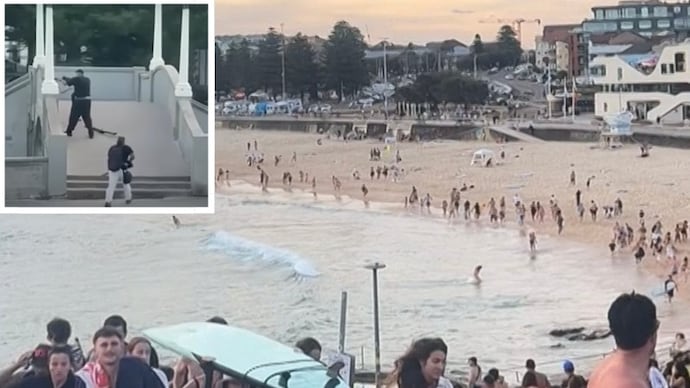
The deadly shooting at Bondi Beach in Sydney, which left 15 people dead and dozens injured during a Jewish Hanukkah gathering, has triggered intense scrutiny of Australia’s intelligence and law-enforcement systems. Authorities and critics alike say the attack revealed deep institutional gaps—from intelligence failures years earlier to a delayed police response during the assault.
The incident, now formally classified as a terrorist attack, involved a father-son pair. The father, Sajid Akram (50), was killed in a shootout with police, while his son, Naveed Akram (24), survived and remains hospitalized under police guard.
INTELLIGENCE WARNINGS AND THE 2019 CLEARANCE
Australian Prime Minister Anthony Albanese confirmed that Naveed Akram had come to the attention of the Australian Security Intelligence Organisation (ASIO) in October 2019.
“He was assessed on the basis of associations with others, and the assessment at that time was that there was no indication of any ongoing threat or of him engaging in violence,” Albanese said.
ASIO Director-General Mike Burgess later acknowledged that Akram had links to a Sydney-based Islamic State (IS) cell, which led to a six-month investigation. However, authorities ultimately discontinued surveillance, concluding he did not pose an immediate threat.
That decision has since come under sharp criticism, particularly after senior police officials confirmed that two IS flags were found in the attackers’ vehicle at Bondi Beach.
LICENSING AND OVERSIGHT QUESTIONS
Sajid Akram, the deceased attacker, held a firearms licence for nearly a decade and legally owned six guns. New South Wales Police Commissioner Mal Lanyon said the licence was issued and monitored according to existing regulations, with no prior red flags.
However, the discovery of extremist symbols and the scale of the attack have raised broader concerns about whether current background checks and monitoring systems are sufficient to detect radicalisation over time.
The Bondi shooting is the deadliest mass-casualty gun attack in Australia in three decades.
RISING ANTISEMITISM IN AUSTRALIA
The attack occurred against the backdrop of a sharp rise in antisemitic incidents across Australia since the outbreak of the Israel–Gaza conflict in October 2023.
According to a January 2025 report cited by CNN, Jewish communities in Sydney and Melbourne have been particularly affected, facing threats, vandalism, arson, graffiti, and violent attacks.
Since mid-December 2024, more than 166 antisemitic incidents have been recorded nationwide, including arson attacks on synagogues, Jewish-owned businesses, and community institutions.
Notable cases include the burning of the Adass Israel Synagogue in Melbourne and the torching of a kosher café near Bondi Beach. Jewish leaders in both cities have described an atmosphere of fear unprecedented in recent decades.
POLICE RESPONSE UNDER FIRE
Eyewitness accounts from Bondi Beach have further intensified controversy, with several witnesses alleging that police officers were slow to respond and appeared unprepared during the attack.
The shooting began shortly before 7 pm local time, with gunmen reportedly firing from an elevated position for nearly 20 minutes.
“Four police officers were present twenty minutes later. No one fired back. Nothing. It was as if they were frozen,” an eyewitness told local media.
Another witness, Grace Matthews, told the ABC that police appeared “very underprepared,” and claimed that a weapon had to be wrestled from a shooter by a civilian before the situation was brought under control.
The attack site was located less than a block from a police station, raising further questions about response times and operational readiness.
OFFICIAL RESPONSE AND CRITICISM
NSW Police Commissioner Mal Lanyon has defended the actions of officers on the ground, praising their bravery under extreme conditions.
However, critics argue that the prolonged rampage highlights shortcomings in active-shooter training, staffing levels, and protocols for responding to ideologically motivated violence.
International leaders condemned the attack. US President Donald Trump described it as “antisemitic,” while UK Prime Minister Keir Starmer called it “deeply distressing.”
Israeli Prime Minister Benjamin Netanyahu accused the Australian government of failing to adequately confront rising antisemitism, though Prime Minister Albanese has called for national unity and calm.
CALLS FOR REFORM
The Bondi Beach tragedy has renewed calls for comprehensive intelligence reform, stronger monitoring of extremist threats, and enhanced police training for mass-casualty and terror-style incidents.
Leaders of Australia’s Jewish community have demanded accountability and long-term measures to ensure their safety, warning that without systemic changes, such violence could recur.
As investigations continue, the attack stands as a stark reminder of the consequences of intelligence blind spots, delayed responses, and the growing challenge of domestic radicalisation.
For breaking news and live news updates, like us on Facebook or follow us on Twitter and Instagram. Read more on Latest World on thefoxdaily.com.



COMMENTS 0