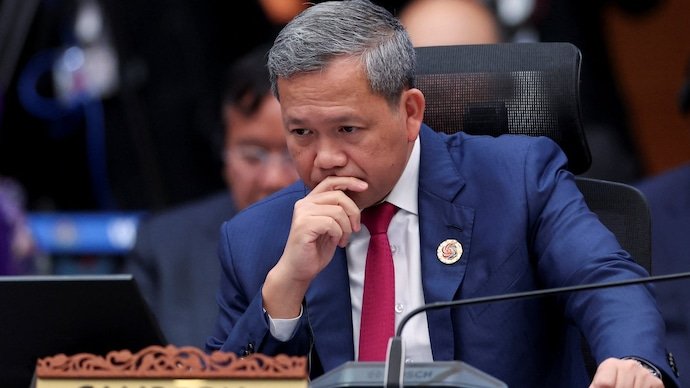
Cambodian Prime Minister has alleged that Thai forces are occupying parts of Cambodian territory months after a ceasefire agreement intended to ease border tensions. In an interview with Reuters, he called on Thailand to allow a joint boundary commission to begin formal demarcation work along the disputed frontier.
The remarks come despite a peace understanding brokered with the involvement of , who has publicly promoted the agreement as a diplomatic success. According to Hun Manet, the situation on the ground remains “fragile,” even though a ceasefire reached in late December halted fresh clashes.
Thailand, however, has rejected the accusation. Thai officials maintain that troop deployments are consistent with de-escalation arrangements and deny any occupation of Cambodian land.
Fragile Ceasefire and Disputed Border Claims
The long-standing border dispute reignited in July last year, marking the worst fighting between the two Southeast Asian neighbours in over a decade. The clashes displaced hundreds of thousands of civilians and disrupted trade across the 508-mile (817-km) shared boundary.
An October peace accord, signed with the participation of the United States and Malaysia’s prime minister, collapsed within weeks. A new ceasefire was eventually secured on December 27, bringing a halt to active hostilities but not resolving core territorial disagreements.
Hun Manet stated that Thai forces remain stationed at multiple sites “deep within Cambodian territory,” even beyond what he described as Thailand’s own unilaterally claimed border line. He further alleged that barbed wire and cargo containers have been placed in areas long acknowledged as Cambodian land, preventing villagers from returning home.
“This is not an accusation but a statement of the facts on the ground,” he said, adding that Cambodia cannot accept what he called a violation of its sovereignty and territorial integrity.
Thailand’s Defence Ministry spokesperson Rear Admiral Surasant Kongsiri responded that Bangkok is adhering to the joint statement committing both sides to preserve current troop deployments. He emphasized that no additional reinforcements have been sent and indicated that a Joint Boundary Commission (JBC) could convene once Thailand’s new government is formally in place.
Hun Manet urged Thailand to begin technical demarcation work as soon as possible, especially now that Thailand’s February 8 election has concluded. Thai Prime Minister Anutin Charnvirakul had campaigned amid rising nationalist sentiment following the border tensions.
“Now the election is done, we hope Thailand can at least begin on a technical level — start measuring, start demarcating in the hot zone — so that life can return to normal,” Hun Manet said.
US Engagement and the “Board of Peace”
During his visit to Washington, Hun Manet attended a meeting of President Trump’s Board of Peace, an initiative originally established to oversee a Gaza peace plan but potentially expanding into broader conflict mediation efforts.
The Cambodian leader expressed confidence that renewed US involvement could help stabilize the border situation. His visit also symbolized warming relations between Phnom Penh and Washington after years of diplomatic friction.
Hun Manet succeeded his father, in 2023 following elections in which the long-ruling Cambodian People’s Party faced limited opposition. A graduate of the United States Military Academy at West Point, Hun Manet’s leadership has coincided with efforts to rebalance Cambodia’s foreign policy.
Balancing US and China Ties
For years, Cambodia has drawn closer to china, particularly in infrastructure and defence cooperation. Addressing concerns over the Chinese-upgraded Ream naval facility, Hun Manet stated that Cambodia has “nothing to hide” and emphasized that relations with the United States and China are not mutually exclusive.
“To choose China over the US or the US over China is not our choice,” he said. “We are a sovereign country. We pursue a policy of friendship with all countries.”
Past US administrations have linked improved bilateral ties to progress on democracy and Human Rights. Hun Manet acknowledged that Cambodia’s political system has drawn scrutiny but argued that democracy extends beyond party politics to include healthcare, education, and press freedoms.
Nevertheless, international watchdogs continue to raise concerns. ranked Cambodia 161st out of 180 countries in its most recent World Press Freedom Index, citing journalist detentions and restrictions on independent media.
Crackdown on Cyber Scam Centres
Beyond border tensions, Hun Manet addressed another pressing issue: cyber scam operations operating from Cambodian territory. Numerous individuals managing compounds linked to online fraud — including romance scams targeting victims worldwide — were sanctioned last year by the US Treasury Department.
Hun Manet acknowledged the existence of such operations but insisted his government does not tolerate them. He said authorities are deporting individuals involved, shutting down compounds, and drafting new legislation to strengthen enforcement.
“Yes, they exist. They have been existing. But does that mean we allow them or endorse them? No,” he said, stressing that online scams are a global problem and not confined to Cambodia alone.
Regional Stability at a Crossroads
The border dispute between Cambodia and Thailand remains a flashpoint in Southeast Asia, with implications for regional trade, security cooperation, and political stability. While the US-brokered ceasefire has temporarily halted open conflict, unresolved territorial claims and mutual mistrust continue to cast uncertainty over the peace process.
Hun Manet’s call for technical demarcation through the Joint Boundary Commission reflects Cambodia’s push for a rules-based resolution grounded in treaties and bilateral agreements. Whether Bangkok agrees to accelerate this process may determine whether the fragile calm evolves into lasting stability — or whether tensions once again flare along the disputed frontier.
For breaking news and live news updates, like us on Facebook or follow us on Twitter and Instagram. Read more on Latest World on thefoxdaily.com.

COMMENTS 0