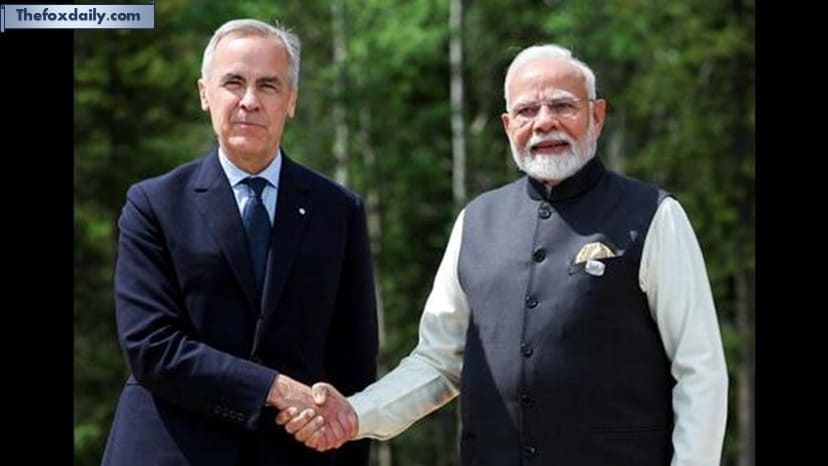
In a significant diplomatic development, the government led by Prime Minister Mark Carney has clarified that India is not currently associated with violent crimes committed on Canadian soil. The announcement marks a notable shift from the position taken by former Prime Minister Justin Trudeau, whose tenure saw relations between Ottawa and New Delhi deteriorate sharply.
Senior Canadian officials, speaking ahead of Carney’s upcoming visit to India, emphasized that Ottawa is no longer concerned about alleged interference or repression activities by Indian operatives in Canada. The statement signals a renewed effort to stabilize and strengthen bilateral ties between the two nations after years of diplomatic strain.
Background: Strained Canada–India Relations Under Trudeau
Canada’s relationship with India entered a turbulent phase following former Prime Minister Justin Trudeau’s public allegation that Indian agents were involved in the 2023 killing of Hardeep Singh Nijjar. Nijjar, who was designated a terrorist by New Delhi in 2020 due to his alleged involvement in Khalistani extremism, was shot dead in British Columbia.
At the time, Trudeau stated there was “credible evidence” suggesting that “agents linked to the government of India had killed a Canadian citizen on Canadian soil.” The remarks triggered diplomatic fallout, including expulsions of diplomats and heightened tensions between the two countries.
The Royal Canadian Mounted Police (RCMP) further intensified the situation by previously linking Indian agents to violent crimes in Canada, including alleged threats against activists and evidence of “homicides and violent acts.” Four individuals were later charged in connection with Nijjar’s murder, adding a complex legal dimension to the diplomatic dispute.
| Key Event | Details | Impact on Canada–India Relations |
|---|---|---|
| 2020 | India labels Hardeep Singh Nijjar a terrorist | Raised tensions over Khalistani activism abroad |
| 2023 | Nijjar killed in British Columbia | Triggered diplomatic crisis |
| 2023 | Justin Trudeau alleges Indian involvement | Relations deteriorate significantly |
| 2026 | Mark Carney administration distances India from crimes allegations | Signals diplomatic reset and renewed engagement |
Carney Government: A Shift Toward Diplomatic Re-engagement
The Mark Carney administration has adopted a more measured and pragmatic tone. Senior officials highlighted advancements in security negotiations and renewed collaboration between Ottawa and New Delhi during a media briefing before Carney’s scheduled trip.
“I really don’t think we’d be taking this trip if we thought these kinds of activities were continuing,” a senior Canadian official told the Toronto Star, signaling confidence that previously alleged activities are no longer ongoing.
Another senior government source, speaking anonymously, stressed that Canada now maintains “very robust diplomatic engagement, including between national security advisers,” and expressed confidence that contentious activities have ceased.
The Prime Minister’s Office reinforced this approach in a recent statement, noting that “respect for the ongoing law enforcement dialogue will continue to be the basis of our step-by-step approach to re-engagement with India.” This statement underlines that while political ties are warming, legal and investigative processes remain independent and ongoing.
Carney’s strategy reflects a broader “pragmatic foreign policy” outlook, prioritizing economic growth, global trade diversification, and strategic partnerships.
Economic and Strategic Motivations Behind the Reset
The timing of this diplomatic recalibration is significant. Canada is seeking to diversify its global partnerships amid uncertain relations with the United States. Strengthening trade and investment ties with India—the world’s most populous nation and a rapidly growing economic powerhouse—has become increasingly attractive.
Prime Minister Carney is embarking on a nine-day international tour that includes meetings with Indian Prime Minister Narendra Modi. The trip also features stops in Mumbai, Australia, and japan, reflecting Canada’s broader Indo-Pacific engagement strategy.
Officials have indicated that discussions may cover potential collaborations across key sectors, including:
- Oil and gas partnerships
- Artificial intelligence and technology innovation
- Trade expansion and supply chain resilience
- National security cooperation
This renewed engagement signals Ottawa’s intent to balance security concerns with economic opportunities, ensuring Canada remains competitive in the global marketplace.
The Dual-Track Strategy: Security and Economic Engagement
Despite the diplomatic thaw, public debate within Canada remains active. Members of the Sikh community and advocacy groups, including Sikhs for Justice, have expressed concern over rapprochement with India. Protesters gathered on Parliament Hill to voice opposition to the government’s evolving stance.
The legacy of the RCMP’s earlier findings continues to influence public discourse, particularly around allegations of foreign interference and community safety.
However, Canadian officials have clarified that the government’s approach is not a binary choice between security and economic interests. Instead, Ottawa is pursuing what has been described as a “dual-track strategy.”
Foreign Trade Minister Maninder Sidhu acknowledged that his constituency includes Canada’s largest South Asian community and recognized concerns related to crime, including extortion. At the same time, he underscored recent agreements between Canadian and Indian authorities aimed at strengthening law enforcement cooperation.
These measures include enhanced intelligence-sharing frameworks and the appointment of liaison officers in both countries to facilitate smoother communication between agencies.
“I do think we can accomplish two tasks simultaneously. We can keep our community safe. We may continue to interact economically with partners worldwide and have discussions about law enforcement,” Sidhu told the Toronto Star.
| Track | Focus Area | Key Actions |
|---|---|---|
| Security Track | Law enforcement & public safety | Intelligence sharing, liaison officers, ongoing investigations |
| Economic Track | Trade & strategic partnerships | Energy collaboration, AI partnerships, Indo-Pacific engagement |
What This Means for Canada–India Relations
The Carney government’s recalibration does not erase the tensions of the past few years, but it does signal a clear attempt to move forward. By distancing India from current allegations of violent crime while maintaining active law enforcement dialogue, Ottawa is attempting to rebuild trust without abandoning accountability.
For India, the shift represents a diplomatic opportunity to reset ties with a G7 nation that hosts a large Indian diaspora. For Canada, it is a strategic balancing act—protecting domestic security interests while unlocking trade and geopolitical advantages in the Indo-Pacific region.
As Prime Minister Mark Carney proceeds with his visit to India, the world will be watching closely to see whether this pragmatic, dual-track approach can transform a previously strained relationship into a stable and mutually beneficial partnership.
Keywords: Canada–India relations, Mark Carney India visit, Canada foreign policy shift, Hardeep Singh Nijjar case, RCMP India allegations, Canada trade with India, diplomatic reset, dual-track strategy Canada.
For breaking news and live news updates, like us on Facebook or follow us on Twitter and Instagram. Read more on Latest World on thefoxdaily.com.






COMMENTS 0