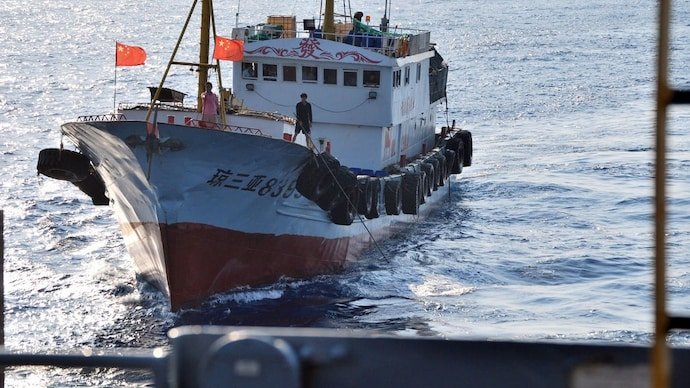
In a surprising development that has raised alarms among security analysts, thousands of Chinese fishing vessels have reportedly gathered in large coordinated formations in the East china Sea. The unusual maneuver, which took place near Taiwan and close to Japanese-controlled islands, has sparked speculation about whether China is testing strategies for a future military operation or blockade involving Taiwan.
Satellite tracking and maritime monitoring data analyzed by experts indicate that between 1,300 and 2,000 Chinese vessels formed long parallel lines roughly 300 kilometers northeast of Taiwan. The formations appeared at least twice in recent months — first on December 25, 2025, and again on January 11, 2026.
According to maritime monitoring data collected from the vessels’ Automatic Identification System (AIS) signals, the boats maintained their positions for nearly 30 hours. The coordinated activity occurred despite difficult weather conditions, including winds approaching gale force.
Reports also indicated that nearby South Korean fishing boats were forced to return to port during the December incident because of the severe weather and the presence of the large Chinese flotilla.
Unusual Vessel Formations Raise Questions
Experts analyzing satellite imagery and ship-tracking data say the formations stood out because of their precision. The vessels reportedly arranged themselves in long geometric patterns — something rarely seen in normal fishing activity.
Jason Wang, CEO of satellite analytics firm ingeniSPACE, said the formations immediately raised suspicion when he reviewed the tracking data.
According to Wang, such straight-line formations are extremely unusual in natural maritime activity. While gatherings of hundreds of fishing vessels are sometimes observed, he said seeing more than a thousand vessels coordinated in this way is highly unusual.
Similarly, Chisako Masuo, a professor of International Relations at Kyushu University who specializes in Chinese maritime strategy, described the scale of the mobilization as unprecedented.
Masuo told Japanese media outlet Nikkei that she had never previously heard of such a large concentration of fishing vessels operating in coordinated formations in this region. She suggested the move could be intended as a show of pressure directed at both Taiwan and Japan.
Scale of Mobilization Larger Than Previous Incidents
The recent gatherings appear to be significantly larger than earlier incidents involving Chinese fishing fleets. For example, in 2016 between 200 and 300 Chinese fishing boats gathered near the disputed Senkaku Islands — known in China as the Diaoyu Islands.
Those islands are administered by Japan but claimed by China, making the surrounding waters a frequent hotspot for maritime tensions.
Compared with that earlier event, the new formations involving up to 2,000 vessels represent a dramatic escalation in scale and coordination.
| Event | Number of Chinese Vessels | Location | Significance |
|---|---|---|---|
| 2016 Fishing Fleet Gathering | 200–300 vessels | Near Senkaku/Diaoyu Islands | Raised concerns over maritime territorial claims |
| December 25, 2025 Formation | 1,300–2,000 vessels | 300 km northeast of Taiwan | Large-scale coordinated positioning |
| January 11, 2026 Formation | 1,300–2,000 vessels | East China Sea | Repeated formation suggesting possible drills |
Experts Say the Vessels Were Likely Not Fishing
Maritime analysts believe it is highly unlikely that the vessels were engaged in normal fishing operations. Experts pointed out that fishermen typically spread out across wide areas rather than clustering together in tightly coordinated lines.
Gregory Poling, director of the Asian Maritime Transparency Initiative at the Center for Strategic and International Studies (CSIS), said he had never seen such a large gathering of Chinese fishing boats outside a port.
Former Australian naval officer Jennifer Parker also described the incident as a demonstration with a clear military dimension. She said the vessels were operating too closely together and in too organized a pattern for normal fishing activities.
According to Parker, regardless of what the vessels were doing, they were almost certainly not fishing.
Possible Link to China’s Maritime Militia
Security experts believe that many of the vessels involved may belong to China’s maritime militia — a special paramilitary force that operates using civilian ships and fishermen.
The maritime militia is frequently used by China in so-called “gray zone” operations — activities that fall short of open military conflict but are designed to advance strategic objectives or pressure rival countries.
Former US Navy officer Thomas Shugart noted that China has previously conducted large-scale drills around Taiwan that analysts interpret as preparation for blockades or potential military operations.
Because China’s armed forces have limited amphibious landing capacity for large-scale operations, Shugart said civilian vessels such as fishing boats could play an important role in any military campaign targeting Taiwan.
These vessels could potentially be used to transport troops, equipment, or supplies, or to help enforce a maritime blockade around the island.
China’s Maritime Militia: The “Third Sea Force”
China’s maritime militia is officially known as the People’s Armed Forces Maritime Militia (PAFMM). It is a unique paramilitary organization composed largely of civilian sailors and fishing vessels that can be mobilized for military purposes.
Although members of the maritime militia work in civilian maritime industries during normal times, they are organized, trained, and sometimes equipped under the direction of the Chinese military.
According to maritime strategy experts, the militia functions as a “third sea force” alongside China’s navy and coast guard.
| China’s Maritime Forces | Primary Role | Characteristics |
|---|---|---|
| PLA Navy (PLAN) | Military combat operations | Warships, submarines, aircraft carriers |
| China Coast Guard (CCG) | Law enforcement and maritime patrol | Large patrol ships enforcing maritime claims |
| Maritime Militia (PAFMM) | Gray-zone operations and strategic support | Civilian fishing vessels used for strategic missions |
The use of civilian vessels allows China to operate in disputed waters while avoiding direct military confrontation. Fishing boats and other civilian ships can assert territorial claims or harass rival vessels in ways that would be more provocative if performed by naval warships.
According to a Pentagon report, Chinese authorities subsidize certain fishing fleets and maritime companies so that their vessels can be mobilized for government missions when required.
Implications for Taiwan and Regional Security
Experts say that China’s maritime militia could play a crucial role in any future crisis involving Taiwan. One potential strategy would be a naval blockade aimed at isolating the island and cutting off commercial shipping routes.
Taiwan’s economy is heavily dependent on maritime trade, and any disruption to shipping lanes could quickly create severe economic pressure.
A 2024 report by the Center for Strategic and International Studies suggested that China could use maritime militia vessels to divert or block commercial shipping routes around Taiwan during a crisis.
Such a blockade would present a major challenge for Taiwan as well as for regional powers including Japan and the United States.
The recent mass mobilization of Chinese fishing vessels therefore raises important questions about whether Beijing is testing the logistics and coordination needed for such operations in the future.
While Chinese authorities have not publicly explained the purpose of the vessel formations, analysts believe the drills could represent training exercises, strategic signaling, or preparation for possible crisis scenarios in the Taiwan Strait.
For breaking news and live news updates, like us on Facebook or follow us on Twitter and Instagram. Read more on Latest World on thefoxdaily.com.

COMMENTS 0