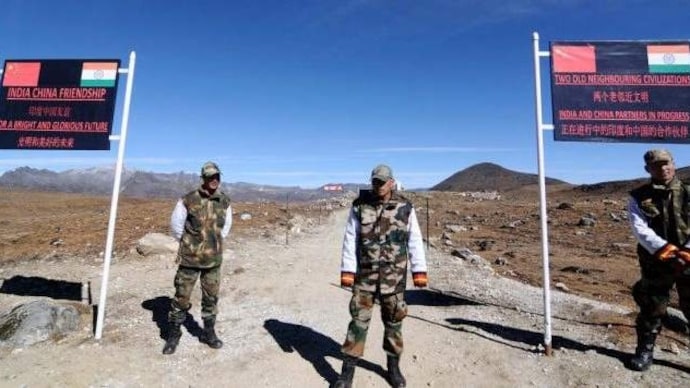
While the prolonged military standoff between India and china along the Line of Actual Control (LAC) in eastern ladakh has shown signs of stabilization, a new and potentially more serious flashpoint may be emerging. A recent report submitted by the US Pentagon to the US congress indicates that China has now elevated Arunachal Pradesh to the status of a “core interest,” placing it in the same strategic category as Taiwan.
This designation is significant because Beijing traditionally reserves the term “core interests” for issues on which it is unwilling to compromise and may even resort to military action. The inclusion of Arunachal Pradesh in this category suggests that the northeastern Indian state could become a major source of friction between New Delhi and Beijing in the coming years.
According to the Pentagon report, China views its territorial and maritime claims as essential to achieving its long-term national objective of “great rejuvenation of the Chinese nation” by the year 2049, which will mark the centenary of the People’s Republic of China. This goal includes securing disputed regions such as Taiwan, strengthening control in the South China Sea, and asserting claims over Arunachal Pradesh.
The report further states that China is investing heavily in building a “world-class military” capable of conducting “fight and win” operations. This modernization drive is aimed at enabling Beijing to operate at a higher level on the global stage and deter or defeat perceived adversaries.
India, for its part, has consistently and unequivocally rejected China’s claims. New Delhi has repeatedly stated that Arunachal Pradesh “was, is, and will always remain” an integral and inalienable part of India.
Arunachal Pradesh Emerging as a New Flashpoint
India and China reached an understanding last year to disengage troops at certain friction points along the LAC in eastern Ladakh, leading to a period of relative calm after years of tension. However, recent developments suggest that Arunachal Pradesh may now be emerging as the next major area of confrontation.
Tensions resurfaced last month following the detention of Prema Thongdok, an Indian national, during an 18-hour layover at Shanghai airport. Thongdok, who was traveling from London to japan, was reportedly stopped by Chinese authorities because her Indian passport listed her place of birth as Arunachal Pradesh.
According to her account, Chinese officials declared her passport invalid, denied her access to food and other airport facilities, and subjected her to prolonged questioning. She was eventually allowed to continue her journey only after a friend in the United Kingdom contacted the Indian consulate in Shanghai on her behalf.
In another incident highlighting the sensitivity of the issue, a YouTuber was reportedly detained in China earlier this week for referring to Arunachal Pradesh as an integral part of India in a video that supported Thongdok.
US Taking Note of China’s Arunachal Strategy
Beijing refers to Arunachal Pradesh as “South Tibet” or “Zangnan” and bases its claim on its rejection of the McMahon Line, the boundary demarcated in 1914 during the Simla Convention. The agreement was signed between British India and then-independent Tibet, a demarcation that China has never formally accepted.
Historically, China’s claim was limited mainly to the Tawang region, which holds both strategic and religious significance, particularly for Tibetan Buddhism. Over time, however, Beijing expanded its claim to include the entire state of Arunachal Pradesh.
In recent years, China has sought to reinforce its position by releasing multiple lists of “standardized” Chinese names for locations in Arunachal Pradesh. India has dismissed these moves as symbolic and reiterated that renaming places does not alter ground realities.
Former Indian diplomat Mahesh Sachdev noted that the US explicitly highlighting China’s Arunachal strategy is significant. He pointed out that while Washington has previously focused more on Ladakh-related issues, it is now paying closer attention to Beijing’s pressure tactics in Arunachal Pradesh.
China’s Pakistan Factor and Long-Term Strategy
The Pentagon report also flags another area of concern for India: China’s long-term “twin-track” strategy. This approach combines tactical calm along the India-China border with sustained indirect pressure through Pakistan, described as China’s “all-weather ally.”
According to the assessment, Beijing may seek to keep tensions along the LAC under control while simultaneously enabling Pakistan militarily to constrain India’s strategic options. This was particularly evident during Operation Sindoor, when Pakistan reportedly deployed a large number of Chinese-manufactured weapons and systems.
The report notes that while many of these systems underperformed, the broader strategy remains a concern for Indian security planners. It also suggests that China is attempting to stabilize relations with India just enough to prevent New Delhi from moving closer to Washington and other Western partners.
Taken together, the Pentagon’s findings indicate that while overt hostilities may be avoided in the short term, Arunachal Pradesh is likely to remain a critical and sensitive fault line in India-China relations, with long-term strategic implications for regional security.
For breaking news and live news updates, like us on Facebook or follow us on Twitter and Instagram. Read more on Latest World on thefoxdaily.com.






COMMENTS 0