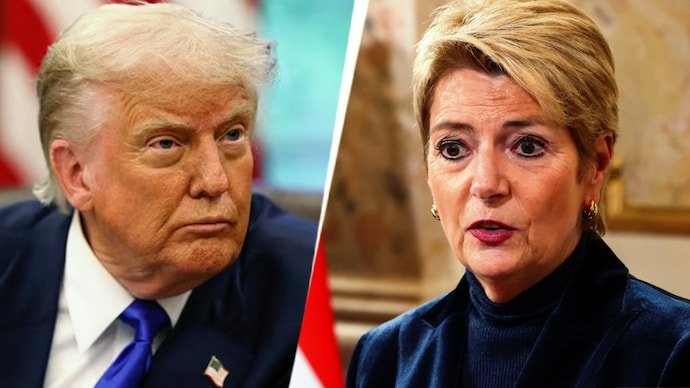
US President Donald Trump has claimed that a phone conversation with a senior swiss leader influenced his decision to raise tariffs on Switzerland, underscoring once again how trade policy under his administration is often shaped by direct leader-to-leader exchanges.
In an interview with Fox Business, Trump said he ordered an additional nine-percentage-point increase in tariffs on Swiss goods after he was dissatisfied with the tone used by Karin Keller-Sutter, a member of Switzerland’s Federal Council. Trump appeared to mistakenly refer to her as the “Prime Minister” of Switzerland — a position that does not exist under the country’s political system.
According to Trump, he initially imposed what he described as a “low” tariff rate of 30 percent on Swiss imports. However, following what he called an “emergency call” from Keller-Sutter, the rate was raised to 39 percent.
“I set a fairly low tariff of thirty percent. Then I got an emergency call from, I believe, the Prime Minister of Switzerland, and she was very aggressive but nice — but very aggressive,” Trump said in the interview. “She said, ‘SIR, we are a small country. We can’t do this. We can’t do this.’ I couldn’t get her off the phone.”
Trump further stated that he reminded the Swiss official that Switzerland runs a trade surplus with the United States, which he estimated at approximately USD 42 billion, despite being a relatively small economy.
“She kept saying, ‘No, no, we are a small country,’ again and again and again,” Trump said. “I couldn’t get her off the phone, so it was 30 percent. Instead of reducing her, I increased it to 39 percent because I didn’t particularly like the way she spoke to us.”
The remarks quickly circulated online, with clips of the interview widely shared on social media platforms. In the same interview, Trump reiterated his long-standing criticism that Switzerland exports significant volumes of goods to the United States while facing comparatively low trade barriers.
The US president asserted that Switzerland was exporting products to the US “like nobody could believe” while paying minimal tariffs in return.
Political Context and Switzerland’s Governance Structure
Trump had made similar remarks weeks earlier at the World Economic Forum in Davos, where he appeared uncertain about Switzerland’s political leadership structure. At that time, he questioned whether the country had a president or a prime minister.
“The Prime Minister phoned — a woman — and I’m not sure if that’s the President,” Trump said during his Davos address. “She repeated herself a lot. ‘No, no, no, you can’t do that, thirty percent. We are a little, tiny nation.’ But I said, ‘You may be small, but you have a big deficit.’”
In reality, Switzerland does not have a prime minister or an executive president in the traditional sense. The country is governed by a seven-member Federal Council, which collectively serves as the executive branch. Each member heads a federal department, and the presidency rotates annually among them.
Karin Keller-Sutter is one of the seven Federal Council members and currently serves in a senior governmental capacity, but she does not hold the title of prime minister.
Trade Negotiations and Investment Commitments
The tariff increase comes despite ongoing economic discussions between Washington and Bern. In November, Swiss industry representatives reportedly committed to investing approximately USD 200 billion in the United States by the end of 2028. The pledge was part of preliminary negotiations aimed at reducing tariff rates to around 15 percent.
The latest escalation in tariff levels raises questions about the future of those negotiations and whether a revised trade framework can still be achieved.
Trade analysts note that US-Switzerland economic ties are deeply intertwined, particularly in pharmaceuticals, machinery, financial services, and precision manufacturing. Any prolonged tariff dispute could impact supply chains and bilateral investment flows.
Trump’s remarks also highlight a broader theme of his trade policy approach — the emphasis on reducing trade deficits and leveraging tariffs as a negotiating tool. Throughout his presidency, he has repeatedly argued that countries benefiting from trade surpluses with the US must accept higher duties or increase American market access.
Whether the latest tariff hike represents a negotiating tactic or a longer-term shift in US-Switzerland trade relations remains to be seen. For now, the comments have added a diplomatic dimension to what was already a sensitive economic discussion between the two countries.
For breaking news and live news updates, like us on Facebook or follow us on Twitter and Instagram. Read more on Latest World on thefoxdaily.com.



COMMENTS 0