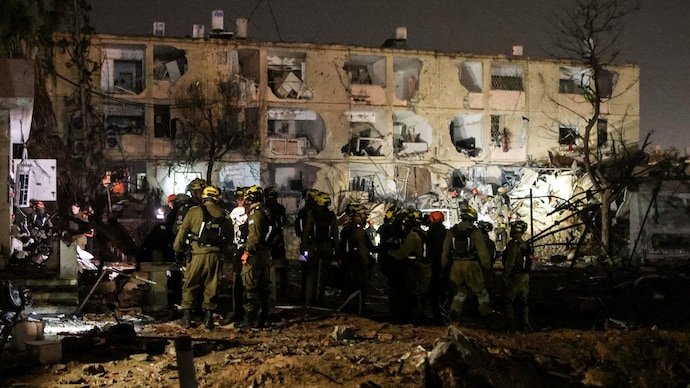
A major security scare unfolded in southern Israel after a missile strike hit the city of Dimona, home to the country’s highly sensitive nuclear research facility. The attack left dozens injured and has intensified fears of a broader regional conflict involving Israel, Iran, and global powers.
The incident occurred just hours after Iranian state media reported that US-Israeli forces had launched an attack on Iran’s Shahid Ahmadi-Roshan nuclear enrichment facility in Natanz earlier the same day. However, the Israeli military has firmly denied any involvement in strikes on Iranian nuclear sites.
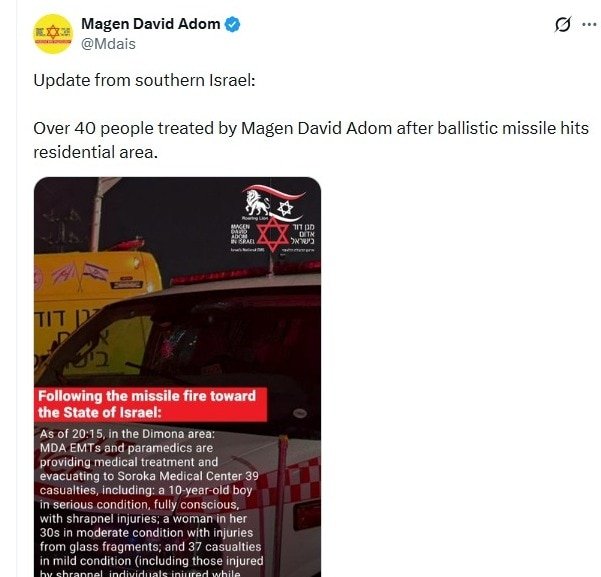
According to Magen David Adom (MDA), Israel’s national emergency medical service, at least 37 individuals required urgent medical attention following the missile strike on a residential neighborhood in Dimona. The city is widely known for housing Israel’s primary nuclear research center, making the attack particularly sensitive.
MDA later updated the figures, stating that more than 40 people were treated after the ballistic missile impacted the area. Many of the injured suffered from shrapnel wounds, while others were hurt during the chaos as they rushed to find shelter.
Among the injured was a 10-year-old boy who sustained shrapnel injuries. Emergency responders described his condition as mild, and he is expected to recover. Medical teams also provided assistance to individuals experiencing severe anxiety and panic triggered by the sudden strike.
Emergency crews worked swiftly at the scene, treating victims and transporting the more seriously injured to nearby hospitals. The situation highlighted the challenges faced by civilians in high-risk zones during escalating military confrontations.
The International Atomic Energy Agency (IAEA), the United Nations’ nuclear watchdog, acknowledged reports of the missile incident in Dimona. However, the agency stated that it had not received any confirmation of damage to the Negev Nuclear Research Center.
The IAEA further noted that it is closely monitoring the situation and that no abnormal radiation levels have been detected so far. This has provided some reassurance amid fears of a potential nuclear safety crisis.
The Dimona nuclear facility, established in 1958, has long been at the center of speculation regarding Israel’s nuclear capabilities. While Israel maintains a policy of ambiguity, neither confirming nor denying the possession of nuclear weapons, the site remains strategically significant.
Meanwhile, Iranian media claimed that the strike on Dimona was carried out in retaliation for the alleged attack on the Natanz enrichment complex. According to these reports, the Natanz facility was targeted earlier in the day, although officials stated that there was no radioactive leakage and that nearby residents were not in immediate danger.
A video purportedly showing the missile striking Dimona quickly went viral on Social Media, amplifying global attention and concern. The footage, though not independently verified, has contributed to widespread discussion about the scale and implications of the attack.
Despite Iran’s claims, the Israeli military has denied conducting any operation against the Natanz facility. Rafael Mariano Grossi, Director General of the IAEA, confirmed that the agency is actively investigating the situation to determine the facts surrounding the reported strike.
Russia’s Foreign Ministry also weighed in on the developments, condemning the alleged attack on the Natanz complex. Officials warned that such actions could pose a “real risk of catastrophic disaster” across the Middle East, particularly if nuclear infrastructure is compromised.
Notably, the Natanz facility has been targeted before. It sustained damage during a 12-day conflict in June of the previous year and again during the early phase of the current escalation, indicating a pattern of repeated attacks on critical infrastructure.
Missile Strikes Extend to Arad, Signaling Escalation
At nearly the same time as the Dimona strike, another southern Israeli city, Arad, was also hit by incoming missiles. The Israeli military confirmed that both Dimona and Arad were targeted and acknowledged that its air defense systems were unable to intercept all incoming threats.
This marks a significant development, as it is reportedly the first time Iranian missiles have successfully penetrated Israel’s air defense systems in the Dimona region. The breach has raised concerns about the effectiveness of existing defense mechanisms.
Before news of the Arad strike became widely known, Iranian Parliament Speaker Mohammad Bagher Ghalibaf commented on the situation via social media. He suggested that the inability to intercept missiles in heavily defended areas like Dimona indicates a “new phase” in the ongoing conflict.
Israeli Prime Minister Benjamin Netanyahu addressed the nation following the attacks, describing the situation as extremely serious. “This has been a very difficult evening in the battle for our future,” he said, underscoring the gravity of the developments.
| Key Event | Details |
|---|---|
| Missile Strike on Dimona | Residential area hit; over 40 people injured |
| Location Significance | Home to Israel’s primary nuclear research facility |
| Casualties | At least 37–40 injured, including a child |
| IAEA Response | No confirmed damage to nuclear facility; no radiation leak detected |
| Natanz Facility Incident | Iran claims US-Israeli strike; Israel denies involvement |
| Additional Strike | Arad city also targeted by missiles |
| Air Defense Breach | Missiles reportedly penetrated Israeli defense systems |
| Global Reaction | Russia warns of catastrophic regional risks |
In conclusion, the missile strike on Dimona marks a significant escalation in Middle East tensions, particularly given the city’s association with Israel’s nuclear infrastructure. While no radiation threat has been reported, the attack has raised serious concerns about regional stability, defense vulnerabilities, and the potential for further conflict. As investigations continue and global powers monitor the situation closely, the risk of a broader confrontation remains a pressing concern.
For breaking news and live news updates, like us on Facebook or follow us on Twitter and Instagram. Read more on Latest World on thefoxdaily.com.




COMMENTS 0