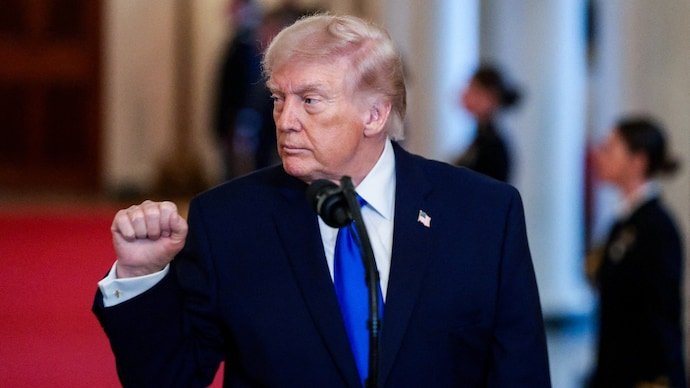
President Donald Trump has issued a sharp warning to global trading partners, cautioning that any country attempting to withdraw from newly negotiated trade agreements with the United States could face harsher tariffs or additional financial penalties. His remarks come just days after the US Supreme Court struck down his sweeping global tariff regime, a decision that temporarily disrupted one of his signature economic policies.
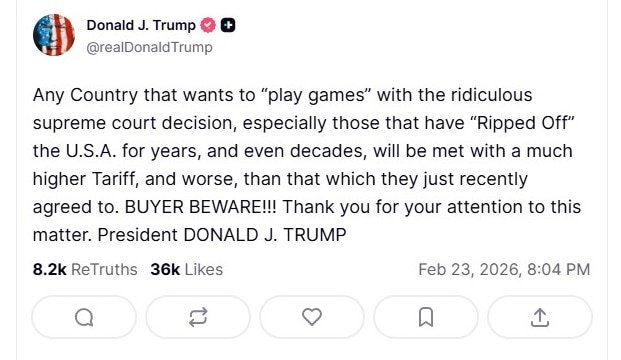
In a strongly worded statement posted on Truth Social, Trump declared that nations attempting to “play games” with the Court’s ruling would encounter consequences more severe than those outlined in their recent trade agreements. He emphasized that countries which he claims have “ripped off” the United States for years or even decades should not interpret the ruling as a sign of weakness from Washington.
“Any nation that seeks to ‘play games’ with the absurd Supreme Court ruling would face a tariff that is worse than the one they recently agreed to,” Trump wrote, ending his message with a bold warning: “BUYER BEWARE!!!”
Supreme Court Ruling and the Tariff Shift
The Supreme Court decision invalidated Trump’s earlier tariff framework imposed under the International Emergency Economic Powers Act (IEEPA). While the ruling struck down that particular legal approach, Trump argued that it left the door open for alternative mechanisms that could be even more forceful.
According to Trump, the Court’s decision confirmed that he retains authority to apply tariffs under different statutory provisions — potentially in what he described as a “much more powerful and obnoxious way,” with greater legal certainty than before.
In addition to potential tariff increases, Trump floated the idea of imposing license fees on trading partners. However, he did not provide detailed clarification on how such fees would be structured or enforced. The Office of the US Trade Representative declined immediate comment on the proposal.
New Tariffs Under the Trade Act of 1974
Financial markets have reacted cautiously as investors await clarity on the administration’s next move. On February 20, Trump invoked Section 122 of the Trade Act of 1974 to implement a temporary 10 percent import surcharge. Within 24 hours, the duty was raised to 15 percent — the maximum permitted under that statute.
The 15 percent tariff is scheduled to take effect at 12:01 a.m. EST on Tuesday. Meanwhile, US Customs and Border Protection is set to stop collecting the now-invalid IEEPA-based tariffs, more than three days after the Supreme Court’s ruling.
| Policy Element | Previous Approach (IEEPA) | New Strategy |
|---|---|---|
| Legal Basis | International Emergency Economic Powers Act | Section 122, Trade Act of 1974 |
| Initial Tariff Rate | Varied global tariffs | 10% temporary import charge |
| Revised Rate | Invalidated by Supreme Court | 15% maximum allowed under statute |
| Additional Measures | Not specified | Possible license fees & Section 301 probes |
Impact on US–EU Trade Negotiations
The uncertainty surrounding US tariff policy has already influenced international negotiations. In Brussels, the European Parliament postponed a planned vote on a new trade agreement with the United States following Trump’s temporary duty announcement.
Under the proposed arrangement, European Union goods would face a 15 percent US tariff, though exemptions would apply to hundreds of food products, aircraft components, critical minerals, and pharmaceutical ingredients. In exchange, the EU would eliminate tariffs on numerous American industrial goods, potentially expanding bilateral trade.
The delay signals that foreign governments are reassessing their positions amid ongoing legal and policy shifts in Washington.
Section 301 Investigations and Future Trade Pressure
US Trade Representative Jamieson Greer indicated over the weekend that the administration is preparing to launch new investigations under Section 301 of US trade law. These investigations target alleged unfair trade practices and could serve as a legal pathway for imposing additional tariffs on selected countries.
Section 301 has historically been used as a powerful enforcement tool in trade disputes, enabling the United States to respond unilaterally to practices deemed discriminatory or harmful to American businesses.
Trump’s latest warning underscores his continued commitment to aggressive trade enforcement. While the Supreme Court ruling may have dismantled one legal foundation of his tariff regime, it appears to have prompted a pivot rather than a retreat.
As global markets monitor developments closely, trading partners now face a critical decision: maintain cooperation under revised US trade terms or risk confronting even steeper economic measures.
For breaking news and live news updates, like us on Facebook or follow us on Twitter and Instagram. Read more on Latest World on thefoxdaily.com.

COMMENTS 0