- What Happened: A High-Stakes Rescue Operation
- Massive Military Response: Resources and Coordination
- Why Some US Aircraft Were Allegedly Destroyed
- Breaking Down the Financial Cost
- Trump’s Position on Ground Troops
- Why the Rescue Mission Is a Strategic Warning
- Kharg Island: A Potential Flashpoint
- Analysis: From Rescue to Potential Conflict
- The Human and Strategic Cost
- Conclusion
A high-risk rescue operation involving a stranded American F-15E airman inside Iran has emerged as a critical case study in the debate over potential US ground operations in the region. The 36-hour mission, which required extensive military coordination and resources, has raised serious questions about the feasibility and cost of deploying troops on Iranian soil.
The incident unfolded after an F-15E Strike Eagle was shot down over Iran, leaving two crew members behind enemy lines. While one was rescued quickly, the second—identified as a weapons systems officer—remained stranded in hostile territory, triggering a complex and resource-intensive rescue mission. The episode has since been viewed by analysts as a real-world preview of the risks associated with deeper military engagement in Iran.
What Happened: A High-Stakes Rescue Operation
The crisis began on April 3, when the US fighter jet was brought down, reportedly by Iranian forces. Both crew members ejected safely, but landed in separate locations within Iranian territory. The pilot was recovered within hours, but the second officer landed in a remote and mountainous region, making rescue efforts significantly more challenging.
For nearly 48 hours, the stranded officer—reportedly injured—evaded detection while Iranian forces launched an extensive search operation. According to reports, he took shelter in the rugged terrain of the Zagros Mountains, carefully managing his movements and communication to avoid capture.
“He only activated his emergency beacon intermittently, balancing the need for rescue with the risk of detection,” a report noted.
The situation quickly escalated into a race against time, with both US and Iranian forces attempting to locate the officer first.
Massive Military Response: Resources and Coordination
To retrieve the stranded airman, the United States reportedly deployed a large-scale operation involving special forces, intelligence agencies, drones, helicopters, and transport aircraft. Estimates suggest that more than 200 commandos were involved in the mission, supported by advanced surveillance and deception tactics.
Among the strategies used were:
- Deployment of drones for real-time surveillance
- Use of false signals and beacons to mislead opposing forces
- Coordination between military units and intelligence agencies
- Continuous air support to secure the extraction zone
Such a multi-layered operation underscores the complexity of conducting missions deep inside hostile territory, even when the objective is limited to rescuing a single individual.
Why Some US Aircraft Were Allegedly Destroyed
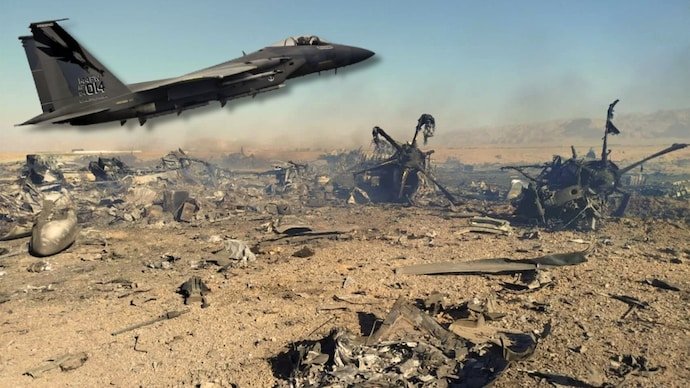
One of the most debated aspects of the mission is the reported destruction of US military aircraft during the extraction phase. According to multiple reports, some helicopters and transport aircraft faced technical and environmental challenges that made take-off risky.
Rather than risk sensitive technology falling into enemy hands, US forces allegedly destroyed certain assets on the ground. While these claims remain disputed, images circulating online appear to show wreckage consistent with such actions.
This decision, if confirmed, reflects a standard military protocol in extreme situations—but it also highlights the steep material costs involved.
Breaking Down the Financial Cost
The financial implications of the mission are significant. The F-15E aircraft itself is estimated to cost up to $100 million. When combined with the cost of additional aircraft, fuel, logistics, and operational deployment, the total expenditure runs into hundreds of millions of dollars.
| Component | Estimated Cost Impact |
|---|---|
| F-15E Fighter Jet | Up to $100 million |
| Transport Aircraft & Helicopters | High-value assets (millions each) |
| Drones & Surveillance Systems | Operational and deployment costs |
| Fuel & Logistics | Extended mission expenses |
| Total Estimated Cost | Hundreds of millions of dollars |
While no American lives were lost, the scale of resource deployment for a single rescue mission has drawn attention from military experts and policymakers alike.
Trump’s Position on Ground Troops
In a recent interview, US President Donald Trump indicated that he would not rule out sending ground troops into Iran if diplomatic efforts fail. Reports suggest that the administration has considered limited ground operations, including targeting strategic sites such as Kharg Island or nuclear-related facilities.
“No,” Trump said when asked if he would rule out ground deployment, signalling that military options remain on the table.
Such statements come amid rising tensions and ongoing discussions within US defence circles about the scope and scale of potential military actions.
Why the Rescue Mission Is a Strategic Warning
The rescue operation, though successful, has been widely interpreted as a warning sign. If rescuing a single officer required such an extensive effort, a full-scale or even limited ground operation could be exponentially more complex.
Military analysts point to several key concerns:
- High risk of troop exposure in hostile environments
- Complex logistics in unfamiliar terrain
- Potential for escalation into prolonged conflict
- Significant financial and material costs
The mission demonstrated that even well-planned operations can face unexpected challenges, from terrain difficulties to mechanical failures.
Kharg Island: A Potential Flashpoint
Kharg Island, Iran’s primary oil export hub, has been identified as a possible target in discussions of limited US ground operations. Capturing or disabling the facility could significantly impact Iran’s economy.
However, experts warn that such an operation would be far more complex than the recent rescue mission. Unlike the mountainous terrain where the airman was stranded, Kharg Island is a heavily guarded and strategically critical location.
Its characteristics include:
- Flat and exposed terrain
- Proximity to Iranian military bases
- Dense infrastructure and population presence
- Strong defensive positioning by Iranian forces
These factors would make any military operation highly vulnerable to counterattacks and prolonged engagement.
Analysis: From Rescue to Potential Conflict
The transition from a rescue mission to a broader military operation is not just a matter of scale—it is a shift in complexity. While the rescue focused on a single objective, a ground operation would involve multiple targets, extended timelines, and sustained troop presence.
The recent mission highlights a critical reality: success in a limited operation does not necessarily translate into feasibility for larger campaigns.
It also raises questions about the cost-benefit balance of such actions. While strategic objectives may justify certain risks, the margin for error remains extremely thin.
And here lies a subtle but important point—modern warfare is not just about capability, but also about sustainability. A mission can succeed tactically while still exposing broader strategic vulnerabilities.
The Human and Strategic Cost
Beyond financial and logistical considerations, the human element remains central. The rescue mission underscored the risks faced by personnel operating in hostile environments.
While the airman was successfully brought back, the operation required extraordinary effort and coordination. Scaling such efforts for larger missions would inevitably increase the stakes, both in terms of lives and resources.
Experts caution that even limited engagements can escalate quickly, especially in regions with complex geopolitical dynamics.
Conclusion
The rescue of the F-15E airman stands as both a demonstration of military capability and a cautionary tale. It showed that the United States can execute complex operations deep inside hostile territory—but it also revealed the immense costs and risks involved.
As discussions around potential ground operations in Iran continue, this incident offers valuable insight into what such actions might entail. From logistical challenges to financial burdens and strategic uncertainties, the margin for error remains narrow.
In the end, the mission succeeded—but the lessons it leaves behind may prove even more significant than the rescue itself.
For breaking news and live news updates, like us on Facebook or follow us on Twitter and Instagram. Read more on Latest World on thefoxdaily.com.






COMMENTS 0