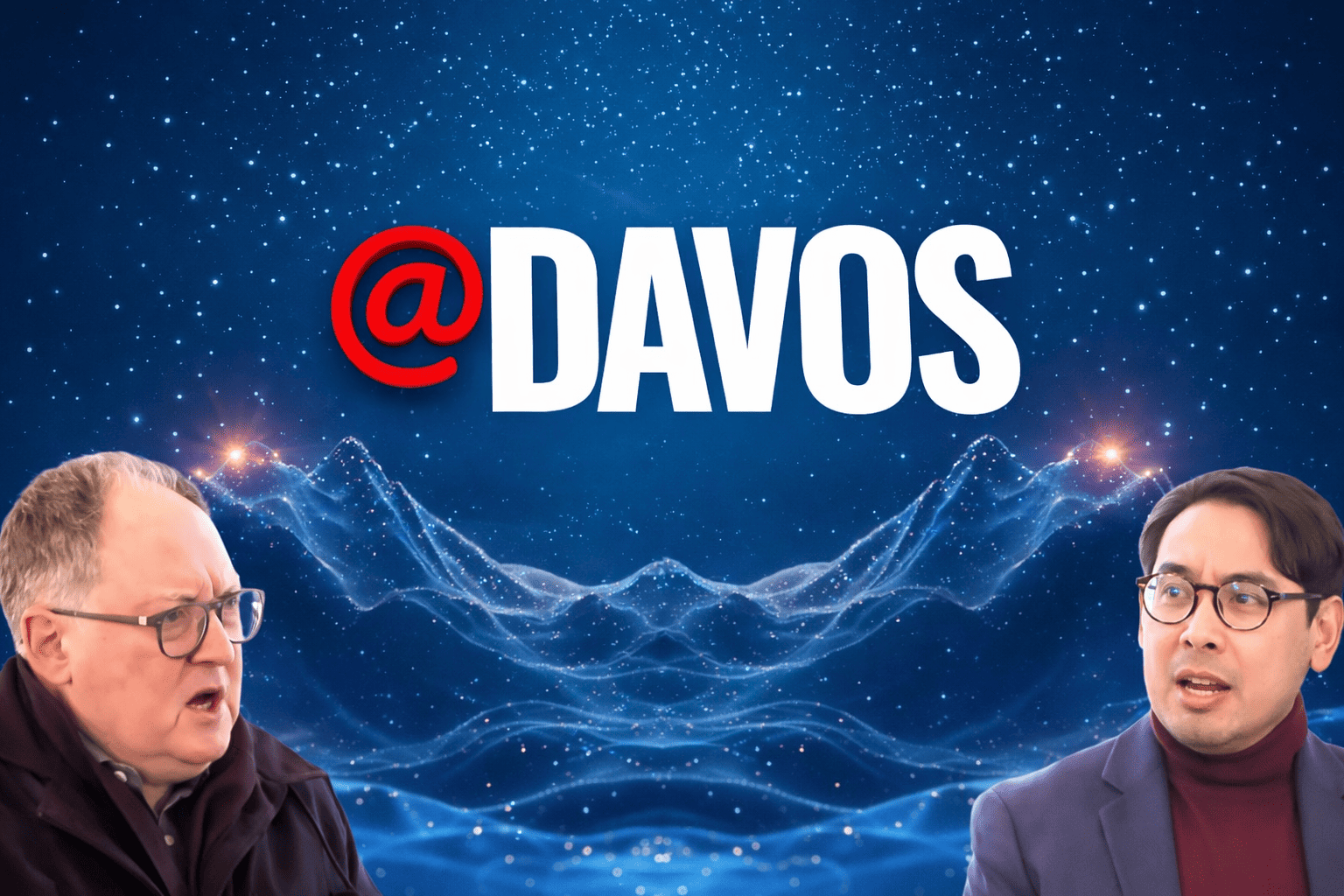
Amid renewed uncertainty surrounding a potential second Donald Trump presidency and fresh tariff threats from Washington, geopolitical analyst Fareed Zakaria has offered India a clear, pragmatic roadmap: remain calm, ignore the noise, and stay focused on long-term economic fundamentals.
Speaking on the sidelines of the World Economic Forum (WEF) annual meeting in Davos, Zakaria told India Today Consulting Editor Rajdeep Sardesai that India should resist the temptation to overreact to Trump’s unpredictability.
“Time is on India’s side,” Zakaria said, stressing that New Delhi should not allow short-term political turbulence in Washington to distract it from its broader growth trajectory.
Offering blunt advice on how to deal with Trump’s foreign policy style, Zakaria urged India to avoid unnecessary confrontation. “Be patient. Trump is erratic. Trump is peculiar,” he remarked.
“Manage him as much as you can. Try to make him laugh,” Zakaria added, half-jokingly suggesting that diplomacy with Trump should lean heavily on optics and personal engagement.
“Throw him a big fancy state dinner at Rashtrapati Bhavan — it’s four times the size of Buckingham Palace — if he likes big fancy state dinners,” Zakaria said, underlining Trump’s fondness for spectacle.
Continuing the analogy, Zakaria quipped that India could even outdo British ceremonial traditions. “They had a few hundred horses. India could have a few thousand elephants,” he said, suggesting that pageantry often matters as much as policy substance when dealing with Trump.
“You have the Maharajas and Maharanis. If the government lacks creativity, call the Ambanis and ask them how to throw a spectacular party,” Zakaria added. “He likes ruling as a king — so treat him like that.”
“If There Is No Leverage, Don’t Threaten Trump”
When asked whether India should publicly confront Trump over tariffs or trade pressure, Zakaria’s answer was unequivocal: “No.”
“Trump knows when he has power and when he doesn’t,” he explained. “When there is an imbalance of power, he applies intense pressure. India does not yet have the same leverage over the United States that china does.”
Zakaria cautioned against bluffing in diplomacy. “When you don’t have leverage, don’t make threats. Build leverage first — and then play your cards. Avoid bluffing. He’s very good at spotting that.”
Zakaria on India’s Economy and Modi’s Role
On the economic front, Zakaria struck an optimistic note, arguing that India should remain confident about its long-term growth story.
“India’s economy has been doing remarkably well. At this point, it’s fair to say this is a 25-year growth story,” he said.
Zakaria pointed out that India’s macroeconomic trajectory has remained consistent across political regimes. “The numbers under Manmohan Singh and Narendra Modi are essentially similar. Per capita GDP growth is almost the same,” he observed.
Within that broader continuity, Zakaria credited Prime Minister Modi for effective economic stewardship. “Modi has been a very good manager of the economy in most ways,” he said.
He emphasized that India’s priority should remain modernization — of both society and the economy — rather than being distracted by short-term global disruptions.
Zakaria also highlighted a structural strength that sets India apart globally: its consumption-driven economy.
“India has a big advantage. Most of its economy is driven by domestic consumption,” he said.
“Only three major economies — India, the United States, and Indonesia — have consumption accounting for more than 60% of GDP. In China, it’s closer to 30–35%,” Zakaria noted.
Economies heavily dependent on exports, he warned, are far more vulnerable to global shocks. “India is not export-dependent. It is consumption-led.”
However, Zakaria cautioned against complacency, especially amid Trump’s tariff tactics. “Exports still matter,” he said. “They create good-paying jobs and push countries to the technological frontier.”
He cited India’s growing role in smartphone manufacturing as a success story. “India’s iPhone story is extraordinary. From zero to now, India supplies about 45% of America’s smartphones,” he said.
Zakaria urged India to continue expanding into advanced manufacturing, electric vehicles, and technology-intensive sectors.
Trade Deal Impasse: Zakaria’s View
On India–US trade negotiations, Zakaria warned against portraying a deal as existential. “It’s great if you get a good trade deal. But understand this — India will not die without one,” he said.
“This is not a make-or-break situation for India,” he added.
At the same time, Zakaria acknowledged the asymmetry in the relationship. “The Indian economy barely registers for the United States. It’s a pimple on a giant,” he remarked bluntly.
Yet, he underscored that Washington remains central to India’s ambitions. “America is going to be the force that helps India move up the value chain in technology and industry.”
India–US trade talks continue to stall over disagreements on tariffs and market access. While Washington seeks steep tariff reductions on agricultural products, dairy, medical devices, and automobiles, New Delhi views these areas as politically sensitive red lines tied to farmer livelihoods, public health, and domestic industry.
Zakaria’s bottom line for India: stay patient, build leverage quietly, avoid theatrical confrontations — and keep playing the long game.
For breaking news and live news updates, like us on Facebook or follow us on Twitter and Instagram. Read more on Latest World on thefoxdaily.com.




COMMENTS 0