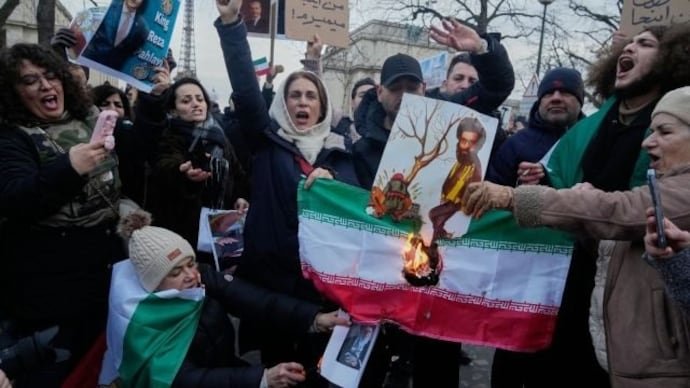
Protests across Iran have entered a far more violent and dangerous phase, with mounting fatalities reported as authorities intensify efforts to reassert control. Armed security units have been deployed across major cities, transforming once-crowded streets into zones of fear, surveillance, and open confrontation.
Witnesses inside Iran describe scenes of extreme militarisation and escalating violence as security forces moved aggressively to crush demonstrations that initially erupted over the country’s collapsing economy but have since evolved into a direct challenge to the ruling regime.
For days, information from inside the country was limited after authorities imposed a near-total internet blackout. However, as restricted international communication began to return on Wednesday, Iranians were able to speak to foreign media, offering chilling firsthand accounts of what they described as a near-war environment in several urban centres.
Residents told journalists they were seeing heavily armed security units positioned throughout major cities, particularly in Tehran, with streets, intersections, and public spaces effectively placed under military-style control.
Basij Forces and Anti-Riot Police Deployed Nationwide
According to multiple eyewitnesses speaking to the Associated Press, anti-riot police clad in body armour and helmets were stationed at key crossroads. These units were reportedly equipped with shotguns, batons, shields, and tear gas launchers, forming defensive lines that blocked roads and restricted movement.
Security personnel in civilian clothing were also seen moving through public areas, while members of the Revolutionary Guard’s volunteer Basij force were observed openly carrying firearms and batons. Their presence, witnesses said, created an atmosphere of constant intimidation.
“It felt like a war zone,” one witness told the Associated Press, describing police lines sealing off streets and armed officers monitoring crowds from rooftops, alleyways, and street corners.
Several witnesses reported that government buildings and banks were set ablaze during the unrest. The shutdown of internet services further paralysed daily life, making it difficult for banks to conduct transactions and adding to the sense of chaos and uncertainty.
While some shops reopened in parts of Tehran, foot traffic remained sparse and tense. Even the Grand Bazaar—long considered a symbolic centre of protest—resumed operations only under what witnesses described as heavy pressure and surveillance from security forces.
Fearing arrest, retaliation, or worse, many individuals spoke only on the condition of anonymity, underscoring the climate of fear gripping the country.
Medical professionals reported a disturbing shift in the nature of injuries arriving at hospitals. According to accounts cited by The New York Times, early casualties showed signs of beatings and pellet wounds. In recent days, however, patients have increasingly arrived with gunshot wounds and severe skull fractures.
“This is a mass-casualty situation,” one doctor told The New York Times, explaining that emergency wards were overwhelmed, understaffed, and struggling to cope with the influx of critically injured protesters.
Reports of Live Fire Against Protesters
Eyewitnesses told international media that government forces had begun firing live ammunition at protesters, sometimes seemingly indiscriminately. Some accounts described the use of automatic weapons, with people collapsing in the streets amid prolonged bursts of gunfire.
Despite the communications blackout, harrowing images have begun to surface. Photographs showing dozens of body bags lined up on mortuary floors have circulated widely on social media. In videos shared by opposition activists, grieving families can be seen crying over bloodied bodies sealed inside unzipped bags.
Iranian state television has also aired footage from a morgue, showing rows of body bags arranged under stark fluorescent lighting, further reinforcing the scale of the violence, according to reports.
On the streets, witnesses said officers in civilian clothing stopped people at random, interrogating them and searching mobile phones. Others reported raids on residential buildings in search of satellite internet equipment, including Starlink terminals, as authorities sought to tighten control over the flow of information.
Fear, exhaustion, and anger emerged as common themes across all accounts. Yet many witnesses said the severity of the crackdown had not silenced dissent. Instead, they claimed, the violence had hardened public resolve and deepened resentment toward the authorities.
According to the latest figures from the US-based Human Rights Activists News Agency (HRANA), at least 2,403 demonstrators have been killed since anti-government protests began. The group also reports that a minimum of 18,137 people have been arrested nationwide, figures that continue to rise as the crackdown intensifies.
For breaking news and live news updates, like us on Facebook or follow us on Twitter and Instagram. Read more on Latest World on thefoxdaily.com.




COMMENTS 0