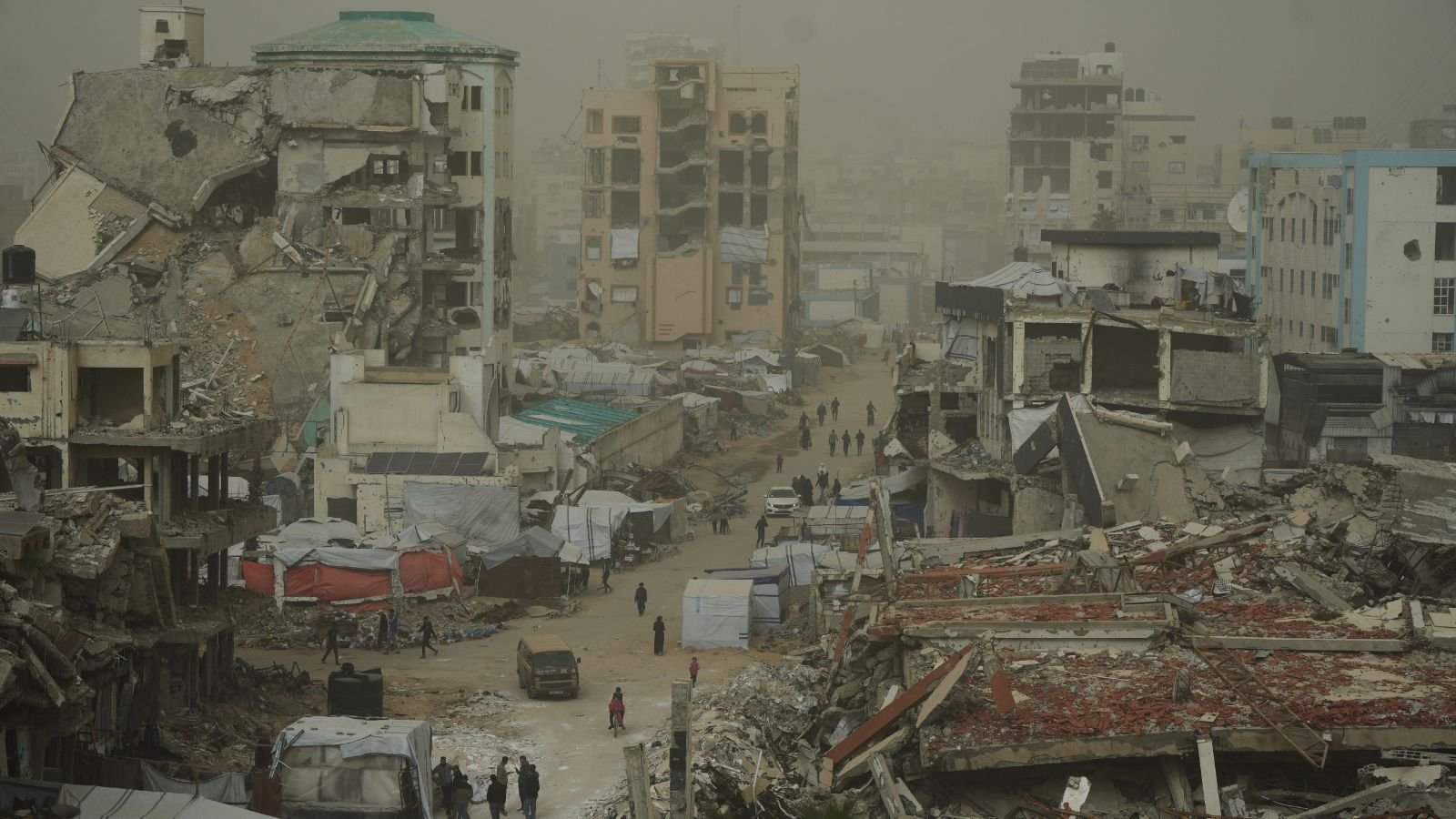
At least 11 Palestinians were killed in Israeli Airstrikes across the Gaza Strip on Sunday, according to Palestinian health officials, as Israel claimed it was responding to what it described as repeated ceasefire violations by Hamas. The latest escalation threatens to further destabilize a fragile truce that has struggled to hold amid mutual accusations and ongoing hostilities.
The strikes come at a sensitive diplomatic moment, just days before the inaugural meeting of US President Donald Trump’s proposed international peace initiative for Gaza.
Airstrikes Reported Across Gaza Strip
Palestinian medical sources said that an Israeli airstrike hit a tent camp sheltering displaced families, killing at least four people. In southern Gaza, near Khan Younis, another strike reportedly killed five individuals. Health officials also confirmed that one person was shot dead in northern Gaza.
In Gaza City’s Tel Al-Hawa neighborhood, Israeli aircraft targeted an individual believed to be a commander affiliated with Islamic Jihad, a group aligned with Hamas. The Israeli military has not publicly disclosed the identity of the targeted individual but stated that the operation was “precise” and in line with international law.
Israel: “Response to Flagrant Ceasefire Breach”
An Israeli military spokesperson said the strikes were launched in response to what the Israel Defense Forces (IDF) described as a “flagrant breach” of the October ceasefire agreement by Hamas in the Beit Hanoun area.
According to Israeli officials, militants allegedly emerged from a tunnel and crossed near Israeli forces on the Israeli side of the so-called “Yellow Line” — a demarcation established under the ceasefire framework to distinguish areas under Hamas and Israeli control.
“Crossing the Yellow Line while armed near IDF forces constitutes a clear violation of the ceasefire agreement,” the spokesperson said, accusing Hamas of repeatedly attempting to harm Israeli troops despite the truce.
The Israeli military also confirmed that it continues to demolish underground tunnels in northern Gaza, claiming that aircraft targeted a building east of the Yellow Line after militants were observed exiting a tunnel. Israeli sources said at least two militants were killed, though Gaza officials did not confirm those casualties.
Hamas: “A New Massacre” and Violation of Truce
Hamas spokesperson Hazem Qassem strongly condemned the airstrikes, accusing Israel of committing a new “massacre” against displaced Palestinians and violating the ceasefire agreement.
Qassem urged international actors, particularly participants in the upcoming US-led peace meeting, to pressure Israel to adhere to the truce and implement the ceasefire terms fully.
The exchange of accusations underscores the deep mistrust between both sides, with each blaming the other for undermining the fragile agreement.
Ceasefire Under Strain
The October ceasefire is a cornerstone of broader international efforts to halt what has become the deadliest and most destructive chapter in the Israeli–Palestinian conflict in decades.
According to Israeli estimates, approximately 1,200 people were killed during Hamas’s October 7, 2023, attack on southern Israel, which triggered the current conflict. Since then, Gaza’s Health Ministry reports that nearly 72,000 Palestinians have been killed in Israel’s air and ground campaign in the enclave.
Israeli officials maintain that militants in Gaza have killed four Israeli troops since the ceasefire took effect, while the Gaza health ministry says at least 600 Palestinians have been killed by Israeli fire during the same period.
Complicating matters further, Israel has reportedly shifted the “Yellow Line” deeper into Gaza, despite provisions in the ceasefire agreement requiring phased Israeli withdrawals. Meanwhile, Hamas has rejected demands to fully disarm — a key component envisioned in the broader peace plan — prompting Israel to warn it may take further action if the group does not comply.
Diplomatic Backdrop: Trump’s Peace Initiative
The escalation comes ahead of the first meeting of President Donald Trump’s newly formed international peace board for Gaza, scheduled to take place in Washington.
According to US sources cited in recent reports, Trump is expected to unveil a proposal for a UN-authorized stabilizing force for Gaza alongside a multibillion-dollar reconstruction and rehabilitation plan for the Palestinian enclave.
The ceasefire agreement is central to these diplomatic efforts. However, the continued exchange of strikes and accusations threatens to undermine prospects for sustainable de-escalation.
Humanitarian and Strategic Implications
Sunday’s strikes once again highlight the precarious nature of the Gaza ceasefire. With displaced families still sheltering in temporary camps and infrastructure severely damaged, renewed hostilities risk compounding an already dire humanitarian crisis.
For Israel, the stated objective remains preventing militant activity and dismantling tunnel networks. For Hamas, maintaining its position and resisting disarmament remains a central stance.
As diplomatic efforts intensify and global attention turns to Washington’s peace discussions, the immediate priority for civilians on both sides remains the preservation of life and the prevention of a broader breakdown of the truce.
Whether Sunday’s escalation marks a temporary flare-up or a deeper unraveling of the ceasefire may depend on the coming days of political negotiations and military restraint.
For breaking news and live news updates, like us on Facebook or follow us on Twitter and Instagram. Read more on Latest World on thefoxdaily.com.






COMMENTS 0