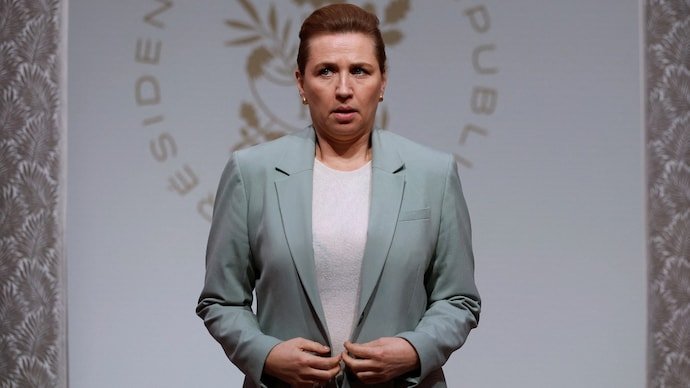
As an editor with years of experience covering geopolitics and transatlantic relations, it is evident that the long-simmering Greenland dispute has now reached a critical juncture. Danish Prime Minister Mette Frederiksen on Sunday described the situation as a “decisive moment” following repeated statements by US President Donald Trump suggesting the possible use of force to take control of the Arctic island.
Speaking ahead of key meetings in Washington on global competition for critical raw materials, Frederiksen stated unequivocally, “There is a conflict over Greenland.” In discussions with other Danish political leaders, she emphasized that the stakes extend far beyond Greenland alone and touch upon fundamental principles of sovereignty, international law, and global stability.
“This is a decisive moment with consequences that go beyond the immediate issue of Greenland’s future,” Frederiksen said, underlining that Denmark views the matter as a test of shared democratic values and the rules-based international order.
In a message posted on Facebook, the Danish prime minister reaffirmed Copenhagen’s position, writing, “We are prepared to defend our values wherever it is necessary, including in the Arctic. We support both the right of peoples to self-determination and respect for international law.”
Denmark’s stance has received strong backing from several European allies. Germany and Sweden were among the first to publicly support Copenhagen after Trump reiterated claims over the autonomous Danish territory, once again raising alarms across Europe.
Swedish Prime Minister Ulf Kristersson strongly condemned what he described as “threatening rhetoric” from Washington, following Trump’s statement that the United States was “going to do something on Greenland, whether they like it or not.”
Addressing a defence conference in Sälen, attended by NATO’s top US general, Kristersson said, “Sweden, the Nordic countries, the Baltic states, and several major European countries stand together with our Danish friends.”
Kristersson warned that any attempt by the US to seize mineral-rich Greenland would constitute “a violation of international law” and could set a dangerous precedent by encouraging other nations to act similarly.
No Immediate Military Threat, but Rising Strategic Risks
Ahead of high-level talks in Washington, Germany also reiterated its support for both Denmark and Greenland. The German foreign ministry confirmed that Foreign Minister Johann Wadephul was scheduled to meet US Secretary of State Marco Rubio before traveling to Iceland to discuss the “strategic challenges of the Far North.”
“The legitimate interests of all NATO allies, as well as those of the people living in the Arctic region, must be at the centre of our discussions,” Wadephul said in a statement.
He earlier told Germany’s Bild newspaper that decisions regarding Greenland’s territory and sovereignty lie “exclusively with Greenland and Denmark,” reinforcing Europe’s united front on the issue.
German Finance Minister Lars Klingbeil echoed this sentiment, stressing that NATO members were working together to enhance Arctic security. “We are strengthening security in the Arctic together, as allies, and not against one another,” he said before attending a global conference on critical raw materials in Washington.
European leaders moved swiftly to coordinate a response after the White House confirmed this week that Trump had again floated the idea of purchasing Greenland and had not ruled out the use of military force. Leaders from seven European nations, including France, the United Kingdom, Germany, and Italy, signed a joint statement asserting that only Denmark and Greenland have the right to determine the island’s future.
Trump has repeatedly argued that Greenland is vital to US national security, citing increased military activity in the Arctic by both china and Russia as justification for Washington’s interest.
NATO’s Supreme Allied Commander, General Alexus Grynkewich, told the Swedish defence conference that Greenland’s status was being discussed within the alliance. While he noted that there was “no immediate threat” to NATO territory, he emphasized that the strategic importance of the Arctic is growing rapidly.
Grynkewich confirmed that conversations about Greenland were taking place at the North Atlantic Council but declined to comment directly on the political implications of recent US rhetoric. “Those discussions are ongoing in Brussels, and from what I have heard, they have been constructive,” he said.
Greenland, which gained home rule decades after being a Danish colony until 1953, has been gradually debating whether to fully sever ties with Denmark. Opinion polls consistently show that Greenlanders are strongly opposed to any form of US takeover.
Reiterating his assessment, Grynkewich said, “I don’t think there’s an immediate threat to NATO territory right now.” However, he cautioned that Chinese and Russian naval vessels have been observed operating jointly near Russia’s northern coast and close to Alaska and Canada.
As Arctic ice continues to recede due to global warming, access to new shipping routes and untapped resources is intensifying geopolitical competition. For Denmark and its allies, the Greenland dispute has now become a defining test of international law, alliance unity, and the future balance of power in the Arctic.
For breaking news and live news updates, like us on Facebook or follow us on Twitter and Instagram. Read more on Latest World on thefoxdaily.com.






COMMENTS 0