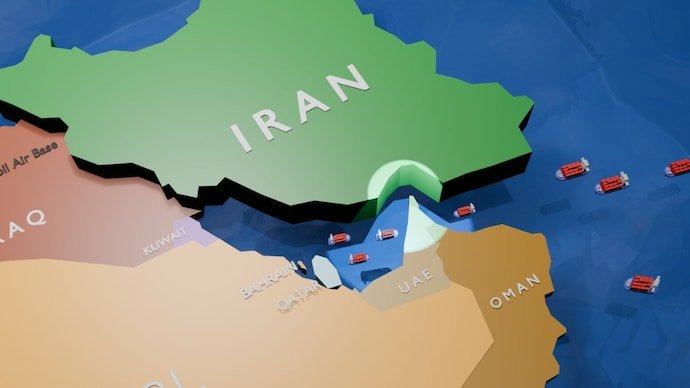
Washington/Beijing/Brussels: The United States’ decision to impose a naval blockade in the Strait of Hormuz has triggered alarm across global capitals, raising a critical question: is this a regional standoff with Iran, or the beginning of a broader geopolitical confrontation involving major powers like China and Europe?
Following the collapse of high-stakes US-Iran negotiations, President Donald Trump’s move to control maritime traffic through one of the world’s most vital energy corridors has significantly escalated tensions. By targeting vessels of all nations, the blockade risks extending the conflict far beyond West Asia, potentially disrupting global trade and energy stability.
Why the Strait of Hormuz Matters Globally
The Strait of Hormuz is not just a regional waterway—it is a global energy lifeline. Situated at the mouth of the Persian Gulf, it handles a substantial share of the world’s oil and gas shipments.
| Key Metric | Details |
|---|---|
| Global Oil Flow | ~20% passes through Hormuz |
| Major Users | China, India, Europe, Japan |
| Strategic Role | Primary export route for Gulf oil producers |
Any disruption in this narrow corridor has immediate ripple effects across global markets, from rising fuel prices to supply chain instability.
China in the Crosshairs
Energy Dependence and Strategic Stakes
China stands out as one of the most affected players in this crisis. As Iran’s largest oil customer, Beijing relies heavily on crude shipments passing through the Strait of Hormuz.
Estimates suggest that China imports over 1.5 million barrels of Iranian oil per day, accounting for a significant portion of its energy needs. Beyond Iran, it also depends on Gulf nations like Saudi Arabia and the UAE.
This deep dependence means that any US attempt to control or restrict maritime traffic could directly impact China’s Energy Security.
Will the US Stop Chinese Ships?
A key flashpoint is whether US naval forces will intercept or restrict Chinese-flagged vessels. Such a move would mark a dramatic escalation, potentially forcing China into a more direct role in the conflict.
Washington has already issued warnings, indicating that Beijing could face economic consequences if it is found supporting Iran militarily.
“If China does that, China is going to have big problems,” Trump warned.
Trade War Risks and “Grey Zone” Retaliation
While a direct military clash between the US and China remains unlikely, analysts point to the possibility of economic retaliation.
China’s Economic Leverage
China has several tools at its disposal that fall short of open conflict but can still inflict significant damage:
- Restricting exports of rare earth elements
- Limiting semiconductor supply chains
- Imposing targeted trade barriers
These “grey zone” tactics could disrupt Western industries, triggering a broader economic slowdown at a time when global markets are already fragile.
A Two-Front Crisis for the Global Economy
A combined energy shock and renewed US-China trade tensions could create a double crisis:
- Rising oil prices due to supply disruption
- Manufacturing slowdowns from trade restrictions
This scenario would have far-reaching consequences for both developed and emerging economies.
Beyond Hormuz: The Bab el-Mandeb Threat
The risks are not limited to the Strait of Hormuz. Another critical chokepoint—the Bab el-Mandeb Strait—could also be affected.
This passage connects the Red Sea to the Arabian Sea and is essential for trade between Europe and Asia.
| Bab el-Mandeb Facts | Details |
|---|---|
| Global Oil Trade | ~12% passes through |
| Annual Trade Value | ~$1 trillion cargo flow |
| Strategic Link | Gateway to Suez Canal |
Any disruption here—particularly by Iran-backed groups in the region—could compound the crisis, creating multiple pressure points in global shipping routes.
Europe’s Growing Headache
Energy and Trade Vulnerabilities
Europe is particularly vulnerable to disruptions in maritime trade routes. A blockade or sustained conflict could force ships to reroute around the Cape of Good Hope, significantly increasing:
- Shipping time
- Freight costs
- Insurance premiums
These factors would likely drive up energy prices across the continent, adding to inflationary pressures and economic uncertainty.
Potential Military Involvement
The crisis could also push European nations toward a more active role, including:
- Deploying naval forces to secure trade routes
- Coordinating with US-led operations
- Strengthening regional security alliances
Such involvement would mark a shift from economic concern to direct strategic participation.
A Multi-Front Geopolitical Risk
The Hormuz blockade is no longer just about US-Iran tensions. It intersects with multiple global fault lines:
- US-China rivalry
- Energy security concerns
- Global trade dependencies
- Regional instability in West Asia
There are also concerns that China could respond indirectly by increasing pressure in other regions, such as the South China Sea or around Taiwan, further complicating the global security landscape.
Analysis: Escalation or Strategic Pressure?
Trump’s decision to impose a blockade can be seen as both a strategic move to pressure Iran and a high-risk escalation that could draw in other powers.
Key questions remain:
- Will the US enforce the blockade against all nations equally?
- How will China respond if its energy supply is threatened?
- Can Europe remain a bystander, or will it be forced to act?
The answers to these questions will determine whether the crisis remains contained or evolves into a broader confrontation.
Conclusion: A Local Conflict with Global Consequences
The Strait of Hormuz blockade represents a pivotal moment in global Geopolitics. What began as a regional dispute now carries the potential to reshape International Relations, trade networks, and energy markets.
As tensions rise, the risk is not just military confrontation but a cascading series of economic and strategic disruptions affecting multiple regions.
Looking ahead, the challenge for global leaders will be to balance assertiveness with restraint. Because in a world so deeply interconnected, a conflict in one narrow strait can quickly become a crisis for the entire globe.
For breaking news and live news updates, like us on Facebook or follow us on Twitter and Instagram. Read more on Latest World on thefoxdaily.com.





COMMENTS 0