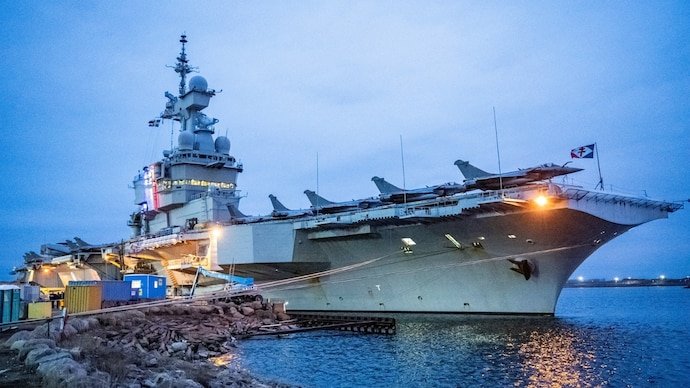
In a striking example of how modern technology can compromise military secrecy, a simple workout logged on a fitness app ended up exposing the location of one of France’s most strategic naval assets. At a time of heightened tensions in the Middle East, this unintended leak has raised serious concerns about operational security in the digital age.
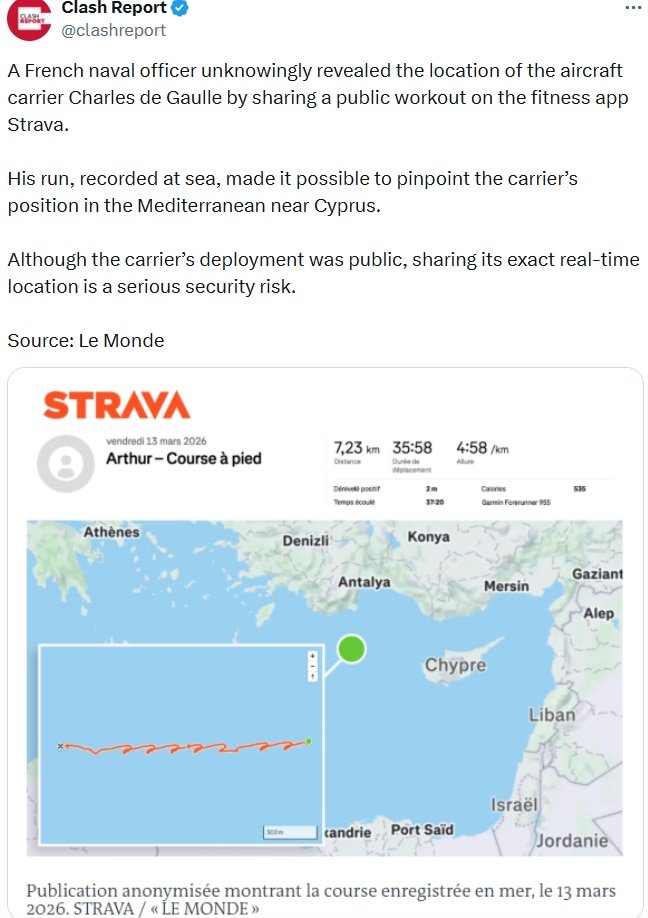
According to a report by the French newspaper Le Monde, a young sailor aboard the Aircraft Carrier Charles de Gaulle recorded a 36-minute exercise session using the popular fitness tracking app Strava. What seemed like a harmless activity quickly turned into a major breach when the app publicly displayed geolocation data tied to the workout.
HOW A SIMPLE WORKOUT EXPOSED A MILITARY SECRET
The recorded activity revealed the exact coordinates of the aircraft carrier in the Mediterranean Sea. The data indicated that the vessel was positioned approximately 100 kilometers off the Turkish coastline, northwest of Cyprus — a strategically sensitive location given ongoing geopolitical tensions in the region.
This revelation was particularly significant because France had only recently announced the deployment of the carrier on March 3, shortly after joint military actions by the United States and Israel targeting Iran.
With over 120 million users worldwide, Strava allows individuals to track and share their physical activities such as running, cycling, and workouts. However, its geolocation feature, when left public, can unintentionally broadcast sensitive information — including the movements of military personnel and assets.
REAL-TIME TRACKING AND SATELLITE CONFIRMATION
What made the situation even more alarming was the level of detail available through the app. The publicly accessible workout data allowed observers to track not only the sailor’s movement but also the position of the aircraft carrier and its accompanying fleet in near real time.
To verify the findings, Le Monde cross-checked the location data with satellite imagery captured shortly after the workout. The images confirmed the presence of the 262-meter-long nuclear-powered vessel in the same area, clearly identifying its distinctive shape.
This incident underscores how open-source intelligence (OSINT) tools, when combined with publicly shared data, can reveal highly sensitive military information without any sophisticated hacking.
| Key Element | Details |
|---|---|
| Platform Used | Strava (Fitness Tracking App) |
| Activity Logged | 36-minute workout session |
| Location Revealed | Mediterranean Sea (Near Turkey and Cyprus) |
| Military Asset | Aircraft Carrier Charles de Gaulle |
| Verification Method | Satellite imagery confirmation |
| Risk Factor | Public geolocation data exposure |
NOT AN ISOLATED INCIDENT
Investigations revealed that this was not a one-off occurrence. At least one other crew member on active deployment had also shared geolocated fitness data online. Some posts even included images of the ship’s deck, onboard equipment, and fellow personnel — further compounding the security risk.
Such repeated lapses highlight a broader issue: the growing gap between everyday digital habits and strict military security protocols. While sharing fitness achievements has become routine for millions, doing so in a military environment can have unintended consequences.
FRENCH MILITARY RESPONSE AND SECURITY CONCERNS
The French Armed Forces General Staff acknowledged the seriousness of the incident, stating that publishing such data violates operational digital security guidelines. Officials confirmed that appropriate disciplinary measures would be taken against those responsible.
This episode serves as a reminder of the increasing challenges militaries face in maintaining secrecy in a hyper-connected world, where even a smartphone app can become a vulnerability.
GEOPOLITICAL CONTEXT AND STRATEGIC IMPLICATIONS
The timing of the incident is particularly sensitive. The Middle East remains on edge following escalating tensions involving Iran, the United States, and Israel. Strategic maritime routes, especially the Strait of Hormuz, are under close watch due to their importance in global oil and gas supply chains.
Despite calls from Washington to enhance security in the region, France has remained cautious about increasing its military involvement. French Finance Minister Roland Lescure noted that operations in critical zones like the Strait of Hormuz would only proceed once security risks are minimized.
European nations, in general, have shown reluctance to deepen military engagement in the conflict, opting instead for a more measured approach amid concerns over supply disruptions and regional instability.
THE BIGGER LESSON: DIGITAL FOOTPRINTS CAN BE DANGEROUS
This incident highlights a crucial lesson in modern warfare: data is as powerful as weapons. Even seemingly harmless digital footprints can reveal critical intelligence when combined with publicly available tools.
As militaries continue to operate in an increasingly digital world, stricter controls and awareness around data sharing will be essential to prevent similar breaches in the future.
For breaking news and live news updates, like us on Facebook or follow us on Twitter and Instagram. Read more on Latest World on thefoxdaily.com.





COMMENTS 0