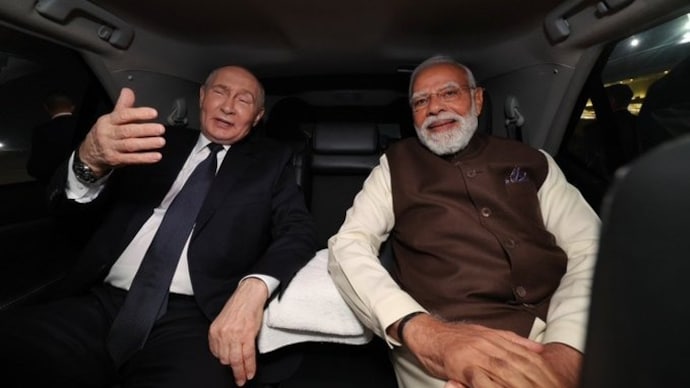
Selfies usually capture personal moments – but sometimes, they also send deliberate political messages. In the age of digital diplomacy, a single image can trigger international reactions. The recent selfie of Prime Minister Narendra Modi and Russian President Vladimir putin appears to have done exactly that. While neither leader is active on Instagram, the image’s unofficial “seen list” unmistakably includes Washington policymakers, who are watching the growing India–Russia warmth with unease.
On the surface, the picture was simply a candid moment taken during a state visit. But the optics went deeper. Modi and Putin chose a white Toyota Fortuner – a Japanese-made, India-assembled SUV – instead of a Western luxury vehicle like a Range Rover or Mercedes. The choice itself served as a subtle signal: a strategic comfort zone outside Western frameworks, captured through a friendly, informal selfie.
Reports soon emerged that Modi personally hosted Putin and accompanied him to his residence at 7 Lok Kalyan Marg. The symbolism wasn’t lost on anyone. During a hearing on US foreign policy, Congresswoman Sydney Kamlager-Dove projected a large poster of the selfie in the US Capitol, warning lawmakers that Washington’s own aggressive pressure tactics were pushing New Delhi closer to Moscow.
Calling the image “worth a thousand words,” she said the US – not India – was damaging a partnership built over decades. The congresswoman argued that recent American actions were “cutting our nose to spite our face,” eroding strategic trust between the two democracies.
Her criticism directly targeted the Trump administration’s high tariffs and coercive diplomacy. Earlier this year, the US imposed 50% tariffs on most Indian exports, followed by an additional 25% penalty linked to India’s Russian oil imports – a justification analysts have widely dismissed as illogical. Ironically, the US barely trades with Russia, making the punitive measure appear more political than strategic.
At a time when Washington insists India is essential to its Indo-Pacific strategy against China, penalizing New Delhi over Moscow has raised eyebrows across the diplomatic community.
In an exclusive conversation with India Today Group, President Putin mocked the US rationale. He noted that numerous American companies were privately reaching out to Russia, seeking to resume operations once political conditions improved.
“American businesses have written to us, asking us not to forget them,” Putin said, highlighting the contradiction between Washington’s punitive approach toward India and its own corporations pushing for renewed engagement.
A Modi–Putin Car Ride That’s Making Global Headlines
Putin revealed that the joint car ride with Modi was spontaneous – an impromptu gesture symbolizing their personal camaraderie. The moment, captured in a selfie, came during his first visit to India since the war in Ukraine began in 2022, further magnifying its geopolitical significance.
Interestingly, even members within Trump’s party have noted the growing warmth between India and Russia. Republican Congressman Bill Huizenga praised India as one of the world’s fastest-growing major economies and emphasized that US businesses were eager to access the Indian market – provided the playing field was fair.
Huizenga asserted that India–US cooperation is “defining for the twenty-first century,” stressing that both nations are critical to securing a free Indo-Pacific and strengthening global supply chains. He expressed hope that Trump and Modi could still finalize a long-awaited trade agreement.
The messaging reflects internal divisions. While Trump has publicly called Modi a “friend,” his policies – including reciprocal tariffs and H-1B restrictions – have strained ties, complicating the strategic equation.
Meanwhile, India and the US still lack a formal bilateral trade deal despite years of negotiations. Congressional leaders like Kamlager-Dove have accused Trump of allowing personal grievances and unconventional diplomacy to overshadow national interests. She mocked his alleged fixation on a Nobel Peace Prize, arguing that “bullying strategic partners” will not earn global recognition.
Even as Washington’s rhetoric sharpens, India–Russia trade and political cooperation have continued largely uninterrupted – if not strengthened. The Modi–Putin selfie has therefore become more than a candid photograph; it has turned into a symbol of the United States inadvertently pushing India toward Moscow.
For Washington, this is troubling. India is on track to become the world’s third-largest economy, and its partnership is vital to counterbalancing China’s influence. Any drift in New Delhi’s strategic alignment poses risks to American interests.
Against this backdrop, Kamlager-Dove’s warning to the Trump administration was blunt: “Being a coercive partner has a cost.” The viral selfie now stands as a reminder that diplomacy built over decades can unravel quickly – and that the US must recalibrate if it hopes to preserve the trust of one of its most important global partners.
For breaking news and live news updates, like us on Facebook or follow us on Twitter and Instagram. Read more on Latest World on thefoxdaily.com.


COMMENTS 0