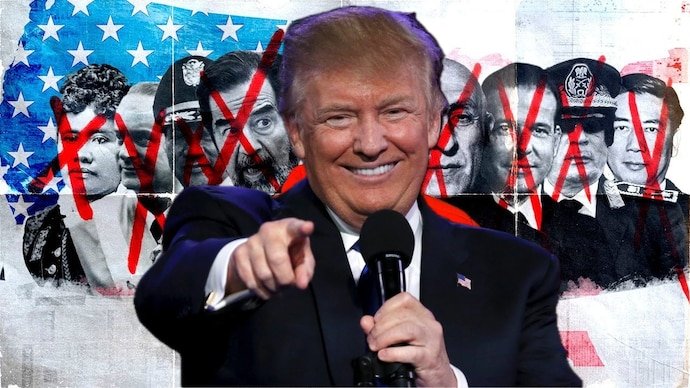
The United States presents itself as a reluctant defender of democracy, stepping in only when disorder leaves it no choice. History, however, tells a far darker story. From Iran in 1953 to Venezuela in 2025, Washington has repeatedly crossed sovereign boundaries using coercion, economic warfare, and disinformation rather than diplomacy.
The debate is no longer about whether the US engineers regime change. It is about how the machinery works. Across decades and continents, the same blueprint appears—five devastatingly effective stages that turn independent states into failed ones.
Step 1: Identify and Frame the Target
The process begins with selecting leaders who challenge US economic interests or geopolitical dominance. Ideology matters less than obedience. Leftists, nationalists, or even mildly independent actors become threats if they refuse to align with Washington’s priorities.
Iran’s Prime Minister Mohammad Mosaddegh posed no military danger to the US. His crime was nationalizing oil in 1953. Guatemala’s Jacobo Árbenz threatened the United Fruit Company through land reform. Libya’s Muammar Gaddafi controlled resources outside Western influence. Venezuela’s Nicolás Maduro sat atop the world’s largest oil reserves while resisting US demands.
Democracy is optional. Stability is secondary. Compliance is everything.
Step 2: Strangle the Economy
Once the target is defined, economic warfare follows. Sanctions escalate. Assets are frozen. trade routes are disrupted. Aid disappears. The objective was stated bluntly by Richard Nixon: make the economy scream.
Iran’s currency collapse and runaway inflation are products of prolonged “maximum pressure” sanctions. Venezuela’s banking restrictions crippled daily life. Guatemala’s economy was quietly undermined through trade manipulation. Iraq endured devastating sanctions throughout the 1990s, long before invasion.
The suffering fuels public anger. That anger is redirected toward leadership rather than its external cause. Desperation becomes the gateway to destabilization.
Step 3: Manufacture Chaos and Build Proxies
As economies weaken, proxy forces are cultivated. Disgruntled generals, opposition figures, exiles, media voices, and corporate elites are courted. Money moves quietly. Promises are made. Bribes lubricate the system.
In Iran’s 1953 Operation Ajax, protestors, journalists, clerics, and military officers were bought outright. In Guatemala, mercenaries backed by radio propaganda convinced the army resistance was futile. In Afghanistan, loyalty was secured almost overnight with massive cash infusions.
Total popular support is unnecessary. Only enough confusion is required to fracture the state. Psychological operations—fabricated protests, false narratives, staged opposition—create the illusion of organic revolt. Diplomatic ultimatums harden into threats. Military exercises loom nearby.
Step 4: Apply Overwhelming or Surgical Force
When covert tools fall short, overt force is unleashed. The method varies, but the aim remains constant: swift decapitation of leadership.
Panama in 1989 showcased brute efficiency. Manuel Noriega shifted overnight from CIA asset to enemy villain. The invasion was rapid, decisive, and destructive. Sovereignty collapsed in days.
Iraq in 2003 marked the most visible iteration—“shock and awe.” Even as the justification of weapons of mass destruction collapsed, the invasion continued. Libya in 2011 refined the approach further: air power and proxies replaced occupation, all under the banner of humanitarian protection.
Venezuela in 2025 represented peak efficiency. Precision operations and political pressure culminated in Maduro’s capture—proof, in Washington’s view, that regime change could be surgical and repeatable.
Step 5: Install Compliance and Declare Victory
The final stage is narrative control. Friendly leaders are installed. Business interests are secured. Military access is preserved. Media declares liberation. Planners move on.
Iran received the Shah, whose authoritarian rule—backed by CIA-trained secret police—lasted until the 1979 revolution. Guatemala descended into decades of repression and genocide. Iraq’s dismantled state apparatus fueled insurgency, sectarian violence, and eventually ISIS. Libya collapsed into militia rule, slave markets, and mass migration. Panama paid quietly and permanently.
America wins the opening act and loses the ending. Tactical success, strategic failure. Stability is sacrificed. Blowback is inevitable. Accountability never arrives.
Who Comes Next?
Analysts warn that Iran now fits the target profile almost perfectly. Economist Jeffrey Sachs argues that Washington’s success in Caracas may have reinforced the belief that regime change can be clean and repeatable.
Phase one is already visible: escalating rhetoric, economic pressure, currency collapse, and renewed threats echoing the language once used against Venezuela. The warning lights are flashing.
Another nation may soon be prepared for forced transformation instead of peace. And if history is any guide, the true cost will only be understood when it is far too late to undo.
For breaking news and live news updates, like us on Facebook or follow us on Twitter and Instagram. Read more on Latest World on thefoxdaily.com.


COMMENTS 0