Texmati – a name that sounds almost as quirky as Bagwati from the 2011 film Zindagi Na Milegi Dobara – was among the boldest attempts by the US to engineer its own version of India’s iconic Basmati rice. But much like any “first copy,” it could never achieve the aroma, length, or delicate fluffiness of the original Basmati grown in the Himalayan foothills. A Hermes or Birkin replica never feels the same – and nor did Texmati.
Developed in Texas in the early 1980s, the hybrid was christened “Texmati.” Its purpose was straightforward: reduce American dependency on imported aromatic rice varieties, especially premium Indian Basmati. Yet, over the decades, Texmati never managed to dethrone Basmati on US dining tables.
And now, there is a fresh reason for revisiting the Texmati-Basmati-Jasmati debate.
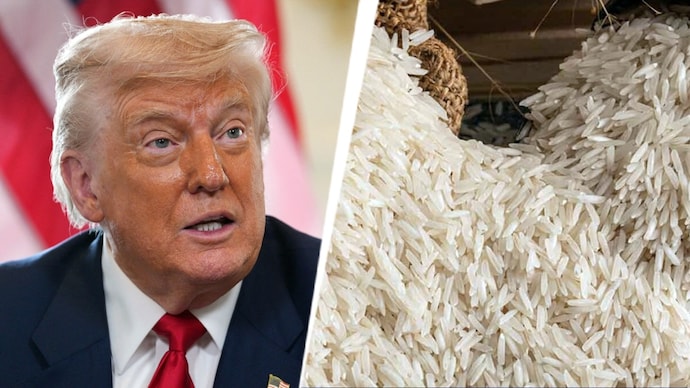
Earlier this week, US President Donald Trump issued a new threat – to impose higher tariffs on Indian rice exports to counter what he alleges is “dumping.”
Just yesterday, on December 10, we explained how American claims of Indian rice dumping ignore historical context. In the 1960s, India survived on minimal US PL-480 wheat aid. But a combination of America’s dietary shifts and India’s Green Revolution flipped the equation: the former recipient of aid became the global agricultural powerhouse.
Even US efforts to engineer alternatives – Texmati and Jasmati – failed to reduce American reliance on Indian Basmati. Today, Trump has announced a $12 billion support package for US farmers, including rice growers, in response to mounting political pressure.
American Texmati vs Indian Basmati: Why the Hybrid Failed to Beat the Original
Texmati was created by Texas-based RiceTec by crossbreeding American long-grain rice with authentic Basmati. Their objective was to produce a US-grown grain with long, slender kernels and the signature nutty fragrance associated with Basmati. Later, Jasmati was introduced – combining jasmine rice aroma with Basmati-like structure. Both varieties are sold as non-GMO by RiceSelect.
Jasmati works well in salads and stir-fries, while Texmati carries a popcorn-like flavour suitable for pilafs.
But fast-forward forty years: although these hybrids have survived in the market, they never eclipsed the original. Indian Basmati continues to dominate, accounting for over 85% of all rice India exports to the United States.
Texmati also became entangled in controversy in 1997, when RiceTec secured a broad US patent covering basmati-like traits such as aroma and grain-elongation. India, NGOs, and global activists challenged the patent vigorously. Eventually, the US Patent and Trademark Office struck out 15 of the 20 claims and removed the word “Basmati” from the title altogether.
Even after RiceTec continued to market Texmati and Jasmati, the episode reaffirmed a crucial truth: real Basmati can only originate from select regions in Punjab and Haryana, where the Himalayan foothills impart unique soil and water characteristics.
Indian Basmati remains unmatched because of attributes the US hybrids cannot replicate. It contains 12 times more 2-acetyl-1-pyrroline – the compound responsible for its intense nutty-floral aroma. When cooked, the grains double in length yet remain separate and fluffy.
Texmati and Jasmati may work in some recipes, but their depth and refinement do not compare. Moreover, Indian Basmati is aged for 6 to 12 months – a process that enhances aroma and texture in ways American hybrids do not match.
American consumers – especially the Indian diaspora and health-focused shoppers – have consistently chosen authenticity. As a result, premium Indian Basmati sells at $880–$900 per tonne. For FY 2023–24, India supplied 88% of all Basmati imported by the US. Pakistan, which also cultivates Basmati, accounts for only 9%.
In 2023, US imports of Basmati rose 9% to 270,000 metric tonnes. While Thai Jasmine dominates its own segment with a 97% share, Basmati remains India’s strongest niche in America.
US Rice Farmers Under Pressure as Basmati Dominance Grows
The inability to replace authentic Indian Basmati has intensified pressure on American rice farmers.
During a White House meeting, President Trump accused India of dumping rice in the US market and warned of additional tariffs to curb it.
At the same event, he introduced the Farmer Bridge Assistance Program – an $11 billion support package for farmers growing rice, wheat, soybeans, and corn, with payouts expected by February 2026. Specialty crops will receive the remaining funds.
His tariff warning came following direct complaints from US rice growers.
Meryl Kennedy, head of a Louisiana rice mill, claimed that “foreign rice” from India, China, and Thailand had flooded markets such as Puerto Rico, displacing American produce.
Currently, India faces a 50% tariff on most US-bound exports and 53% on rice. Trump hinted that even higher rates may be imposed soon.
The $12 billion aid package aims to offset falling prices, high input costs – especially fertilizers – and trade disruptions caused partly by Trump’s own reciprocal tariff policies.
But here’s the twist: only 3% of India’s rice exports go to the US. So any tariff escalation would barely hurt Indian exporters. Africa remains India’s fastest-growing rice market, while Gulf nations are its largest consumers. The ones most affected by higher US Tariffs may actually be American consumers paying more at supermarkets.
India exported 22.5 million metric tonnes of rice in 2024–25 – a staggering leap from the 1960s, when it depended on American food aid to survive. Shipments to the US totaled $392 million last fiscal year, of which 86% was Basmati.
No matter how aggressively lobbyists push Texmati, the original remains unbeatable.
For breaking news and live news updates, like us on Facebook or follow us on Twitter and Instagram. Read more on Latest World on thefoxdaily.com.






COMMENTS 0