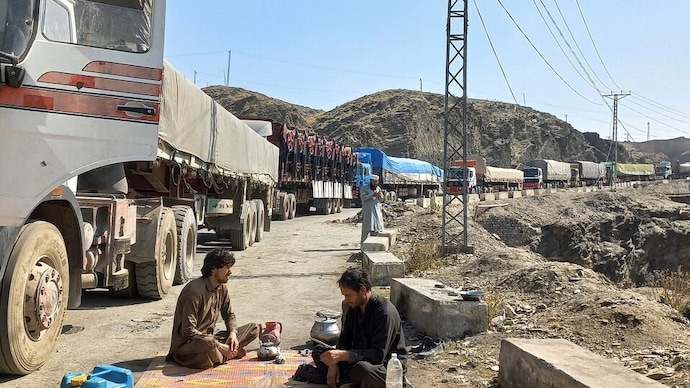
The Pakistan military’s warning to Kabulissued by DG ISPR Lt Gen Ahmed Sharif Chaudhry that “blood and business cannot go together”has backfired dramatically. The already fragile relations between Pakistan and Afghanistan plunged further after a brief border clash, mass deportation of Afghan refugees during peak winter, and now, a full-fledged trade shutdown. The fallout has hit Pakistan proportionally harder than its poorer neighbour.
The border was closed on October 11, triggering an unprecedented disruption. Afghanistan swiftly rerouted commercial links through Iran, India, and Central Asian states. Pakistan, however, has been unable to cushion the blow. Its economyalready battling inflation, manufacturing slowdowns, and foreign exchange shortageshas been dealt a severe shock with cross-border trade coming to a standstill, according to multiple reports including Dawn.
In Khyber Pakhtunkhwa, Pakistan’s Pathan-majority region that depends heavily on Afghan trade, manufacturers and merchants were furious. Many demanded an immediate reversal of the embargo. Their anger intensified as businesses started collapsing.
Last week, a delegation of Pakistani businessmen urgently met JUI-F Chief Maulana Fazlur Rehman, pleading for intervention as the prolonged suspension of Durand Line crossings had cost “trillions of rupees” in losses, reported Ariana News Network.
As one Pakistani journalist wrote in Nikkei Asia, the trade war has “boomeranged” on Islamabad, exposing the fragility of its economic structure and overdependence on Afghan cross-border markets.
While not all trade routes are closed, major Pakistani industries that rely heavily on Afghan imports and exports are facing shortages, rising prices, and production chaos. The debate has spilled onto social media, where Afghans are sharing videos of Pakistani mandis flooded with unsold producerotting due to the absence of Afghan buyers.
Meanwhile, Pakistan’s Foreign Minister and Deputy PM Ishaq Dar revealed that the United Nations has urged Islamabad to reconsider the trade suspension. Dar said he will discuss the matter with Prime Minister Shehbaz Sharif and Army Chief Asim Munir, reported Tolo News.
Afghanistan, despite being one of the poorest nations in the worldwith a GDP per capita of just $434 and poverty rates exceeding 64% as per UNDPhas responded strategically. The Taliban government is actively diversifying trade to reduce dependence on Pakistan. Recent visits by Afghan delegations to India, including Commerce Minister Alhaj Nooruddin Azizi’s trip, reflect Kabul’s shift toward alternative partners such as India and Turkey.
Pakistan’s Cement and Pharmaceutical Sectors Worst Hit
Pakistan’s cement industry is among the biggest casualties of the border closure. Afghan coalessential for cement productionhas vanished from the market. Manufacturers are now forced to import significantly costlier coal from South Africa, Mozambique, and Indonesia, Dawn reported.
Local coal prices have surged from PKR 30,000–32,000 to PKR 42,000–45,000 per tonne. Afghan coal, previously available for PKR 30,000–38,000, has completely disappeared.
The repercussions extend far beyond cement. Pharmaceutical exports to Afghanistanworth approximately USD 187 million annuallyhave collapsed. Many medicine consignments remain stuck in Pakistani warehouses. Several drugs cannot be sold domestically as they are not registered for the local market. Manufacturers now face crushing financial losses, as reported by Profit by Pakistan Today.
Perishable Fruits and Vegetables Rot as Trade Freezes
Perishable produce is suffering the worst fate. Afghanistan was one of the largest buyers of Pakistani fruits and vegetables. With the trade freeze entering its 48th day, shipments meant for Kabul are either destroyed or piled up in storage with no buyers.
The domestic market has reacted sharply. Prices of imported fruits have doubled in Pakistan, while exporters have written off entire consignments. Meanwhile, falling export revenues have reduced customs and transit-duty income, depriving Pakistan of precious foreign exchange in a period of severe economic strain.
For small-scale traders and transport workers, the crisis has become existential. Business chainsonce thriving along the Afghan trade routesare now collapsing. Transporters are unable to repay loans, labourers fear mass layoffs, and traders face bankruptcy.
Afghan–Pakistan Relations at Their Lowest Point
Since the Taliban’s takeover in 2021, relations between Kabul and Islamabad have sharply deteriorated. Accusations of cross-border terrorism, Pakistani airstrikes targeting alleged TTP hideouts, and Afghan claims of sovereignty violations have triggered open hostility.
Think tank ORF highlighted that terrorist attacks inside Pakistan have surged, border closures are frequent, and billions in bilateral trade has been choked.
The Taliban regime, tired of restrictions and political pressure from Islamabad, is rapidly diversifying economic partnerships. Beyond improved ties with Iran and Central Asia, Kabul has extended its outreach to Russia and India.
Earlier in November, Afghanistan’s Deputy PM for Economic Affairs, Mullah Ghani Baradar, ordered Afghan traders to “immediately seek alternative routes to Pakistan,” warning that if they continue using Pakistani routes, “the Islamic Emirate will not cooperate when problems arise.”
Pathans in Khyber Pakhtunkhwa Turn Against Islamabad
The economic pain is most visible in Khyber Pakhtunkhwa (KP), where traders share deep cultural and tribal ties with Afghans. Business leaders, traders, and transporters gathered at a jirga in Bacha Khan Markaz demanding the immediate reopening of crossings with Afghanistan.
Leaders of the Awami National Party (ANP) condemned the Shehbaz Sharif government for “double standards”highlighting that Pakistan had allowed trade with India despite years of political hostility, yet chose to block trade with Afghanistan, hurting its own people.
The irony is striking: The Pakistani military’s assertion that “blood and business cannot go together” has come full circle. While Pakistan’s defense minister calls the suspension a “blessing in disguise,” the real price is being paid by ordinary traders, transport workers, and small businesses.
The trade war, intended as a pressure tactic against the Taliban, has ended up inflicting deeper wounds on Pakistan’s own economywhile a poorer Afghanistan adapts, reorganizes, and seeks new partners.
For breaking news and live news updates, like us on Facebook or follow us on Twitter and Instagram. Read more on Latest World on thefoxdaily.com.





COMMENTS 0